What Is the Electronic Locking Differential
The electronic locking differential is a device housed in the front or rear axle and, when activated allows both wheels on that axle to turn at the same speed. The electronic locking differential can provide additional traction should your vehicle become stuck. You can activate the differential electronically and shift it on the fly within the operating speed range. The electronic differential automatically disengages when the vehicle speed exceeds a set value and it automatically reengages when the vehicle speed goes below a set value. See Switching the Electronic Locking Differential On and Off. It also automatically engages based on certain selected G.O.A.T modes.
See G.O.A.T. Mode Control. The electronic locking differential is for use in mud, rocks, sand, or any off-road condition where you need maximum traction. It is not for use on dry pavement.
Note: The electronic locking differentials are for off-road use only and not for use on dry pavement. Using the electronic locking differentials on dry pavement results in increased tire wear, noise and vibration or driveline damage.
Note: The front electronic locking differential is only available in four-wheel drive low (4L).
Note: Locking the front differential reduces your ability to make tight turning maneuvers and creates additional resistance to steering inputs.
Note: Switching the electronic locking differentials off while turning results in disengagement difficulties. If the electronic locking differential has difficulty disengaging, release the accelerator pedal and turn the steering wheel back and forth in small increments while maintaining control and following a straight line.
SWITCHING THE ELECTRONIC LOCKING DIFFERENTIAL ON AND OFF
Activating the Electronic Locking Differential
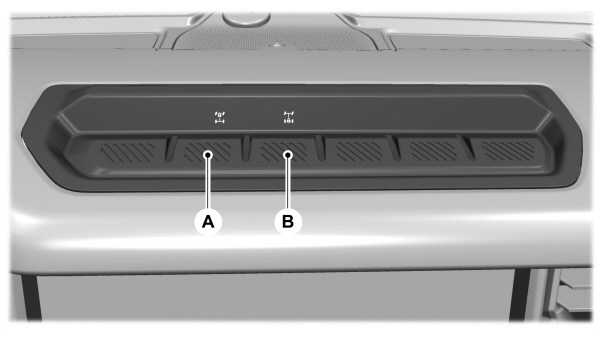
A Front locking differential switch Front locking differential switchB Rear locking differential switch |
You can activate the front or rear locking differential by pressing the switch on the center switch pack.
Note: Do not perform this operation when cruise control or trail control is selected and active. The differential could have difficulty engaging.
Front Electronic Locking Differential Engagement Speed and Availability
| Four-Wheel Drive Mode | Maximum Engagement Speed | Automatic Disengagement Speed | Automatic Re-Engagement Speed |
|---|---|---|---|
| 4L | 32 km/h (20 mph) | 41 km/h (25 mph) | 32 km/h (20 mph) |
Rear Electronic Locking Differential Engagement Speed and Availability
| G.O.A.T Modes (Four-Wheel Drive Modes) | Maximum Engagement Speed | Automatic Disengagement Speed | Automatic Re-Engagement Speed |
|---|---|---|---|
| Normal (2H,4A, 4H) | 32 km/h (20 mph) | 41 km/h (25 mph) | 32 km/h (20 mph) |
| Eco (2H, 4A, 4H) | 32 km/h (20 mph) | 41 km/h (25 mph) | 32 km/h (20 mph) |
| Sport (2H, 4A, 4H) | 32 km/h (20 mph) | 41 km/h (25 mph) | 32 km/h (20 mph) |
| Slippery (2H, 4A, 4H) | 32 km/h (20 mph) | 41 km/h (25 mph) | 32 km/h (20 mph) |
| Sand (4H, 4L)1 | |||
| Mud/Ruts (4H, 4L)1 | |||
| Baja (2H, 4H, 4L) | No speed imit | No speed limit | No speed limit |
| Rock Crawl (4L)1 |
1Automatically engages when you select these G.O.A.T modes. You have the ability to manually override the automatic engagement by pressing the electronic locking differential switch.
| G.O.A.T Modes (Four-Wheel Drive Modes) | Maximum Engagement Speed | Automatic Disengagement Speed | Automatic Re-Engagement Speed |
|---|---|---|---|
| 4L | No speed limit | No speed limit | No speed limit |
Download Manual