Tyres
 Warning
► Driving with tyres that are worn, damaged or improperly inflated can lead to a loss of control or blow out of the tyres which can result in a collision with serious or fatal injury.
Tyre inflation pressures
1600 models

Check the tyre inflation pressure of all the tyres while they are cold; if insufficient or excessive, adjust to the specified value.
After the tyre inflation pressure has been adjusted, check the tyres for damage and air leaks. Be sure to put caps on the valves.
1800 models (petrol-powered vehicles)
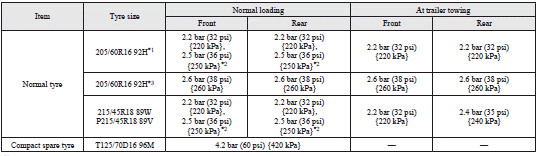
1: Vehicles for Russia, Kazakhstan and Ukraine
2: Above 160 km/h (99 mph)
3: Except for vehicles for Russia, Kazakhstan and Ukraine
Check the tyre inflation pressure of all the tyres while they are cold; if insufficient or excessive, adjust to the specified value.
After the tyre inflation pressure has been adjusted, check the tyres for damage and air leaks. Be sure to put caps on the valves.
1800 models (diesel-powered vehicles)
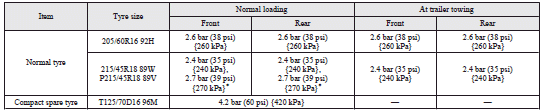
: Above 160 km/h (99 mph)
Check the tyre inflation pressure of all the tyres while they are cold; if insufficient or excessive, adjust to the specified value.
After the tyre inflation pressure has been adjusted, check the tyres for damage and air leaks. Be sure to put caps on the valves.
2000 models

Above 160 km/h (99 mph)
Check the tyre inflation pressure of all the tyres while they are cold; if insufficient or excessive, adjust to the specified value.
After the tyre inflation pressure has been adjusted, check the tyres for damage and air leaks. Be sure to put caps on the valves.
Wheel condition
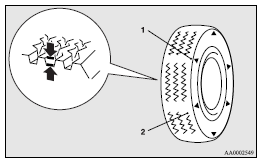
1- Location of the tread wear indicator
2- Tread wear indicator
Check the tyres for cuts, cracks and other damage.
Replace the tyres if there are deep cuts or cracks.
Also check each tyre for pieces of metal or pebbles.
The use of worn tyres can be very dangerous because of the greater chance of skidding or hydroplaning.
The tread depth of the tyres must exceed 1.6 mm in order for the tyres to meet the minimum requirement for use.
Tread wear indicators will appear on the surface of the tyre as the tyre wears, thereby indicating that the tyre no longer meets the minimum requirement for use. When these wear indicators appear, the tyres must be replaced with new ones.
On 4-wheel drive vehicles, when replacement of any of the tyres is necessary, replace all of them.
 Caution
► Always use tyres of the same size, same type, and same brand, and which have no wear differences.
Using tyres of different size, type, brands or degree of wear, will increase the differential oil temperature, resulting in possible damage to the driving system.
Further, the drive train will be subjected to excessive loading, possibly leading to oil leakage, component seizure, or other serious faults.
Replacing tyres and wheels
Caution
► Avoid using different size tyres from the one listed and the combined use of different types of tyres, as this can affect driving safety.
Refer to “Tyres and wheels”.
► Even if a wheel has the same rim size and offset as the specified type of wheel, its shape may prevent it from being fitted correctly.
We recommend you to consult a specialist before using wheels that you have.
Tyre rotation
Tyre wear varies with vehicle conditions, road surface conditions and individual driver’s driving habits.
To equalize the wear and help extend tyre life, it is recommended to rotate the tyres immediately after discovery of abnormal wear, or whenever the wear difference between the front and rear tyres is recognizable.
When rotating tyres, check for uneven wear and damage. Abnormal wear is usually caused by incorrect tyre pressure, improper wheel alignment, out of balance wheel, or severe braking. We recommend you to have it checked to determine the cause of irregular tread wear.
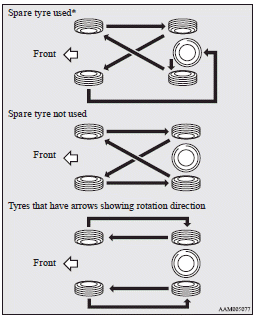
- If the spare tyre wheel differs from the standard tyre wheel, do not perform tyre rotation using a spare wheel.
Caution
► A compact spare tyre can be fitted temporarily in place of a tyre that has been removed during the tyre rotation. However, it must not be included in the regular tyre rotation sequence.
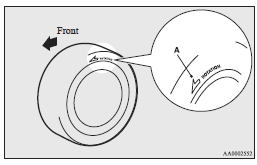
► If the tyres have arrows (A) indicating the correct direction of rotation, swap the front and rear wheels on the left hand side of the vehicle and the front and rear wheels on the right hand side of the vehicle separately. Keep each tyre on its original side of the vehicle. When fitting the tyres, make sure the arrows point in the direction in which the wheels will turn when the vehicle moves forward. Any tyre whose arrow points in the wrong direction will not perform to its full potential.
Caution
► Avoid the combined use of different types of tyres. Using different types of tyres can affect vehicle performance and safety.
Snow tyres
The use of snow tyres is recommended for driving on snow and ice. To preserve driving stability, mount snow tyres of the same size and tread pattern on all 4 wheels.
Snow tyres worn more than 50% are no longer suitable for use as snow tyres.
Snow tyres which do not meet specifications must not be used.
Caution
► Observe permissible maximum speed for your snow tyres and the legal speed limit.
 Note
Note
► The laws and regulations concerning snow tyres (driving speed, required use, type, etc.) vary. Find out and follow the laws and regulations in the area you intend to drive.
► If flange nuts are used on your vehicle, change to tapered nuts when steel wheels are used.
Tyre chains
If tyre chains have to be used, ensure that they are fitted only on the drive wheels (front) in accordance with the manufacturer’s instructions.
It is recommended that snow chains are carried in snow regions and fitted when required to the front wheels in accordance with the manufacture’s instructions.
Use only tyre chains which are designed for use with the tyres mounted on the vehicle: use of the incorrect size or type of chain could result in damage to the vehicle body.
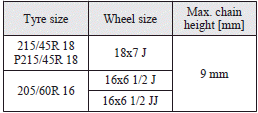
Contact a MITSUBISHI MOTORS Authorized Service Point before putting on tyre chains. The max. chain height is as follows.
When driving with tyre chains on the tyres, do not drive faster than 50 km/h (30 mph). When you reach roads that are not covered in snow, immediately remove the tyre chains.
Caution
► Practice fitting the chains before you need them.
Don’t expect help from other people in the cold.
► Choose a clear straight stretch of road where you can pull over and still be seen while you are fitting the chains.
► Do not fit chains before you need them.
This will wear out your tyres and the road surface.
► After driving around 100-300 metres, stop and retighten the chains.
► Drive carefully and do not exceed 50 km/h (30 mph). Remember that preventing accidents is not the purpose of tyre chains.
► When tyre chains are installed, take care that they do not damage the disc wheel or body.
► Do not install a tyre chain on an emergency wheel which is compact in size. If one of the front wheels has a puncture, replace it with one of the rear wheels and install the compact spare wheel in that place before fitting a tyre chain.
► An aluminium wheel can be damaged by a tyre chain while driving. When fitting a tyre chain on an aluminium wheel, take care that any part of the chain and fitting cannot be brought into contact with the wheel.
► Remove the wheel covers before installing a tyre chain, otherwise they may be damaged by the tyre chain. (Refer to “Wheel covers”.)
► When installing or removing the tyre chains, take care that hands and other parts of your body are not injured by the sharp edges of the vehicle body.
Note
► The laws and regulations concerning the use of tyre chains vary. Always follow local laws and regulations.
In most countries, it is prohibited by law to use tyre chains on roads without snow.
Parking brake break-in
Break-in the parking brake linings whenever the brake performance of the parking brake is insufficient or whenever the parking brake linings and/or discs are replaced, in order to assure the best brake performance.
This procedure is described in the vehicle service manual and can be carried out by a MITSUBISHI MOTORS Authorized Service Point.
Download Manual