Starting and stopping the engine
Tips for starting
► Do not operate the starter motor continuously longer than 10 seconds; doing so could run down the battery. If the engine does not start, turn the ignition switch back to “LOCK”, wait a few seconds, and then try again.
Trying repeatedly with the starter motor still turning will damage the starter mechanism.
► After starting the engine in cold weather, drive in a way that keeps the engine speed low for the first few minutes or the bar graph of the engine coolant temperature display starts to move. Otherwise the engine operation may not rev smoothly and the vehicle could jerk or surge while driving.
A longer warm up period will only consume extra fuel.
► [For vehicles equipped with Twin Clutch SST] The following may occur after the engine is started, but they do not indicate an abnormality.
• You may hear operational sounds of the Twin Clutch SST and you may feel vibration in the vehicle body.
• If you shift the gearshift lever into the “N” (NEUTRAL) position and depress the accelerator pedal, increases in the engine speed will be limited.
► [Diesel-powered vehicles] While the vehicle is stationary with the clutch pedal fully depressed, the engine revolutions do not rise to over 3,000 rpm in order to protect the engine even if the accelerator pedal is depressed.
 Warning
► Never run the engine in a closed or poorly ventilated area any longer than is needed to move your vehicle in or out of the area. Carbon monoxide gases are odourless and can be fatal.
 Caution
► Never attempt to start the engine by pushing or pulling the vehicle.
► Do not run the engine at high rpm or drive the vehicle at high speed until the engine has had a chance to warm up.
► Release the ignition key as soon as the engine starts to avoid damaging the starter motor.
Starting the engine (petrol-powered vehicles)
[For vehicles equipped with keyless operation system]
For information on operations for vehicles equipped with the keyless operation system, refer to “Keyless operation system: Starting” on pages 1-16, 1-20.
[Except for vehicles equipped with keyless operation system]
The starting procedure is as follows: 1. Insert the ignition key and fasten the seat belt.
2. Make sure the parking brake is applied.
3. Depress and hold the brake pedal.
4. Fully depress the clutch pedal (M/T).
 Note
Note
► On vehicles with the Auto Stop & Go (AS&G) system, the starter will not operate unless the clutch pedal is fully depressed (Clutch interlock).
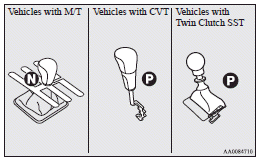
5. On vehicles equipped with M/T, place the gearshift lever in the “N” (Neutral) position.
On vehicles equipped with a CVT or Twin Clutch SST, make sure the selector lever (CVT) or gearshift lever (Twin Clutch SST) is in the “P” (PARK) position.
Note
► On vehicles equipped with a CVT, the starter will not operate unless the selector lever is in the “P” (PARK) or “N” (NEUTRAL) position.
On vehicles equipped with Twin Clutch SST, the starter will not operate unless the gearshift lever is in the “P” (PARK) position or the gearshift lever is in the “N” (NEUTRAL) position with the brake pedal depressed.
For safety reasons, start the engine in the “P” (PARK) position so that the wheels are locked.
6. After turning the ignition key to the “ON” position, make certain that all warning lamps are functioning properly before starting the engine.
7. Turn the ignition key to the “START” position without depressing the accelerator pedal, and release it when the engine starts.
Note
► Minor noises may be heard on engine startup.
These will disappear as the engine warms up.
Idling speed in high altitude area
At high altitude locations, the idling speed may be higher. This is done in order to stabilize the idling speed when the power steering system and other systems operate. It does not indicate a malfunction.
Starting the engine (diesel-powered vehicles)
[For vehicles equipped with keyless operation system]
For information on operations for vehicles equipped with the keyless operation system, refer to “Keyless operation system: Starting” on pages 1-17, 1-20.
[Except vehicles equipped with keyless operation system]
1. Insert the ignition key and fasten the seat belt.
2. Make sure the parking brake is applied.
3. Depress and hold the brake pedal.
4. Fully depress the clutch pedal.
Note
► On vehicles with the Auto Stop & Go (AS&G) system, the starter will not operate unless the clutch pedal is fully depressed (Clutch interlock).
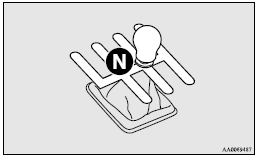
5. Place the gearshift lever in the “N” (Neutral) position.
6. Turn the ignition key to the “ON” position.
The diesel preheat indication lamp will first illuminate, and then after a short time go out, indicating that preheating is completed.
Note
► If the engine is cold, the diesel preheat indication lamp is on for a longer time.
► When the engine has not been started within about 5 seconds after the diesel preheat indication lamp went out, return the ignition key
to the “LOCK” position. Then, turn the key to the “ON” position to preheat the engine again.
► When the engine is warm, the diesel preheat indication lamp does not come on even if the ignition key is placed in the “ON” position.
Start the engine by turning the ignition key right to the “START” position.
7. Turn the ignition key to the “START” position without depressing the accelerator pedal, and release it when the engine starts.
Note
► Minor noises may be heard on engine startup.
These will disappear as the engine warms up.
Using the MIVEC engine
The MIVEC engine automatically controls valve timing in accordance with driving conditions for maximum engine performance.
Note
► To protect the engine, the high-speed mode may not be selected while the engine coolant temperature is low.
Fuel injection amount learning process (diesel-powered vehicles)
To keep exhaust emissions and engine noise low, the engine very occasionally performs a learning process for the fuel injection amount.
The engine sounds slightly different from usual while the learning process is taking place. The change in the engine sound does not indicate a fault.
Stopping the engine
1. Bring the vehicle to a complete stop.
2. Fully engage the parking brake while depressing the brake pedal.
3. For vehicles equipped with M/T, turn the ignition switch to the “LOCK” position to stop the engine, and then move the gearshift lever to the 1st (on a uphill) or “R” (Reverse) (on a downhill) position.
On vehicles with CVT or Twin Clutch SST, move the selector lever (CVT) or gearshift lever (Twin Clutch SST) to the “P” (PARK) position, and turn the ignition switch to the “LOCK” position to stop the engine.
Note
► For vehicles equipped with Twin Clutch SST, the engine will stop and the vehicle power will turn off approximately 1 second after the ignition switch is turned to the “LOCK” position.
The reason for this is that, in the time from when the ignition switch is turned to the “LOCK” position until the engine stops, the gears inside the Twin Clutch SST disengage so that the engine will start smoothly the next time it is started.
Two clutches installed in the Twin Clutch SST alternately engage and disengage to achieve smooth shifting.
In addition, the gear on the side with the free clutch is always engaged, therefore, quick shifting is performed.
If the engine was stopped with the gear engaged like this, it would provide resistance the next time the engine is started. Therefore, the gear disengages in the approximately 1- second period until the engine stops.
► For vehicles equipped with Twin Clutch SST, do not operate the gearshift lever or the accelerator pedal for approximately 1 second until the engine stops.
► For vehicles equipped with Twin Clutch SST, if the temperature inside the engine compartment is high, the cooling fans (A) will continue to operate for some time even if the engine is stopped.
Therefore, the operation sound of the cooling fans may be heard even after the engine is stopped. This sound is normal and does not indicate a malfunction.
After operating for a period of time, the cooling fans will stop automatically.
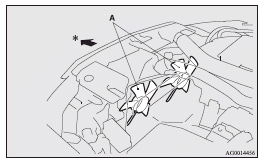
: Front of the vehicle
Download Manual