How to change a tyre
Before changing a tyre, first stop your vehicle in a safe, flat location.
1. Park the vehicle on level and stable ground, free of loose pebbles, etc.
2. Set the parking brake firmly.
3. On vehicles with M/T, turn the ignition switch to the “LOCK” position, move the gearshift lever to the “R” (Reverse) position.
On vehicles with CVT or Twin Clutch SST, move the selector lever (CVT) or gearshift lever (Twin Clutch SST) to the “P” (PARK) position, turn the ignition switch to the “LOCK” position.
4. Turn on the hazard warning flashers and set up a warning triangle, flashing signal lamp, etc., at an adequate distance from the vehicle, and have all your passengers leave the vehicle.
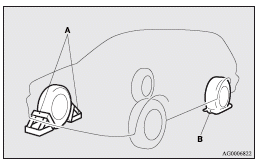
5. To prevent the vehicle from rolling when it is raised on the jack, place chocks or blocks (A) at the tyre that is diagonally opposite from the tyre (B) you are changing.
 Warning
► Be sure to apply chocks or blocks to the correct tyre when jacking up the vehicle.
If the vehicle moves while jacked up, the jack could slip out of position, leading to an accident.
 Note
Note
► The chocks shown in the illustration do not come with your vehicle. It is recommended that you keep one in the vehicle for use if needed.
► If chocks or blocks are not available, use stones or any other objects that are large enough to hold the wheel in position.
6. Get the jack bar and wheel nut wrench ready.
Refer to “Tools and jack”.
Spare wheel information
Check the air pressure of the spare tyre frequently and make sure it is ready for emergency use at any time.
Maintaining the spare wheel at the highest specified air pressure will ensure that it can always be used under any conditions (city/high-speed driving, varying load weight, etc.).
The spare wheel is stored beneath the luggage floor board of the luggage compartment.
 Caution
► The pressure should be periodically checked and maintained at the specified pressure while the tyre is stowed.
Driving with an insufficient tyre pressure can lead to an accident. If you have no choice but to drive with an insufficient tyre pressure, keep your speed down and inflate the tyre to the correct pressure as soon as possible. (Refer to “Tyre inflation pressures”.)
Compact spare wheel
The compact spare tyre is designed to save space in the luggage compartment and its lighter weight makes it easier to use if a flat tyre occurs.
Caution
► The compact spare wheel is for temporary use only and should be removed as soon as the original wheel can be repaired or replaced.
► The vehicle must not be driven at speeds in excess of 80 km/h (50 mph) while using the compact spare wheel.
► The compact spare tyre is not as good as a standard tyre in controllability and stability.
When the compact spare tyre is used, avoid quick starts, sudden braking and sharp steering.
► The compact spare wheel is specifically designed for your vehicle and it should not be used on any other vehicle.
► Do not use tyre chains with your compact spare wheel. Because of the smaller tyre size, a tyre chain will not fit properly.
This could cause damage to the wheel and result in loss of the chain.
If a front tyre becomes flat when using tyre chains, first replace a rear wheel with the compact spare wheel and then use the removed rear wheel to replace the flat front wheel so that you can continue to use the chains.
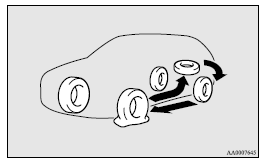
Caution
► Upon installation of the compact spare tyre, the ground clearance is reduced as the tyre is smaller in diameter than the standard tyre. When passing over the projections on the road, take care not to damage the vehicle’s undercarriage.
► Do not install more than one compact spare wheel at the same time.
To remove the spare tyre
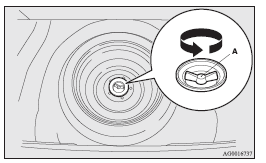
1. Lift up the board.
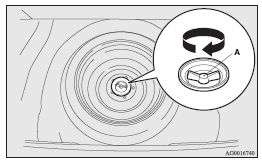
2. To remove the spare tyre, remove the installation clamp (A) by turning it anticlockwise.
Note
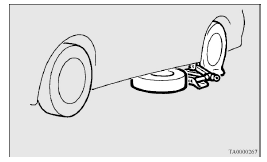
► Put the spare wheel under the vehicle body near the jack. This makes it safer if the jack slips out of position.
To change a tyre
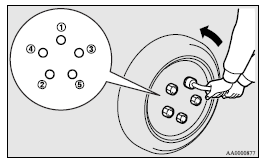
1. On vehicles equipped with wheel covers, first remove the covers (refer to “Wheel covers”). Then loosen the wheel nuts a quarter turn with the wheel nut wrench. Do not remove the wheel nuts yet.
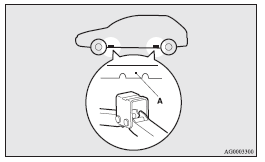
2. Place the jack under one of the jacking points (A) shown in the illustration. Use the jacking point closest to the tyre you wish to change.
Warning
► Set the jack only at the positions shown here. If the jack is set at a wrong position, it could dent your vehicle or the jack might fall over and cause personal injury.
► Do not use the jack on a tilted or soft surface.
Otherwise, the jack might slip and cause personal injury. Always use the jack on a flat, hard surface. Before setting the jack, make sure there are no sand or pebbles under the jack base.
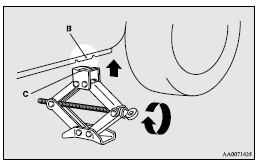
3. Rotate the jack by hand until the flange portion (B) fits in the groove (C) at the top of the jack.
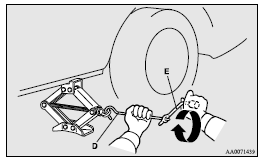
4. Insert the bar (D) into the wheel nut wrench (E). Then put the end of the bar into the shaft’s jack end, as shown in the illustration.
Slowly rotate the wheel nut wrench until the tyre is raised slightly off the ground surface.
Warning
► Stop jacking up the vehicle as soon as the tyre is raised off the ground. It is dangerous to raise the vehicle any higher.
► Do not get under your vehicle while using the jack.
► Do not bump the raised vehicle or leave it sitting on the jack for a long time. Both are very dangerous.
► Do not use a jack except the one that came with your vehicle.
► The jack should not be used for any purpose other than to change a tyre.
► No one should be in your vehicle when using the tyre.
► Do not start or run the engine while your vehicle is on the jack.
► Do not turn the raised wheel. The tyres still on the ground could turn and make your vehicle fall off the jack.
5. Remove the wheel nuts with the wheel nut wrench, then take the wheel off.
Caution
► Handle the wheel carefully when changing the tyre, to avoid scratching the wheel surface.
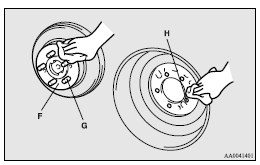
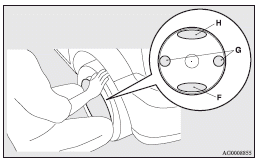
6. Clean out any mud, etc. on the hub surface (F), hub bolts (G) or in the installation holes (H) in the wheel, and then mount the spare tyre.
Warning
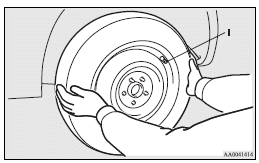
► Mount the spare wheel with the valve stem (I) facing outboard. If you cannot see the valve stem (I), you have installed the wheel backwards.
Operating the vehicle with the spare wheel installed backwards can cause vehicle damage and result in an accident.
7. Finger-tighten the wheel nuts.
Vehicle equipped with steel wheels
Tighten the wheel nuts (tapered nuts) until the tapered parts of the wheel nuts make light contact with the seats of the wheel holes and the wheel is not loose.
With a spare wheel, tighten the wheel nuts in the same way.
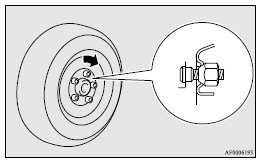
Vehicle equipped with aluminium wheels
Tighten the wheel nuts (flange nuts) until the flanges of the wheel nuts touch the wheel and the wheel is not loose.
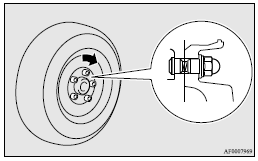
Note
► Flange nuts can be temporarily used on the steel spare wheel as shown in the illustration, but return to the original wheel and tyre as soon as possible.
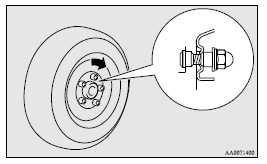
► If all 4 aluminium wheels are changed to steel wheels, e.g. when fitting winter tyres, use tapered nuts.
Caution
► Never apply oil to either the wheel bolts or the nuts, or they will tighten too much.
8. Lower the vehicle slowly by rotating the wheel nut wrench anticlockwise until the tyre touches the ground.
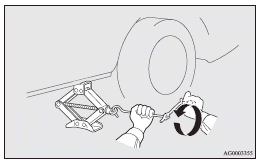
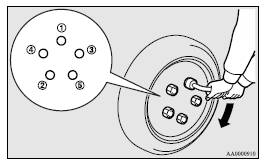
9. Tighten the nuts in the order shown in the illustration until each nut has been tightened to the torque listed here.
Tightening torque 88 to 108 Nm (Achieved by applying a force of 350 to 420 N at the end of the wheel nut wrench supplied with the vehicle.)
Caution
► Never use your foot or a pipe extension for extra force in the wheel nut wrench.
If you do so, you will tighten the nut too much.
10. Lower the jack all the way and remove it.
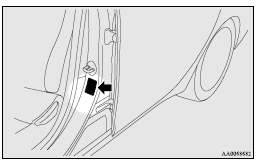
11. Check your tyre inflation pressure at the next gasstation. The correct pressures are shown on the door label. See the illustration.
Caution
► The tyre pressure should be periodically checked and maintained at the specified pressure while the tyre is stowed.
► The compact spare tyre is to be used only temporarily when the standard tyre is damaged. Repair the damaged tyre as soon as possible and use it to replace the compact spare tyre.
► After changing the tyre and driving the vehicle about 1.000 km (620 miles), retighten the wheel nuts to make sure that they have not come loose.
► If the steering wheel vibrates when driving after changing the tyre, we recommend you to have the tyres checked for balance.
► Do not mix one type of tyre with another or use a different size from the one listed.
This would cause early wear and poor handling.
To store the flat tyre or spare wheel
1. Lift up the board.
2. To store the flat tyre or spare wheel, fit the installation clamp (A) by turning it clockwise.
Note
► On vehicles equipped with a compact spare wheel, the clamp cannot be used for a normal size tyre.
3. Have your damaged tyre repaired as soon as possible.
To store the tools and jack
Reverse the removing procedure when storing the jack, bar and wheel nut wrench. Refer to “Tools and jack”.
Wheel covers
To remove
1. Wrap the tip of the bar with a cloth, insert it deeply into the notch provided in the wheel cover, and use it to lever up the cover a little.
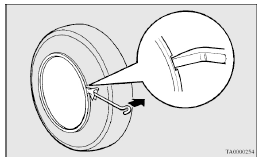
2. With the cover raised a little, pry it off completely using the jack bar. Insert the jack bar under the cover, and move it around the circumference, prying the cover away from the wheel little by little as you move the bar around.
Caution
► If you try to use your hands, they may get hurt by the edge of the wheel cover.
Note
► The wheel cover is made of plastic; take care when prying it off.
To install
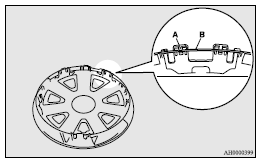
1. Make sure the tabs (A) of the back of the wheel cover are not broken and correctly fitted on the rings (B). If in doubt, do not install the wheel cover and consult your MITSUBISHI MOTORS Authorized Service Point.
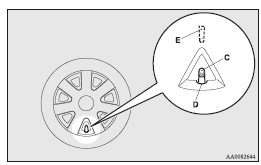
2. Align the air valve (C) of the tyre with the notch (D) in the wheel cover.
Note
► Full wheel covers have a symbol mark (E) provided on the reverse side to show the air valve location.
Before installing the wheel cover to the wheel, make sure that the opening with the symbol mark is correctly aligned with the air valve.
3. Push the bottom part (F) of the wheel cover into the wheel.
4. Gently push both sides (G) of the wheel cover and hold them in place with both knees.
5. Gently tap around the circumference of the wheel cover at the top (H), then push the wheel cover into place.
Download Manual