Twin Clutch SST (Sport Shift Transmission)
The Twin Clutch SST is a transmission that, through integrated control of the engine and transmission, is able to achieve both the smooth shifting of an automatic transmission and the acceleration and fuel economy close to a manual transmission.
In addition, the control mode can be selected from two types to suit the driving conditions.
Together with manual shifting, the transmission is capable of responding to a variety of driving circumstances.
Gearshift lever operation
The Twin Clutch SST has 6 forward gears and 1 reverse gear.
The individual gears are selected automatically, depending on the position of the gearshift lever, the speed of the vehicle and the position of the accelerator pedal.
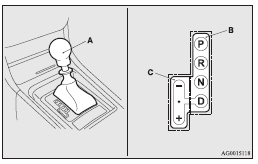
The gearshift lever (A) has 2 gates; the main shift gate (B) and the manual shift gate (C).
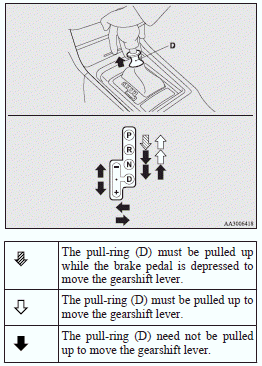
 Warning
► If the pull-ring is always pulled up to operate the gearshift lever, the lever may be accidentally shifted into the “P” (PARK) or “R” (REVERSE) position. Be sure not to pull up the pull-ring when performing the operations indicated by in the illustration.
► Always depress the brake pedal when shifting the gearshift lever into the other position from the “P” (PARK) or “N” (NEUTRAL) position.
Never put your foot on the accelerator pedal while shifting the gearshift lever from the “P” (PARK) or “N” (NEUTRAL) position.
 Note
Note
► If the brake pedal is not depressed and held, the shift-lock device activates to prevent the gearshift lever from being moved from the “P” (PARK) position.
► Do not accelerate immediately after moving the gearshift lever. It may take some time for the transmission to shift to the selected gear.
► When the gearshift lever is operated while the Twin Clutch SST fluid temperature is low, the time required to shift to the selected gear may be longer than usual.
Gearshift lever position display
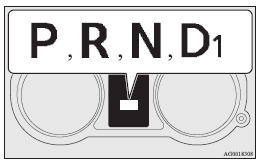
When the ignition switch is turned to the “ON” position, the position of the gearshift lever is indicated in the multi-information display.
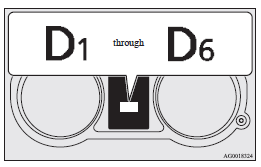
In addition, when the vehicle is driven with the gearshift lever in the “D” (DRIVE) position, the forward gear number is shown.
If the gearshift lever position display  blinks and the buzzer beeps
With the gearshift lever in the “R” (REVERSE) position, if the gearshift lever position display blinks and the buzzer beeps, the transmission gears have not properly engaged. To correct this situation, the following procedure must be performed.
1. Depress the brake pedal with your right foot and place the gearshift lever in the “N” (NEUTRAL) position.
2. Again place the gearshift lever in the “R” (REVERSE) position and confirm that the gearshift lever position display has stopped blinking and that the buzzer has stopped beeping.
3. Repeat 1 and 2 above if the gearshift lever position display continues to blink and the buzzer beeps.
Warning
► To avoid unintended vehicle movement when the gearshift lever position display blinks and the buzzer beeps, keep brake pedal applied with your right foot and do not depress the accelerator pedal.
When the gearshift lever position display is not showing
There may be a problem in the Twin Clutch SST.
If this occurs, the safety device operates and prevents the vehicle from moving. Perform the following procedure.
1. Park your vehicle in a safe place and stop the engine.
2. Restart the engine.
If the gearshift lever position display is shown and the vehicle can move after this procedure is performed, there is no malfunction.
If the gearshift lever position display is not shown and the vehicle cannot move, or if this problem occurs repeatedly, have the vehicle checked by a MITSUBISHI MOTORS Authorized Service Point as soon as possible.
Gearshift lever positions (Manual shift gate)
“P” PARK
This position locks the transmission to prevent the vehicle from moving. The engine can be started in this position.
“R” REVERSE
This position is to back up.
 Caution
► Never shift into the “P” (PARK) or “R” (REVERSE) position while the vehicle is in motion to avoid transmission damage.
“N” NEUTRAL
At this position the transmission is disengaged. It is the same as the neutral position on a M/T, and should only be used when the vehicle is stationary for an extended length of time during driving, such as in a traffic jam.
Warning
► Never move the gearshift lever to the “N” (NEUTRAL) position while driving. A serious accident could occur since you could accidentally move the lever into the “P” (PARK) or “R” (REVERSE) position or you will lose engine braking.
► On a gradient the engine should be started in the “P” (PARK) position. Although the engine can be started when the vehicle is in the “N” (NEUTRAL) position if the brake pedal is depressed, for safety reasons, do not start the engine in the “N” (NEUTRAL) position.
► Always keep your right foot on the brake pedal when shifting into or out of “N” (NEUTRAL), to minimize the risk of loss of control.
“D” DRIVE
This position is for normal driving. The transmission automatically selects a suitable gear ratio for your speed and acceleration.
Engine braking is automatically applied when necessary, depending on road conditions.
Caution
► Never shift into the “D” (DRIVE) position from the “R” (REVERSE) position while the vehicle is in motion to avoid transmission damage.
Note
► When the engine is cold, upshifts occur at a higher vehicle speed than when the engine is warm.
This control is performed to quickly warm up the engine. It does not indicate a malfunction.
After the vehicle has been driven for a while, upshifts will occur at the regular engine speeds.
Twin Clutch SST control mode
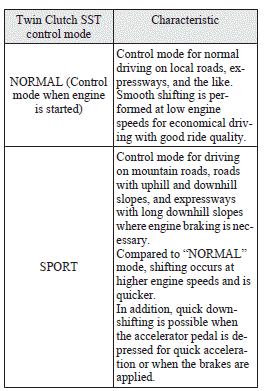
Select the control mode from the following two types to suit the driving conditions.
Note
► When continuously driving on closed circuit tracks or at other locations where the engine is operated at high speeds and under a heavy load, the Twin Clutch SST fluid temperature will have a tendency to rise.
In this case, if the temperature rises too high, the  warning display will appear on the information screen in the multi-information display to alert the driver.
If the warning display appears, be sure to refer to “Warning display” and follow the appropriate measures.
► The Twin Clutch SST control mode can be selected both when “D” range operation is selected and when manual shifting is selected.
► If you select “SPORT” mode while the engine is cold, the transmission may shift up at different speeds compared to that when the engine is warm.
This is simply the operation of the control system to warm the engine quickly. It does not indicate a malfunction.
► For slippery road surfaces, such as roads with accumulated snow, “NORMAL” mode is recommended for smooth shifting at low engine speeds.
Twin Clutch SST control mode
When the ignition switch is set to the “ON” position, operate the Twin Clutch SST control mode switch (A) to change the control mode.
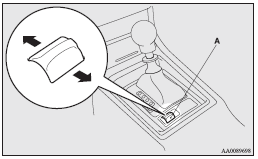
When the engine is started, the control mode is automatically set to the “NORMAL” mode. Use the following procedures to change the control mode.
To shift from “NORMAL” mode to “SPORT” mode
While the vehicle is stopped or being driven, push the Twin Clutch SST control mode switch forward.
To shift from “SPORT” mode to “NORMAL” mode
While the vehicle is stopped or being driven, push the Twin Clutch SST control mode switch rearward.
Note
► If the Twin Clutch SST control mode switch is continuously pushed after a control mode has been selected, an erroneous operation prevention function operates and the control mode is automatically set to the “NORMAL” mode.
If you would like to select a control mode again, return the ignition switch to the “ACC” or “LOCK” position and restart the engine. Then, push the Twin Clutch SST control mode switch.
Twin Clutch SST control mode display
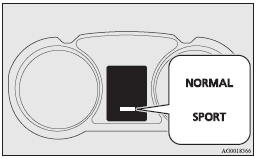
When the ignition switch is turned to the “ON” position, the currently selected control mode is displayed on the multi-information display.
Manual shift
Using the gearshift lever (A) or the shift paddles (B), shifting can be performed manually.
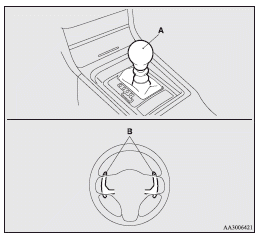
Shifting can be performed even while the accelerator pedal is depressed.
This allows the driver to enjoy sporty driving, such as quick cornering, by nimbly downshifting to reduce vehicle speed just before entering a curve.
Caution
► When manually shifting while the vehicle is being driven, select the correct shift position to control the engine speed so that the tachometer indicator does not enter the red zone.
► Sudden engine braking and rapid acceleration can cause the vehicle to skid. Shift down according to road conditions and vehicle speed.
► If both the left and right shift paddles are operated at the same time, the transmission may not change gears.
Note
► Only the forward gears 1 to 6 can be selected.
To reverse or park, place the gearshift lever in the “R” (REVERSE) or “P” (PARK) position.
► During manual shifting, downshifting will be performed automatically when the vehicle slows down and the transmission will downshift to 1st gear before the vehicle stops.
► If the gearshift lever or shift paddles are operated repeatedly, the transmission will also shift repeatedly.
► In order to ensure driving performance, upshifting may not occur depending on the vehicle speed even if the gearshift lever or shift paddles are operated. In addition, in order to prevent excessive engine speed, the buzzer sounds and downshifting may not occur depending on the vehicle speed even if the gearshift lever or shift paddles are operated.
► When driving in an aggressive manner involving high engine rpm, sudden acceleration and/or deceleration, the Twin Clutch SST could take longer to shift due to higher oil temperatures.
Shifting using the gearshift lever
Selecting manual shifting
While the vehicle is stopped or being driven, move the gearshift lever from the “D” (DRIVE) position in the main shift gate towards the driver’s seat to select manual shifting.
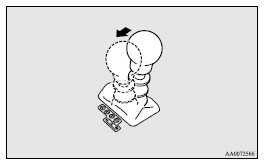
Shifting up and shifting down
Each time the gearshift lever is pulled rearward, the transmission shifts up 1 gear.
In addition, each time the gearshift lever is pushed forward, the transmission shifts down 1 gear.
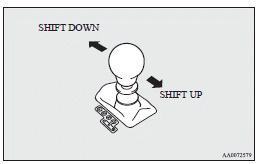
Note
► After manual shifting is selected using the gearshift lever, shifting up and down can also be performed using the shift paddles.
Returning to “D” range operation
Move the gearshift lever towards the front passenger’s seat to return to “D” range operation.
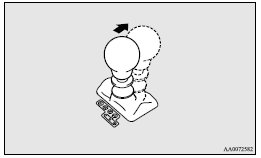
Note
► When the gearshift lever is moved to the “D” (DRIVE) position from the manual shift gate, it may automatically select a gear different from the gear selected during manual shifting depending on vehicle speed or driving conditions.
Shifting using the shift paddles
Selecting manual shifting
While the vehicle is stopped or being driven with the gearshift lever in the “D” (DRIVE) position, manual shifting can be selected by pulling one of the shift paddles towards you.
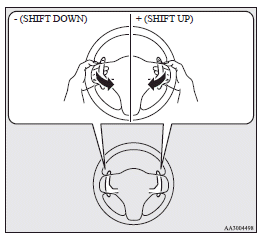
Shifting up
Each time the + (SHIFT UP) shift paddle is pulled, the transmission shifts up 1 gear.
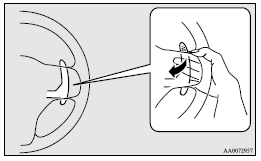
Shifting down
Each time the - (SHIFT DOWN) shift paddle is pulled, the transmission shifts down 1 gear.
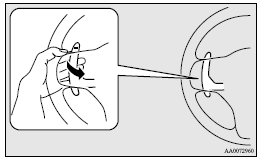
Note
► After manual shifting is selected using the shift paddles, shifting up and down can also be performed using the gearshift lever.
Returning to “D” range operation
When the gearshift lever is in the “D” (DRIVE) position, pull the + (SHIFT UP) shift paddle towards you for 2 seconds or more to return to “D” range operation.
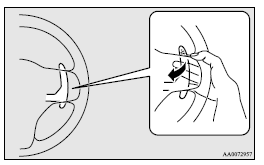
Note
► If manual shifting is selected using the shift paddles when the gearshift lever is in the “D” (DRIVE) position, the transmission will automatically return to “D” range operation before the vehicle stops.
► When the transmission returns to “D” range operation from manual shifting, it may automatically shift up or down from the gear selected using manual shifting depending on the vehicle speed or driving conditions.
► If manual shifting is selected using the shift paddles, “D” range operation will again be selected by moving the gearshift lever from the “D” (DRIVE) position towards the driver’s seat, then return it towards the front passenger’s seat.
Manual shift display
In manual shift, the currently selected gear is displayed on the multi-information display.
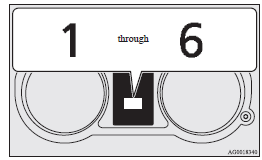
Warning display
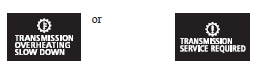
When the warning display or the warning display appears on the information screen in the multiinformation display while you are driving, take the following measures.
When warning display is showing
The temperature of the Twin Clutch SST fluid is high.
If this occurs, take one of the following measures.
► Reduce the vehicle speed.
► Stop the vehicle in a safe place, place the gearshift lever in the “P” (PARK) position, and then open the bonnet with the engine running to cool the engine.
After a while, check that the warning display has gone out. If the display goes out, the vehicle can be driven normally. If the warning display remains on or comes on frequently, have the vehicle checked by a MITSUBISHI MOTORS Authorized Service Point.
Caution
► If the warning display is shown, such as when the vehicle does not accelerate while traveling even if the accelerator pedal is depressed, the vehicle may not be able to be driven normally.
For safety, pay attention to your surroundings when driving the vehicle.
Note
► If the vehicle is continuously driven on hilly roads or in a sporty manner, the vehicle may vibrate.
This vibration is to alert the driver that the Twin Clutch SST fluid temperature has risen.
It does not indicate a malfunction.
If this occurs, perform the same measures for when the warning appears. If the vibration stops, the vehicle can be driven normally.
If vehicle is driven with warning displayed
If the vehicle continues to be driven after the warning display appears, and the temperature of the Twin Clutch SST fluid continues to rise, the transmission protection control may operate and cause the transmission to function as if the gearshift lever was in the “N” (NEUTRAL) position.
(At this time, the vehicle can temporarily not be driven.)
If this occurs, take the following corrective measures: 1. Depress the brake pedal and stop the vehicle in a safe place.
2. Place the gearshift lever in the “P” (PARK) position, and then open the bonnet with the engine running to cool the engine.
3. After a while, check that the warning display has gone out, and then stop the engine if the warning display has gone out.
4. If the engine can be restarted, the vehicle can be driven normally.
If the warning display remains on or comes on frequently, have the vehicle checked by a MITSUBISHI MOTORS Authorized Service Point.
When warning display is showing
A safety device in the Twin Clutch SST has been activated due to a possible malfunction in the Twin Clutch SST or in the engine electronic control module.
If this occurs, perform the following procedure.
1. Park your vehicle in a safe place and stop the engine.
2. Restart the engine.
If the warning display goes out, there is no abnormal condition.
However, if the warning display remains on or comes on frequently, have the vehicle checked by a MITSUBISHI MOTORS Authorized Service Point as soon as possible.
Caution
► If the warning display is shown, such as when the vehicle does not accelerate while traveling even if the accelerator pedal is depressed, the vehicle may not be able to be driven normally.
For safety, pay attention to your surroundings when driving the vehicle.
Operation of the Twin Clutch SST
Caution
► Before selecting a position with the engine running and the vehicle stationary, fully depress the brake pedal to prevent the vehicle from creeping.
The vehicle will begin to move as soon as the Twin Clutch SST is engaged, the brakes should only be released when you are ready to drive away.
► Depress the brake pedal with the right foot at all times.
Using the left foot could cause driver movement delay in case of an emergency.
► To prevent sudden acceleration, never race the engine when shifting from the “P” (PARK) or “N” (NEUTRAL) position.
► Operating the accelerator pedal while the other foot is resting on the brake pedal will affect braking efficiency and may cause premature wear of brake pads.
► Use the gearshift lever in the correct shift position in accordance with driving conditions.
Never coast downhill backward with the gearshift lever in the “D” (DRIVE) or manual shifting position or coast forward with the gearshift lever in the “R” (REVERSE) position.
The engine may stop and the unexpected increase in brake pedal effort and steering wheel weight could lead to an accident.
► Do not race the engine with brake pedal pressed when the vehicle is stationary.
This can cause sudden acceleration and damage the Twin Clutch SST.
Also, when you depress the accelerator pedal while holding down the brake pedal with the gearshift lever in the “D” (DRIVE) position, the engine revolutions may not rise as high as when performing the same operation with the gearshift lever in the “N” (NEUTRAL) position.
Passing acceleration
To gain extra acceleration in “D” (DRIVE) position, push the accelerator to the floor. The Twin Clutch SST will automatically downshift.
Note
► In manual shift, downshifts do not take place when the accelerator is depressed all the way to the floor.
Uphill/downhill driving
DRIVING UPHILL
The Twin Clutch SST may not upshift to a higher shift position if the computer determines the current speed cannot be maintained once a higher shift position is engaged.
For smoother vehicle performance, if you release the throttle while climbing a steep grade, the Twin Clutch SST may not upshift. This is normal, as the computer is temporarily preventing shifting. After reaching the top of the hill, normal shift function will resume.
Caution
► Do not use the tendency of the vehicle to creep forward in order to drive at low speeds up hills.
The transmission may be damaged and an accident may occur due to the following conditions.
• The Twin Clutch SST fluid temperature will rise and can cause transmission damage.
• If the vehicle is continuously driven at low speeds using the tendency of the vehicle to creep forward, the vehicle will vibrate or the warning display will appear on the information screen in the multi-information display to alert the driver that the Twin Clutch SST fluid temperature has risen.
After that, if the Twin Clutch SST fluid temperature rises even higher, the transmission protection control will operate.
If this occurs, the vehicle may suddenly reverse as if the gearshift lever was in the “N” (NEUTRAL) position and cause an accident.
If the warning display appears or the transmission protection control operates, refer to “When warning display is showing”.
DRIVING DOWNHILL
When travelling down steep grades, the computer may automatically select a lower shift position.
This function assists engine braking efforts, reducing the need for using the service brakes.
Waiting
For short waiting periods, such as at traffic signals, the gearshift lever can be left in position and the vehicle held stationary with the service brake.
For longer waiting periods with the engine running, place the gearshift lever in the “N” (NEUTRAL) position and apply the parking brake, while holding the vehicle stationary with the service brake.
Caution
► Do not keep the vehicle in a stopped position on an uphill slope by depressing the accelerator pedal instead of the brake pedal.
The transmission may be damaged and an accident may occur due to the following conditions.
• The Twin Clutch SST fluid temperature will rise and can cause transmission damage.
• If the vehicle is kept in a stopped position by depressing the accelerator pedal instead of the brake pedal, the vehicle will vibrate or “SLOW DOWN” and the warning display will appear on the information screen in the multi-information display to alert the driver that the Twin Clutch SST fluid temperature has risen.
After that, if the Twin Clutch SST fluid temperature rises even higher, the transmission protection control will operate.
If this occurs, the vehicle may suddenly reverse as if the gearshift lever was in the “N” (NEUTRAL) position and cause an accident.
If the warning display appears or the transmission protection control operates, refer to “When warning display is showing”.
Parking
To park the vehicle, first bring it to a complete stop, fully engage the parking brake, and then move the gearshift lever to the “P” (PARK) position.
If you are going to leave the vehicle unattended, always switch off the engine and carry the key.
Note
► On a slope, be sure to apply the parking brake before moving the gearshift lever to the “P” (PARK) position. If you move the gearshift lever to the “P” (PARK) position before applying the parking brake, it may be difficult to disengage the gearshift lever from the “P” (PARK) position when you next drive the vehicle, requiring application of a strong force to the gearshift lever to move from the “P” (PARK) position.
What to do if the following occur with the Twin Clutch SST
If there is a malfunction in the Twin Clutch SST or engine electronic control module, the following may occur.
► Twin Clutch SST does not shift.
► Vehicle cannot move.
► Twin Clutch SST acceleration is slow.
► Vehicle does not creep.
► “Shift shock” is large.
► Shifting occurs at higher engine speed.
► Response is slow.
If either of these occurs, perform the following procedure.
When warning display is showing
The temperature of the Twin Clutch SST fluid is high. Refer to “Warning display” and follow the appropriate measures.
When the check engine warning lamp comes on or blinking
There could be a malfunction in the engine electronic control module. Refer to “Check engine warning lamp” and follow the appropriate measures.
When the gearshift lever position display is not showing
A safety device in the Twin Clutch SST has been activated due to a possible malfunction in the Twin Clutch SST. Refer to “When the gearshift lever position display is not showing” and follow the appropriate measures
When warning display is showing or when no warning is showing in the multi-information display
A safety device in the Twin Clutch SST has been activated due to a possible malfunction in the Twin Clutch SST or in the engine electronic control module.
Perform the following procedure.
1. Park your vehicle in a safe place and stop the engine.
2. Restart the engine.
If the vehicle moves and accelerates normally after this procedure is performed, there is no malfunction.
However, if the vehicle does not move or accelerate normally, or if this problem occurs repeatedly, have the vehicle checked by a MITSUBISHI MOTORS Authorized Service Point as soon as possible.
Caution
► When the Twin Clutch SST fluid temperature is high, the engine idle speed when the vehicle is stopped may increase or the vehicle will have a weak tendency to creep.
After that, if the Twin Clutch SST fluid temperature rises even higher, the warning display will appear.
Full-time 4WD
Full-time 4WD vehicles are propelled by engine power distributed constantly and appropriately to all 4 wheels.
Not only does this ensure better handling on dry, paved roads but also permits better traction when driving on slippery, wet or snow-covered roads and when moving out of mud.
These vehicles, however, are not designed for offroad use, and are unsuitable for driving on bumpy ground that may cause excessive strain. Fulltime 4WD vehicles should be driven only under the same conditions as are suitable for ordinary frontwheel drive vehicles.
Download Manual