Trailer towing
In order to tow a trailer with your vehicle, when having a trailer towing device mounted that meets all relevant regulations in your area, consult a MITSUBISHI MOTORS Authorized Service Point.
The regulations concerning the towing of a trailer may differ from country to country. You are advised to obey the regulations in each area.
 Caution
► Danger of Accident!
A towing bar should be fitted according to MITSUBISHI MOTORS guidelines.
Maximum towable weight with brake and maximum trailer-nose weight
Never exceed the maximum towable weight with brake and the maximum trailer-nose weight as listed in the specifications. (Refer to “Vehicle weight”.) If you tow a trailer at an altitude of more than 1,000 m above sea-level, reduce your weight by 10 % of the gross combination weight for every increase of 1,000 m above sea-level, as the engine output is lowered owing to decrease in atmospheric pressure.
Towing bar mounting specifications
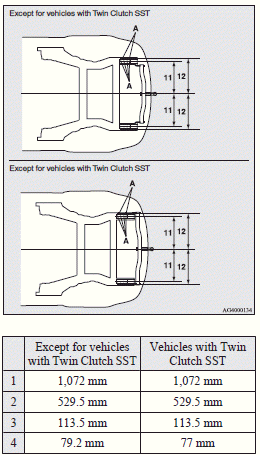
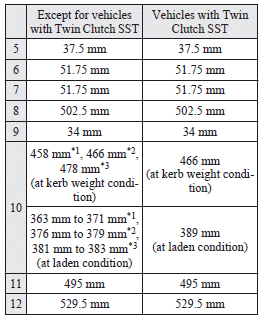
See the following table for fixing points (A) for the towing bar.
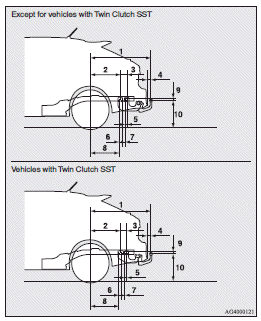
1: Vehicles equipped with 16 inch tyres that are without high ground suspensions
2: Vehicles equipped with 18 inchtyres
3: Vehicles equipped with 16 inch tyres that are with high ground suspensions
1: Vehicles equipped with 16 inch tyres that are without high ground suspensions
2: Vehicles equipped with 18 inch tyres
3: Vehicles equipped with 16 inch tyres that are with high ground suspensions
 Note
Note
► The values under item 10 can be varied depending on the loading condition of cargo or luggage.
Operating hints
► Do not let the clutch slip (vehicles equipped with M/T only) and do not increase the engine speed more than necessary when starting.
► Be sure that the driving speed does not exceed 100 km/h (62 mph) for trailer operation.
It is also recommended that you obey the local regulations in case driving speed with a trailer is limited to less than 100 km/h (62 mph).
► To prevent shocks from the overrun brake, depress the brake pedal lightly at first and then more strongly.
► To make full use of engine braking, change to a lower shift position before descending a slope.
Additional precautions for vehicles equipped with a CVT or Twin Clutch SST
It is recommended the “D” position (CVT or Twin Clutch SST) on slopes or at low speed. Use the sports mode (CVT) or manual shifting (Twin Clutch SST) in mountainous areas in order to make better use of engine braking and to assist the brake system. However, be sure that the speed does not exceed the maximum speed limit for the selected shift position.
Overheating
This will normally occur as a result of some mechanical failure. If your vehicle should overheat, stop and check for a loose or broken water pump/ alternator drive belt, a blocked radiator air intake or a low coolant level. If these items are satisfactory the overheating could be caused by a number of mechanical causes that would have to be checked at a competent service centre.
Caution
► If the engine overheats, please refer to the “Engine overheating” section of “For emergencies” prior to taking any corrective action.
► On vehicles equipped with a CVT or Twin Clutch SST, if the  warning display is showing, the temperature of the CVT fluid or Twin Clutch SST fluid is high.
Read the reference page and take the required measures.
Refer to “When a malfunction occurs in the CVT” or “Warning display”.
Download Manual