Supplemental restraint system (SRS) - airbag
The information written in this Supplemental Restraint System (SRS) section contains important points concerning the driver, front passenger, driver’s knee, side and curtain airbags.
The SRS driver and front passenger airbags are designed to supplement the primary protection of the driver and front passenger side seat belt systems by providing those occupants with protection against head and chest injuries in certain moderate-to-severe frontal collisions.
The SRS driver and front passenger airbags employ a dual stage airbag system. The SRS driver and front passenger airbag is controlled by the impact sensors (at the front of the vehicle) and the control unit (near the centre of the vehicle at floor level).
The SRS driver’s knee airbag (if so equipped) is designed to supplement the primary protection of the driver’s seat belt system. It can reduce the forward movement of the driver’s lower legs and provide increased overall body protection in certain moderateto- severe frontal collisions.
The SRS side airbags (if so equipped) are designed to supplement properly worn seat belts and provide the driver and front passenger with protection against chest and abdomen injuries in certain moderate- to-severe side impact collisions.
The SRS curtain airbags (if so equipped) are designed to supplement properly worn seat belts and provide the driver and passenger with protection against head injuries in certain moderate-to-severe side impact collisions.
The SRS is NOT a substitute for the seat belts; for maximum protection in all types of crashes and accidents, seat belts should ALWAYS be worn by everyone who drives or rides in this vehicle.
How the Supplemental Restraint System works
The SRS includes the following components:
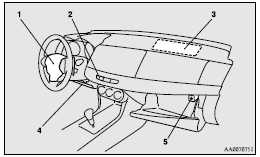
1- Airbag module (Driver)
2- Front passenger’s airbag OFF indication lamp
3- Airbag module (Passenger)
4- Driver’s knee airbag module
5- Front passenger’s airbag ON-OFF switch
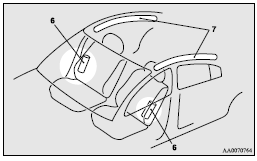
6- Side airbag modules
7- Curtain airbag modules
The airbags will operate only when the ignition switch is in the “ON” or “START” position.
The airbags deployment produces a sudden, loud noise, and releases some smoke and powder, but these conditions are not injurious, and do not indicate a fire in the vehicle. People with respiratory problems may feel some temporary irritation from chemicals used to produce the deployment; open the windows after airbag deployment, if safe to do so.
The airbags deflate very rapidly after deployment, so there is little danger of obscured vision.
 Caution
► Airbags inflate at an extremely rapid speed. In certain situations, contact with inflating airbags can result in abrasions, light cuts, bruises, and the like.
 Warning
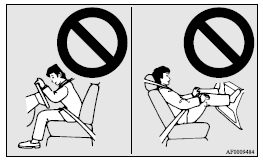
► IT IS VERY IMPORTANT TO BE PROPERLY SEATED.
A driver or front passenger too close to the steering wheel or instrument panel during airbag deployment can be killed or seriously injured.
Airbags inflate very fast, and with great force.
If the driver and passengers are not properly seated and restrained, the airbags may not protect you properly, and could cause serious or fatal injuries when it inflates.
► Do not sit on the edge of the seat or sit with your lower legs too close to the instrument panel, or lean head or chest close to the steering wheel or instrument panel. Do not put feet or legs on or against the instrument panel.
► Place all infants and small children in the rear seat and properly restrained using an appropriate child restraint system.
The rear seat is the safest place for infants and children.
Warning
► Infants and small children should never be unrestrained, stand up against the instrument panel or be held in your arms or on your lap. They could be seriously injured or killed in a collision, including when the airbag inflates. They should be properly seated in the rear seat in an appropriate child restraint system. See the “Child restraint” section of this owner’s manual.
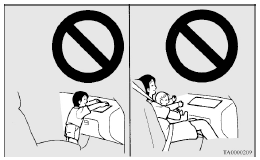
Use rearward facing child restraints in the rear seat or turn off the front passenger’s airbag ON-OFF switch (if so equipped). (Refer to “To turn an airbag off”.)
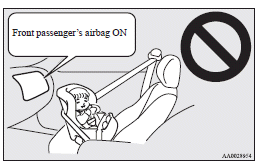
Warning
► A REARWARD FACING CHILD RESTRAINT must NOT be used in the front passenger seat if the front passenger’s airbag has not been deactivated. The force of an inflating airbag could kill or cause serious injuries to the child. A rearward facing child restraint must only be used in the rear seat.
► A FORWARD FACING CHILD RESTRAINT should be used in the rear seat whenever possible; if it must be used in the front passenger seat, adjust the seat to the most rearward position. Failure to do so could kill or cause serious injuries to the child.
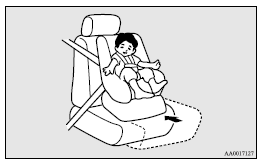
Warning
► Older children should be seated in the rear seat, properly wearing the seat belt, with an appropriate booster seat if needed
Caution for installing the child restraint on vehicles with a front passenger airbag
The label shown here is attached on vehicles with a front passenger airbag.
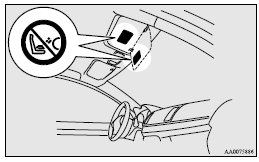
Warning
► Extreme Hazard!
Do not use a rearward facing child restraint on a seat protected by an airbag in front of it!
Front passenger’s airbag ON-OFF switch
The front passenger’s airbag ON-OFF switch can be used to disable the front passenger’s airbag. If you have a rearward facing child restraint system that cannot be fitted to any seat other than the front passenger seat, be sure to turn OFF the front passenger’s airbag ON-OFF switch before using it. (Refer to “To turn an airbag off”.) The front passenger’s airbag ON-OFF switch is located in the glove box.
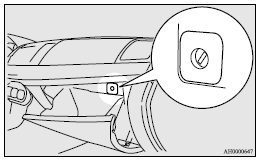
Front passenger’s airbag OFF indication lamp
The front passenger’s airbag OFF indication lamp is located in the instrument panel.
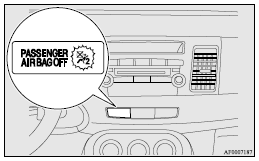
The indication lamp normally comes on when the ignition switch is turned to the “ON” position, and goes off a few seconds later.
When the front passenger’s airbag ON-OFF switch is turned OFF, the indication lamp will stay on to show that the front passenger’s airbag is not operational.
When the front passenger’s airbag ON-OFF switch is turned ON, the indication lamp goes off to show that the front passenger’s airbag is operational.
Warning
► Do not fit any accessory that makes the indication lamp impossible to see, and do not cover the indication lamp with a sticker.
You would not be able to verify the status of the passenger airbag system.
► To reduce risk of serious or fatal injury:
• Always remove the key from the ignition switch before operating a front passenger’s airbag ON-OFF switch.
Failure to do so could adversely affect the airbag performance.
• Wait at least 60 seconds to operate the front passenger’s airbag ON-OFF switch after turning the ignition switch from “ON” position to “LOCK” position.
The SRS airbag system is designed to retain enough voltage to deploy the airbag.
• Always remove the key from the front passenger’s airbag ON-OFF switch after operating that switch. Failure to do so could lead to improper position of the front passenger’s airbag ONOFF switch.
• Do not turn OFF the front passenger’s airbag ON-OFF switch except when a rearward facing child restraint system is fitted to the front passenger seat.
• If the indication lamp does not come on when the front passenger’s airbag ON-OFF switch is turned OFF, do not fit a rearward facing child restraint system to the front passenger seat. We recommend you to have the system inspected by a MITSUBISHI MOTORS Authorized Service Point.
• If the indication lamp remains on when the front passenger’s airbag ONOFF switch is turned ON, do not allow anyone to sit on the front passenger seat. We recommend you to have the system inspected by a MITSUBISHI MOTORS Authorized Service Point.
To turn an airbag off, follow these steps: 1. Insert the key into front passenger’s airbag ON-OFF switch, and turn it to the “OFF” position.
2. Remove the key from the key opening of that front passenger’s airbag ON-OFF switch.
3. Insert the key into the ignition switch, and turn the ignition to the “ON” position. The front passenger’s airbag OFF indication lamp will stay on.
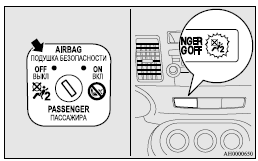
The front passenger’s airbag is now deactivated and will not deploy until switched on again.
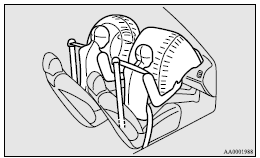
Driver’s and front passenger’s airbag system
The driver’s airbag is located under the padded cover in the middle of the steering wheel. The front passenger’s airbag is contained in the instrument panel above the glove box.
The driver’s airbag inflates at two different rates according to the severity of the impact.
The front passenger’s airbag deploys at the same time as the driver’s airbag, even if the passenger seat is not occupied, and inflates at two different rates according to the severity of the impact.
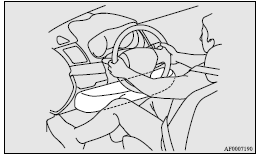
Driver’s knee airbag system
The driver’s knee airbag is located under the steering wheel. The driver’s knee airbag is designed to deploy at the same time as the driver’s front airbag.
Deployment of front airbags and driver’s knee airbag
The front airbags and driver’s knee airbag ARE DESIGNED TO DEPLOY when…
The front airbags and driver’s knee airbag are designed to deploy when the vehicle suffers a moderate- to-severe frontal impact. A typical condition is shown in the illustration.
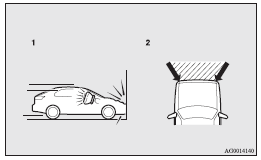
1- Head-on collision with a solid wall at a speed of approximately 25 km/h (16 mph) or higher
2- Moderate-to-severe frontal impact within the shaded area between the arrows
The front airbags and driver’s knee airbag will deploy if the severity of the impact is above the designed threshold level, comparable to an approximately 25 km/h (16 mph) collision when impacting straight into a solid wall that does not move or deform.
If the severity of the impact is below the above threshold level, the front airbags and driver’s knee airbag may not deploy. However, this threshold speed will be considerably higher if the vehicle strikes an object that absorbs the impact by either deforming or moving (for example, another stationary vehicle, pole or a guard rail).
Because frontal collisions can easily move you out of position, it is important to always properly wear your seat belts. Your seat belts will help keep you in a safe distance from the steering wheel and instrument panel during the initial stages of airbag deployment.
The initial stage of airbag inflation is the most forceful, and can possibly cause serious or fatal injuries. Moreover, the seat belts in your vehicle are your primary means of protection in a collision.
The SRS airbags are designed to provide additional protection. Therefore, for your safety and the safety of all occupants, be sure to always properly wear your seat belts.
The front airbags and driver’s knee airbag MAY NOT DEPLOY when…
With certain types of frontal collisions, the vehicle’s body structure is designed to absorb the shock to help protect the occupants from harm. (The vehicle body’s front area may deform significantly as it absorbs the impact.) Under such circumstances, the front airbags and driver’s knee airbag may not deploy irrespective of the deformation and damage to the vehicle body.
Examples of some typical conditions are shown in the illustration.
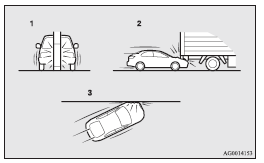
1- Collision with a utility pole, tree or other narrow objects
2- Vehicle slides under the rear body of a truck
3- Oblique frontal impacts
Because the front airbags and driver’s knee airbag do not protect the occupant in all types of frontal collisions, be sure to always properly wear your seat belts.
The front airbags and driver’s knee airbag ARE NOT DESIGNED TO DEPLOY when…
The front airbags and driver’s knee airbag are not designed to deploy in conditions where they cannot typically provide protection to the occupant.
Such conditions are shown in the illustration.
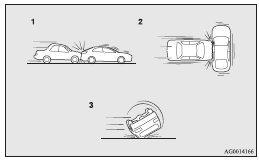
1- Rear end collisions
2- Side collisions
3- Vehicle rolls onto its side or roof
Because the front airbags and driver’s knee airbag do not protect the occupant in all types of collisions, be sure to always properly wear your seat belts.
The front airbags and driver’s knee airbag MAY DEPLOY when…
The front airbags and driver’s knee airbag may deploy if the bottom of the vehicle suffers a moderateto- severe impact (undercarriage damage).
Examples of some typical conditions are shown in the illustration.
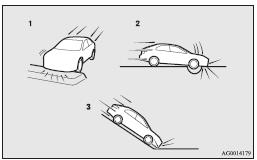
1- Collision with an elevated median/island or kerb
2- Vehicle travels over a deep hole/pothole
3- Vehicle drives down a steep slope and hits the ground
Because the front airbags and driver’s knee airbag may deploy in certain types of unexpected impacts as shown in the illustration that can easily move you out of position, it is important to always properly wear your seat belts. Your seat belts will help keep you in a safe distance from the steering wheel and instrument panel during the initial stages of airbag deployment.
The initial stage of airbag inflation is the most forceful and can possibly cause serious or fatal injuries if you contact it at this stage.
Warning
► Do not attach anything to the steering wheel padded cover, such as trim material, badges, etc. It might strike and injure an occupant if the airbag inflates.
► Do not set anything on, or attach anything to, the instrument panel above the glove box. It might strike and injure an occupant if the airbag inflates.
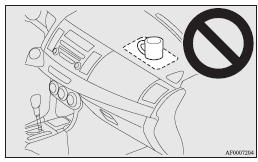
Warning
► Do not attach accessories to, or put them in front of, the windscreen. These objects could restrict the airbag inflation, or strike and injure an occupant if the airbags inflate.
► Do not attach additional keys or accessories (hard, pointed or heavy objects) to the ignition key. Such objects could prevent the driver’s knee airbag from inflating normally or could be propelled and cause serious injury if the airbag inflates.
► Do not attach accessories to the lower portion of the driver’s side instrument panel.
Such objects could prevent the driver’s knee airbag from inflating normally or could be propelled and cause serious injury if the airbag inflates.
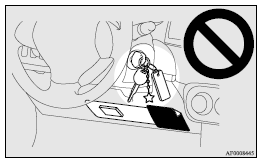
Warning
► Do not put packages, pets or other objects between the airbags and the driver or front passenger. It could affect airbag performance, or could cause injury when the airbag inflates.
► Right after the airbag inflation, several airbag system components will be hot. Do not touch them; you could be burned.
► The airbag system is designed to work only once. Once the airbags have deployed, they will not work again. They must promptly be replaced, and we recommend you to have the entire airbag system inspected by a MITSUBISHI MOTORS Authorized Service Point.
Side airbag system
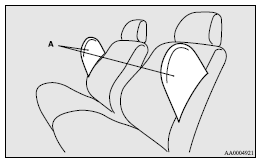
The side airbags (A) are contained in the driver and front passenger seatbacks.
The side airbag is designed to inflate only on the side of the vehicle that is impacted, even with no passenger in the front seat.
The label shown here is attached to the seatbacks with a side airbag.
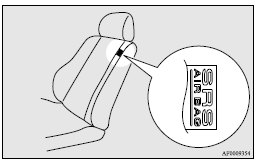
Curtain airbag system
The curtain airbags are contained in the front and rear pillars and roof side rail. The curtain airbag is designed to inflate only on the side of the vehicle that is impacted, even with no passenger in the front seat or rear seat.
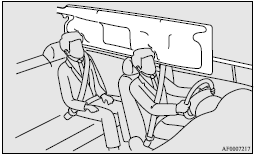
Deployment of side airbags and curtain airbags
The side airbags and curtain airbags ARE DESIGNED TO DEPLOY when…
The side airbags and curtain airbags are designed to deploy when the vehicle suffers a moderate-tosevere side impact to the middle of the passenger compartment.
The typical condition is shown in the illustration.
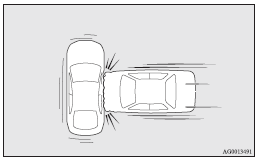
The seat belts in your vehicle are your primary means of protection in a collision. The SRS side airbags and curtain airbags are designed to provide additional protection. Therefore, for your safety and the safety of all occupants, be sure to always properly wear your seat belts.
The side airbags and curtain airbags MAY NOT DEPLOY when…
With certain types of side collisions, the vehicle’s body structure is designed to absorb the shock to help protect the occupants from harm. (The vehicle body’s side area may deform significantly as it absorbs the impact.) Under such circumstances, the side airbags and curtain airbags may not deploy irrespective of the deformation and damage to the vehicle body.
Examples of some typical conditions are shown in the illustration.
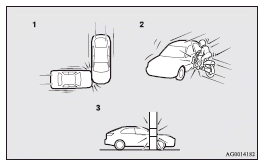
1- Side impacts in an area away from the passenger compartment
2- Motorcycle or other similar small vehicle collides with the side of vehicle
3- Collision with a utility pole, tree or other narrow object
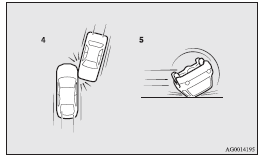
4- Oblique side impacts
5- Vehicle rolls onto its side or roof
Because the side airbags and curtain airbags do not protect the occupant in all types of side collisions, be sure to always properly wear your seat belts.
The side airbags and curtain airbags ARE NOT DESIGNED TO DEPLOY when…
The side airbags and curtain airbags are not designed to deploy in conditions where they cannot usually provide protection to the occupant. Typical conditions are shown in the illustration.
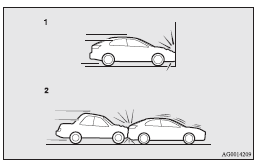
1- Head-on collisions
2- Rear end collisions
Because the side airbags and curtain airbags do not protect the occupant in all types of collisions, be sure to always properly wear your seat belts.
Warning
► The side airbags and curtain airbags are designed to supplement the driver and passenger seat belts in certain side impacts.
Seat belts should always be worn properly, and the driver and passenger should sit well back and upright without leaning against the window or door.
► The side airbag and curtain airbag inflate with great force. The driver and passenger should not put their arms out of the window, and should not lean against the door, in order to reduce the risk of serious or possible fatal injury from the deploying side airbag and curtain airbag.
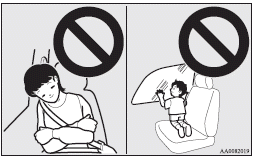
Warning
► Do not allow any rear seat occupant to hold onto the seatback of either front seat, in order to reduce the risk of injury from a deploying side airbag. Special care should be taken with children.
► Do not place any objects near or in front of the seatback of either front seat. They could interfere with proper side airbag inflation, and also could cause injury if thrown free by side airbag deployment.
► Do not place stickers, labels or additional trim on the seatback of either front seat.
They could interfere with proper side airbag inflation.
► Do not install seat covers on seats with side airbags. Do not re-cover the seats with side airbags. They could interfere with proper side airbag inflation.
► Do not attach a microphone (A) or any other device or object around the part where the curtain airbags (B) activate such as on the windscreen, side door glass, front and rear pillars and roof side or assist grips. When the curtain airbags inflate, the microphone or other device or object will be hurled with great force or the curtain airbags may not activate correctly, resulting in death or serious injury.
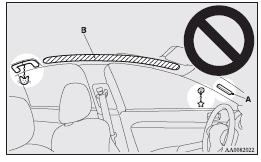
Warning
► Do not put a hanger or any heavy or pointed object on the coat hook.
If the curtain airbag was activated, any such item could be propelled away with great force and could prevent the curtain airbag from inflating correctly. Hang clothes directly on the coat hook (without using a hanger).
Make sure there are no heavy or sharp objects in the pockets of clothes that you hang on the coat hook.
► When loading luggage, do not stack it near the side windows. They could interfere with proper curtain airbag inflation.
► Do not allow a child to lean against or close to the front door even if the child is seated in a child restraint system.
The child’s head should also not lean against or be close to the area where the side airbag and curtain airbag are located.
It is dangerous if the side airbag and curtain airbag inflate.
Failure to follow all of these instructions could lead to serious or fatal injury to the child.
► We recommend work around and on the side airbags and curtain airbags system to be done by a MITSUBISHI MOTORS Authorized Service Point.
SRS warning lamp/display
Warning lamp

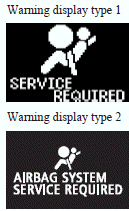
If there is an error in the system, the warning lamp will come on and the warning display will appear on the information screen in the multi-information display.
Under normal conditions, the warning lamp comes on when the ignition switch is turned to the “ON” position and goes off a few seconds later.
The warning lamp will also come on and remain on when the SRS airbags and the seat belt pretensioner system have been activated.
The warning lamp/display is used for both SRS airbag warnings and seat belt pretensioner system warnings.
Warning
► There may be a system error if the warning lamp/display appears as indicated. In such cases, an SRS airbag or a seat belt pretensioner system may not function properly in a collision. Have your vehicle checked by a MITSUBISHI MOTORS Authorized Service Point.
• Even when the ignition switch is in the “ON” position, the warning lamp does not come on or it remains on a few seconds later
• The warning lamp comes on while driving
• The warning display appears while driving
SRS servicing
Warning
► We recommend any maintenance performed on or near the components of the SRS to be performed by a MITSUBISHI MOTORS Authorized Service Point.
Improper work on the SRS components or wiring could result in inadvertent deployment of the airbags, or could render the SRS inoperative; either situation could result in serious injury.
► Do not modify your steering wheel, seat belt retractor or any other SRS components.
For example, replacement of the steering wheel, or modifications to the front bumper or body structure can adversely affect SRS performance and lead to possible injury.
► If your vehicle has sustained any damage, we recommend you to have the SRS inspected to ensure it is in proper working order.
► On vehicles equipped with side airbags, do not modify your front seats, centre pillar and centre console.
It can adversely affect SRS performance and lead to possible injury. If you found any tear, scratch, crack or damage to the seat fabric near the side airbag, the portion of the front and rear pillars and roof side rail, you should have the SRS inspected by a MITSUBISHI MOTORS Authorized Service Point.
 Note
Note
► When you transfer ownership of the vehicle to some other person, we urge you to alert the new owner that it is equipped with the SRS and refer the new owner to the applicable section in this owner’s manual.
► If your vehicle has to be scrapped, do this in line with local legislation and contact a MITSUBISHI MOTORS Authorized Service Point to safely dismantle the airbag system.
Download Manual