Active stability control (ASC)
The Active Stability Control (ASC) takes overall control of the anti-lock brake system (ABS), traction control function and stability control function to help maintain the vehicle’s control and traction.
Please read this section in conjunction with the page on the ABS, traction control function and stability control function.
 Caution
► Do not over-rely on the ASC. Even the ASC cannot prevent the natural laws of physics from acting on the vehicle.
This system, like any other system, has limits and cannot help you to maintain traction and control of the vehicle in all circumstances. Reckless driving may lead to accidents. It is the driver’s responsibility to drive carefully. This means taking into account the traffic, road and environmental conditions.
► Be sure to use the same specified type and size of tyre on all 4 wheels. Otherwise, the ASC may not work properly.
► Do not install any aftermarket limitedslip differential (LSD) on your vehicle.
The ASC may stop functioning properly.
 Note
Note
► An operation noise may be emitted from the engine compartment in the following situations.
The sound is associated with checking the operations of the ASC. At this time, you may feel a shock from the brake pedal if you depress it. These do not indicate a malfunction.
• When the ignition switch is set to the “ON” position.
• When the vehicle is driven for a while after the engine is turned on.
► When the ASC is activated, you may feel a vibration in the vehicle body or hear a whining sound from the engine compartment.
This indicates that the system is operating normally.
It does not indicate a malfunction.
► When the ABS warning lamp is illuminated, the ASC is not active.
Traction control function
On slippery surfaces, the traction control function prevents the drive wheels from excessive spinning, thus helping the vehicle to start moving from a stopped condition. It also provides sufficient driving force and steering performance as the vehicle turns while pressing the acceleration pedal.
Caution
► When driving a vehicle on a snowy or icy road, be sure to install snow tyres and drive the vehicle at moderate speeds.
Stability control function
The stability control function is designed to help the driver maintain control of the vehicle on slippery roads or during rapid steering manoeuvres. It works by controlling the engine output and brake on each wheel.
Note
► The stability control function operates at speeds of about 15 km/h (9 mph) or higher.
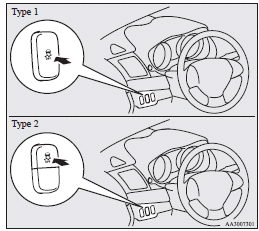
“ASC OFF” switch
The ASC is automatically activated when the ignition switch is turned to the “ON” position. You can deactivate the system by pressing down the “ASC OFF” switch for 3 seconds or longer.
When the ASC is deactivated, the display/indicator will turn on. To reactivate the ASC, momentarily press the “ASC OFF” switch; the display/indicator is turned off.
Caution
► For safety reasons, the “ASC OFF” switch should be operated when your vehicle is stopped.
► Be sure to keep the ASC on while driving in normal circumstances.
Note
► When moving out of mud, sand or fresh snow, pressing the accelerator pedal may not allow the engine speed to increase. In such situations, temporarily turning off the ASC with the “ASC OFF” switch will make it easier to move out your vehicle.
► Using the “ASC OFF” switch turns off both the stability control function and the traction control function.
► If you continue to press the “ASC OFF” switch after the ASC is turned off, the “mistaken operation protection function” will activate and the ASC will turn back on.
ASC operation display or ASC OFF display
 - ASC operation display/ASC indicator
The display/indicator will blink
when the ASC is operating.
 - ASC OFF display/ASC OFF indicator
This display/incicator will turn on
when the ASC is turned off with the
“ASC OFF” switch.
Note
► The combination of items shown on the display varies depending on the vehicle model.
Caution
► When  display/indicator blinks, ASC is operating, which means that the road is slippery or that your vehicle’s wheels are beginning to slip. If this happens, drive slower with less accelerator input.
► If the temperature in the braking system continues to increase due to continuous brake control on a slippery road surface, the  display/indicator will blink. To prevent the brake system from overheating, the brake control of the traction control function will be temporarily suspended.
The engine control of the traction control function and normal brake operation will not be affected. Park your vehicle in a safe place. When the temperature in the braking system has come down, the display/indicator will be turned off and the traction control function will start operating again.
Note
► The display/indicator may turn on when you start the engine. This means that the battery voltage momentarily dropped when the engine was started. It does not indicate a malfunction, provided that the display goes out immediately.
► When a compact spare tyre has been put on your vehicle, the gripping ability of the tyre will be lower, making it more likely that the display/indicator will blink.
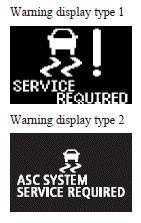
ASC warning display
If an abnormal condition occurs in the system, the following display/indicator will turn on.
 - ASC indicator
 - ASC OFF display/ASC OFF indicator
Note
► The combination of items shown on the display varies depending on the vehicle model.
Caution
► The system may be malfunctioning.
Park your vehicle in a safe place and stop the engine. Restart the engine and check whether the display/indicator goes out. If they go out, there is no abnormal condition.
If they do not go out or appear frequently, it is not necessary to stop the vehicle immediately, but we recommend you to have your vehicle inspected
Towing
Caution
► When towing the vehicle with only the front wheels or only the rear wheels raised off the ground, do not place the ignition switch in the “ON” position. Placing the ignition switch in the “ON” position could cause the ASC to operate, resulting in an accident.
Note that the correct towing method depends on the transmission type and the vehicle’s drive configuration. For details, refer to “Towing”.
Download Manual