ACD (Active centre differential system
The ACD is a system that improves acceleration performance and straight-ahead stability by regulating the differential limiting action and power drive distribution of the centre differential.
 Caution
► Do not over-rely on the ACD. Even the ACD cannot prevent the natural laws of physics from acting on the vehicle. This system, like any other system, has limits and cannot help you to maintain traction and control of the vehicle in all circumstances.
Reckless driving may lead to accidents.
It is the driver’s responsibility to drive carefully. This means taking into account the traffic, road and environmental conditions.
► Be sure to use tyres that are the same specified size, type, and brand, and have no difference in the amount of wear for all four wheels. Otherwise, the ACD may not work properly
 Note
Note
► If the parking brake lever is pulled up while the vehicle is moving, the centre differential is designed to switch to a free state condition which will allow the rear wheel to lock easier.
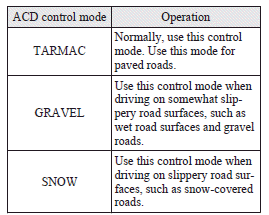
ACD control mode
Select the control mode from the following three types to suit the driving conditions.
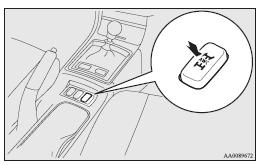
ACD control mode switch
When the ignition switch is set to the “ON” position, operate the AWC switch to change the control mode.
Each time the switch is pushed, the control mode changes in the order “TARMAC” → “GRAVEL” → “SNOW” → “TARMAC”.
Note
► The control mode can be changed while the vehicle is moving.
► The selected control mode is stored in memory even if the engine is stopped.
However, if a battery terminal is disconnected, the control mode stored in memory will be erased and the control mode will be set to the “TARMAC” mode.
ACD control mode display

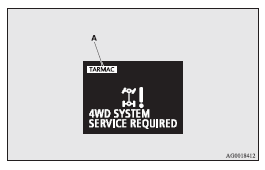
Example: “TARMAC” mode is selected.
The currently selected control mode is displayed on the multi-information display.
In addition, when the control mode is changed, the selected mode appears on the interrupt display screen of the information screen in the multi-information display.
The control mode display will appear on the information screen for a few seconds, and then the original screen will return.
Caution
► The ACD control mode display may flash under aggressive driving conditions.
At this time, ACD control is temporarily suspended in order to protect the ACD device, but this will not affect normal driving.
After the vehicle is driven for a while, if the ACD control mode display remains on, the ACD control will start operating again.
ACD warning display
When there is a malfunction in the system, the warning display will appear on the information screen in the multi-information display.
In addition, the ACD control mode display in section (A) will go out at the same time.
Caution
► The system may be malfunctioning.
Park your vehicle in a safe place and stop the engine.
Restart the engine and check whether the  warning display goes out.
If the  warning display goes out, there is no abnormal condition. If the
  warning display does not go out or appears frequently, it is not necessary to stop the vehicle immediately, but we recommend you to have your vehicle inspected.
Note
► If the ambient temperature drops and the viscosity of the AWC control fluid increases, the warning may be displayed.
At this time, ACD control is temporarily suspended, but this will not affect normal driving.
After the vehicle is driven for a while, if the engine is restarted after the AWC control fluid warms up or the ambient temperature increases, the ACD control will start operating again if the warning display goes out.
Limited-slip differential (LSD)
A limited-slip differential (LSD) is applied for the rear wheel differential. The features of this LSD are described below: Just as with a conventional differential, the wheel on one side is allowed to turn at a different speed from the wheel on the other side when the vehicle is cornering. The difference between the LSD and a conventional differential is that if the wheel on one side of the vehicle loses traction, a greater amount of torque is applied to the wheel on the other side to improve traction.
Note
► Even if there is a difference in the amount of traction the wheels can get, if both of them are spinning, the LSD will not be effective.
Caution
► Never start the engine while one of the rear wheels is jacked up and the other in contact with the ground; doing so may cause the vehicle to jump forward.
► Continuously attempting to extract the vehicle from snow, mud, etc. while using high engine rpm may damage the LSD.
► Using a compact spare wheel w
Download Manual