Seating position
 Introduction
Number of seats
The vehicle has a total of five seats: two seats in the front and three seats in the back.
Every seat is equipped with a safety belt.
 WARNING
Sitting incorrectly in the vehicle can increase the risk of serious or fatal injuries during sudden driving or braking maneuvers, in the event of a collision or accident, and if the airbags are deployed.
-
Before the vehicle starts to move, all vehicle occupants must always be in the correct seating position and maintain it while driving. Safety belts must also be fastened and remain fastened.
-
The number of persons in the vehicle must not exceed the number of seats with safety belts.
-
Always secure children in the vehicle with an approved and suitable child restraint according to the child's body size and weight ⇒ Transporting children safely and⇒ Airbag system.
-
Always keep feet in the footwell while driving. For example, never rest feet on the seat or on the instrument panel and never stick feet out of the window. Otherwise, if the airbag and the safety belt deploy, they could increase the risk of injury in the event of an accident instead of providing protection.
Risk of injury due to an incorrect seating position
Please read the introductory information and heed the Warnings and Notice ⇒
 Introduction.
The risk of serious or fatal injuries will increase if safety belts are not worn or are incorrectly fastened. Safety belts can only achieve the optimum protection if they are routed correctly. An incorrect seating position significantly impairs the protective function of the safety belt. This could result in serious or fatal injuries. The risk of serious or fatal injuries increases even more if a deployed airbag strikes a passenger who is sitting in an incorrect seating position. The driver is responsible for all vehicle occupants and especially for children who are being transported in the vehicle.
The following list includes examples of seating positions that could be dangerous for all vehicle occupants.
The following points always apply when the vehicle is in motion:
-
Never stand inside the vehicle.
-
Never stand on the seats.
-
Never kneel on the seats.
-
Never tilt your seat backrest too far back.
-
Never lean against the instrument panel.
-
Never lay down in the passenger compartment or on the rear bench seat.
-
Never sit only on the front section of the seat.
-
Never sit sideways on the seat.
-
Never lean against the window.
-
Never place your feet out of the window.
-
Never place your feet on the instrument panel.
-
Never place your feet on the seat cushion or on the seat backrest.
-
Never ride in the footwell.
-
Never sit on the armrests.
-
Never drive or ride in a seat without fastening your safety belt.
-
Never ride in the trunk.
WARNING
Incorrect seating positions in the vehicle increase the risk of serious or fatal injuries in the event of an accident or sudden driving and braking maneuvers.
-
All vehicle occupants must always sit in the correct seating position and have their own safety belts correctly fastened while driving.
-
Incorrect seating positions, failure to wear a safety belt, or being too close to an airbag increases the risk of serious injury or death to vehicle occupants, especially if the airbags deploy and come into contact with occupants who are not seated correctly.
Correct seating position
Please read the introductory information and heed the Warnings and Notice ⇒ Introduction.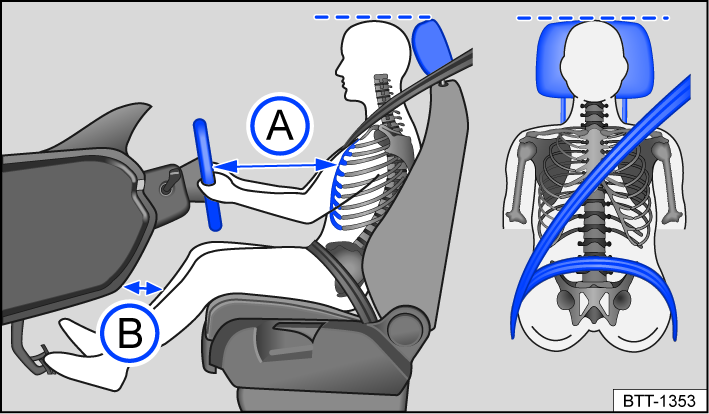
Fig. 14 General example: correct distance between the driver and the steering wheel, correct safety belt routing and correct head restraint adjustment.
The correct seating positions for the driver and passengers are specified in the information that follows.
If individuals cannot achieve the correct seating position due to physical conditions, contact an authorized Volkswagen dealer or authorized Volkswagen Service Facility for more information about possible special modifications. The safety belt and airbags only provide the optimum protection when vehicle occupants are seated in a correct seating position. Volkswagen recommends contacting an authorized Volkswagen dealer or authorized Volkswagen Service Facility.
For your safety and to reduce the risk of injuries in the event of a sudden braking maneuver or accident, Volkswagen recommends the following seating positions:
The following applies to all vehicle occupants:
-
Adjust the head restraint so that the upper edge of the head restraint is in line with the upper portion of the head as much as possible, but not lower than eye level. Position the back of the head as close as possible to the head restraint fig. 14.
-
For shorter individuals, slide the head restraint all the way downward, even if the head is then below the upper edge of the head restraint.
-
For taller individuals, move the head restraint upward all the way.
-
Keep both feet in the footwell while driving.
-
Adjust and fasten the safety belts correctly ⇒ Safety belts.
The following additional points apply to the driver:
-
In vehicles with head restraints that can be moved forward or back, position the head restraint so that it is as close as possible to the back of the head.
-
Adjust the steering wheel so that the distance between the steering wheel and your chest is at least 25 cm (around 10 inches) fig. 14 and you can hold the steering wheel firmly at the sides with both hands and your elbows slightly bent.
-
When adjusted, the steering wheel must always face your chest and not be directed toward your face.
-
Position the seat backrest in an upright position, so that your back rests completely on the seat backrest.
-
Adjust the forward/back position of the driver seat so that you can press the pedals while your legs are slightly bent and there is at least 10 cm (around 4 inches) of space between the instrument panel and your knees fig. 14.
-
Adjust the driver seat so that the top point of the steering wheel can be reached.
-
Always keep both feet in the footwell to keep control of the vehicle at all times.
The following additional points apply to the front passenger:
-
In vehicles with head restraints that can be moved forward or back, position the head restraint so that it is as close as possible to the back of the head.
-
Position the seat backrest in an upright position, so that your back rests completely on the seat backrest.
-
Move the front passenger seat back as far as possible so that the airbag can provide optimum protection if it deploys.
Download Manual