Messages about driving
Pedals

Fig. 84 In the footwell: pedals.
 Accelerator pedal
 Brake pedal
The operation and the ability of the pedals to move freely must never be restricted by objects or floor mats.
Only use floor mats that keep the pedal area open and can be secured from sliding around the footwell.
 WARNING
Objects in the driver footwell can prevent the pedals from moving freely. This can cause the driver to lose control of the vehicle and increases the risk of serious injuries.
-
Make sure all pedals can always be pressed without obstructions.
-
Always attach floor mats securely in the footwell.
-
Never place floor mats or other carpet over the installed floor mat.
-
Make sure no objects can enter the driver footwell while driving.
-
Remove any objects from the footwell when the vehicle is parked.
-
Wear shoes that give your feet good grip for operating the pedals.
WARNING
Always heed the applicable driving regulations and speed limits and drive proactively. Evaluating driving situations correctly can make the difference between safely reaching your destination and being involved in a collision with serious injuries.
-
Take regular breaks on long drives. You should take a break at least every two hours.
WARNING
Driving under the influence of alcohol, drugs, medication, and prescription narcotics can cause serious accidents and fatal injuries.
-
Alcohol, drugs, medication, and prescription narcotics can considerably impair perception, reaction times, and driving safety, which can result in loss of vehicle control.
 NOTICE
It must always be possible to press the pedals with no obstructions. For example, if a brake circuit is malfunctioning, the brake pedal may need to travel farther in order to stop the vehicle. In that case, the brake pedal would need to be pressed down father and more strongly than normal.
Gear recommendation
Depending on the vehicle equipment, a recommendation to select a fuel-saving gear can be displayed in the instrument cluster while you are driving.
Vehicles with an automatic transmission: If the selector lever is in the tiptronic position, the current gear is shown as a number. An arrow gives the recommendation to upshift  or downshift
  to the displayed gear.
Information on “cleaning” the particulate filter
The engine management system detects that the particulate filter is becoming clogged and helps to regenerate the particulate filter by actively recommending a gear. In this instance, as an exception, it may be necessary to drive with a higher engine speed ⇒ Particulate filter.
 CAUTION
The gear recommendation is simply an aid and cannot replace the driver's attention.
-
The responsibility for selecting the correct gear in each driving situation remains with the driver, for example when overtaking or driving uphill.

An optimally selected gear helps to save fuel.
 For vehicles with manual transmission, the gear recommendation display is turned off when you press the clutch pedal. For vehicles with automatic transmission, the gear recommendation display is turned off when you leave the tiptronic position.
Eco tips
The correct driving style can help to reduce consumption, pollution, and wear on the engine, brakes, and tires. The following tips will help you conserve the environment and your money.
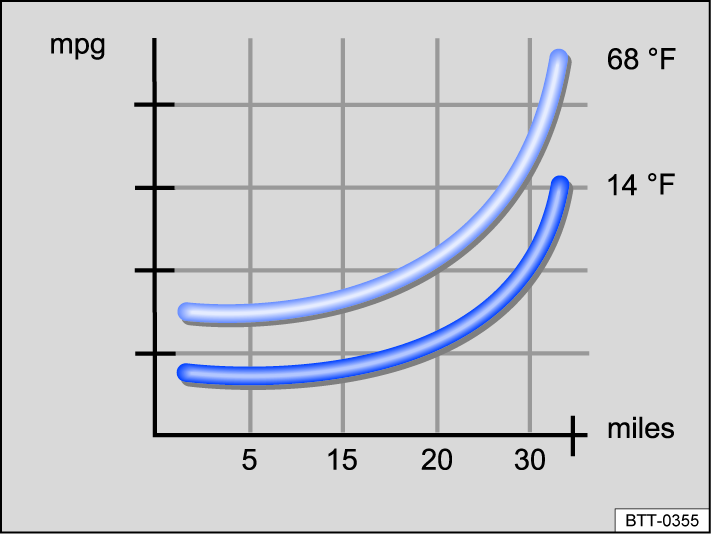
Fig. 85 Fuel consumption in mpg at two different ambient temperatures.
Anticipatory driving
An inconsistent driving style increases consumption. When the driver actively pays attention to traffic, this can prevent frequent acceleration and braking maneuvers. Maintaining enough distance to the vehicle driving ahead helps you to drive with better anticipation.
How to save energy when shifting gears
Early upshifting saves energy at an engine RPM of 2,000. Do not wait as long as possible to upshift gears and avoid high engine speeds.
-
Vehicles with an automatic transmission: Accelerate slowly and avoid using the kick-down function.
Avoiding full acceleration
Excessively high speeds increase the rolling resistance and air resistance and with that, the power needed to move the vehicle. Never drive at the maximum vehicle speed.
Refuel in moderation
A full fuel tank increases the vehicle weight. A fuel tank that is half to three-quarters full is best suited for city driving.
Avoid short trips
A cold engine has a very high consumption rate. The optimal operating temperature is only reached after several kilometers (miles). When outside temperatures are very low, for example in winter, the consumption is much higher than average fig. 85. Plan trips economically and combine short trips.
Have maintenance performed regularly
Regular maintenance is required for fuel-efficient driving and increases the service life of the vehicle.
Checking tire pressures
Low tire pressures cause wear as well as increased rolling resistance of tires, and this increases consumption. Use tires with optimal rolling resistance.
Adapt the tire pressures to the load:
-
Follow the specifications on the tire pressure label ⇒ Tire pressure.
-
Tire Pressure Monitoring System ⇒ Tire Pressure Monitoring System
Using synthetic engine oil
Full synthetic engine oils with a low viscosity reduce the frictional resistance in the engine and distribute significantly better and faster when cold-starting the engine.
Removing unnecessary weight
Clearing out the luggage compartment, for example by removing empty crates or unneeded child restraints, can reduce consumption.
To keep the vehicle air resistance as low as possible, remove accessories such as ski, bicycle, and roof racks after use.
Saving energy
The alternator, which is powered by the engine, generates power for the electrical equipment, such as the climate control system, window heating, or ventilation. Saving energy is simple, for example:
-
When temperatures are high, air out the vehicle before driving and drive short distances with the windows open. Then turn on the climate control system.
-
Turn off electrical equipment when it is no longer needed.
WARNING
Always adapt your speed and remain a safe distance to vehicles driving ahead according to the visual, weather, road, and traffic conditions.
NOTICE
Never let the vehicle roll down mountains or hills in the N neutral setting. The transmission is not lubricated when this happens and this can damage it.
Learn about other ways to protect the environment. Think Blue. is the worldwide Volkswagen brand for sustainability and environmental impact.
An authorized Volkswagen dealer or authorized Volkswagen Service Facility can provide you with more information about correct maintenance and replacement parts that are particularly energy efficient, such as new tires.
In driving situations when less power is required, the engine cylinders can deactivate automatically on vehicles that are equipped with Active Cylinder Management (ACT®). While deactivated, no fuel will be injected into the respective cylinders, which reduces fuel consumption overall.
Information on the brakes
During the first 200 to 300 km (100 to 200 miles), new brake pads do not yet have their full braking efficiency and first need to be “worn in” ⇒  . However, you can compensate for the slightly reduced braking force by pressing firmly on the brake pedal. During the break-in period, the braking distance during full braking or automatic braking is longer than with brake pads that have been broken in. During the break-in period, avoid full braking and situations that place a heavy load on the brakes, such as driving too close to the vehicle ahead.
Brake pad wear depends on driving conditions and style. When driving frequently in cities and on curves or with a sporty driving style, have your brake pads checked frequently by suitably qualified professionals. Volkswagen recommends contacting your Volkswagen dealership.
When driving with wet brakes, for example after driving through water, in heavy rain, or after washing your vehicle, the braking efficiency can be reduced by moisture or ice on the brake rotors. You must “dry” the brakes as soon as possible by braking carefully at high speeds. Make sure there is no vehicle behind you and that you do not endanger anyone else on the road ⇒ .
A coating of salt on the brake rotors and brake pads reduces the braking efficiency and increases the braking distance. If you do not apply the brakes for long periods of time on salt-covered roads, you must brake carefully to clean off the layer of salt ⇒ .
Leaving the vehicle parked for long periods of time, low mileage, and avoiding heavy braking can contribute to corrosion on the brake rotors and dirty brake pads. If you usually avoid heavy braking or if there is corrosion present, occasional heavy braking at high speeds is recommended to clean the brake rotors and pads. Ensure that you do not endanger any other vehicles or anyone else on the road ⇒ .
WARNING
Driving with worn brake pads or a malfunctioning brake system can result in accidents and serious injuries.
-
If you suspect that the brake pads are worn or the brake system is malfunctioning, immediately find a suitably qualified professional and have the brake pads checked and worn brake pads replaced. Volkswagen recommends contacting your Volkswagen dealership.
WARNING
New brake pads have not achieved the optimum braking efficiency yet.
-
New brake pads do not have their full braking efficiency up to the first 300 km (200 miles) and need to be “worn in” first. You can make up for the reduced braking efficiency by pressing the brake pedal harder.
-
To reduce the risk of accidents, serious injuries, and loss of vehicle control, drive with extra caution when the brake pads are new.
-
During the break-in period for new brake pads, do not drive too close to other vehicles and avoid driving situations that place a heavy load on the brakes.
WARNING
Never let the brakes “rub” too often and too long or press the brake pedal too often and too long. Prolonged braking causes the brakes to overheat. This can considerably reduce braking performance, increase braking distance and possibly lead to a total brake system malfunction.
WARNING
Overheated brakes reduces the braking efficiency and increase the braking distance considerably.
-
When driving downhill, a lot of force is placed on the brakes and they become hot quickly.
-
Before driving on a long stretch of road with a steep gradient, reduce your speed by shifting down to a lower gear (with a manual transmission or in tiptronic mode of the automatic transmission). This utilizes the engine braking efficiency and reduces the load on the brakes.
-
Aftermarket or damaged front spoilers can affect the air supply to the brakes and cause them to overheat.
WARNING
Wet, icy, or salt-covered brakes will take longer to brake and increase the braking distance.
-
Test the brakes carefully.
-
Always press the brake pedal carefully several times to dry the brakes and clear the ice and salt from them, as long as the visibility, weather, road, and traffic conditions permit.
If you are having the front brake pads checked, the rear brake pads should be checked at the same time. Regularly check the thickness of the brake pads visually by inspecting them through the openings in the wheel rims or from underneath the vehicle. If necessary, remove the wheels so that the brake pads can be inspected. Volkswagen recommends contacting an authorized Volkswagen dealer or authorized Volkswagen Service Facility.
Driving a loaded vehicle
Heed the following for good vehicle handling when the vehicle is loaded:
-
Stow all cargo securely ⇒ Transporting.
-
Accelerate with extra care and caution.
-
Avoid sudden braking and driving maneuvers.
-
Brake earlier than usual.
WARNING
Sliding loads can considerably impair the driving stability and safety of your vehicle, increase the braking distance when you brake hard or perform an emergency stop, and thus increase the risk of accidents and serious injury.
-
Correctly secure the load to prevent it from sliding.
-
Use suitable tie-downs or securing straps on heavy objects.
-
Engage the rear seat backrests securely.
Driving with an open trunk lid
Driving with an open trunk lid can be especially dangerous. Secure all objects and the open trunk lid correctly and take sufficient precautions to reduce the amount of poisonous exhaust that enters the vehicle.
WARNING
Driving with the trunk lid unlocked or open may cause serious injuries.
-
Always drive with the trunk lid closed.
-
Store all objects securely in the luggage compartment. Loose objects can fall out of the trunk and injure other road users.
-
Always drive carefully and anticipate upcoming traffic situations.
-
Avoid abrupt or sudden driving and braking maneuvers because the open trunk lid can move in an uncontrolled manner.
-
Mark objects sticking out of the luggage compartment so they will be visible to others on the road. Observe legal regulations.
-
If objects must stick out of the luggage compartment, never use the trunk lid to “clamp” or “secure” objects.
-
If there is a roof rack with cargo on the trunk lid, always remove it before driving with an open trunk lid.
WARNING
Poisonous exhaust may enter the vehicle interior when the trunk lid is open. This can lead to a loss of consciousness, carbon monoxide poisoning, accidents, and serious injuries.
-
To prevent poisonous exhaust from entering the vehicle, always drive with the trunk lid closed.
-
If you absolutely must drive with the trunk lid open, take the following precautions to reduce the risk of poisonous exhaust fumes entering the vehicle interior:
-
Close all windows and the power sunroof.
-
Switch off air recirculation by the heating and fresh air system or air conditioner.
-
Open all the air vents in the instrument panel.
-
Set the blower for the heating and fresh air system or air conditioner to the highest setting.
-
NOTICE
Opening the trunk lid changes the height and possibly the length of the vehicle.
Driving through water on roads
Note the following to reduce the risk of vehicle damage when driving through water, for example on flooded roads:
-
The water must not be any higher than the bottom of the vehicle body ⇒
 .
. -
Do not driver faster than walking speeds.
-
Never stop the vehicle, drive in reverse, or stop the engine in water.
-
Oncoming vehicles create waves that can raise the water level for your vehicle enough that it is not safe to drive through.
WARNING
When driving through water, mud, slush, etc., the braking effect may be delayed due to damp or icy brake rotors and brake pads in the winter, and this can extend the braking distance.
-
Perform careful braking maneuvers to “dry and remove ice” from the brakes. Do not endanger road users or disregard legal regulations when doing this.
-
Avoid abrupt and sudden braking maneuvers directly after driving through water.
NOTICE
Vehicle components such as the engine, transmission, suspension, or electrical system can be severely damaged by driving through water.
-
Never drive through salt water because salt can cause corrosion. Immediately clean any vehicle components that come into contact with salt water using fresh water.
Breaking in the engine
A new engine needs to be broken in during the first 1000 miles (1500 km). All moving parts should be able to work together. During the first few hours of operation, the engine has a higher internal friction than it will later.
Up to 1000 km (600 miles):
-
Do not accelerate fully.
-
Do not use more than two thirds of the maximum engine RPM.
Between 1000 and 1500 km (600 to 1000 miles):
-
Increase the speed and engine RPM gradually.
The driving style during the first 1000 miles (1500 km) also affects the engine's quality. Even after that – especially when the engine is cold – the engine should be driven at moderate engine speeds to reduce engine wear and increase the possible mileage.
Do not drive at too low of an engine speed (RPM). Always downshift if the engine stops running “smoothly”.
New tires ⇒ Information about wheels and tires and brake pads ⇒ Information on the brakes must be carefully broken in.
If the new engine is broken in gently, its service life is increased while, at the same time, reducing engine oil consumption.
Operating the vehicle in different countries and continents
The vehicle was manufactured by the factory for a specific country and meets those approval regulations that were valid at the time of vehicle manufacture.
If the vehicle will be used temporarily or for a brief period in another country, then read and observe the following information.
Some countries have special safety standards and regulations that differ from the vehicle configuration. Volkswagen recommends obtaining information about legal regulations from an authorized Volkswagen dealer or authorized Volkswagen Service Facility before driving in other countries.
If the vehicle is sold in another country or will be used for an extended period in another country, then the applicable legal regulations in that country must be observed.
Certain equipment may need to be installed or removed and functions may need to be deactivated. The scope and types of service may also be affected. This particularly applies if the vehicle is being operated for an extended period in a different climate region.
Due to the many different frequency bands around the world, the Infotainment system installed at the factory may not function in other countries.
NOTICE
-
Volkswagen is not responsible for damage to the vehicle caused by substandard fuel, insufficient service, or not using Volkswagen Genuine parts.
-
Volkswagen is not responsible if the vehicle does not meet all of the applicable legal requirements in other countries and continents.
Troubleshooting
 Brake system malfunction
The red warning light turns on.
A message may also be displayed.
 Do not continue driving!
-
Contact a suitably qualified professional and have the brake system checked. Volkswagen recommends contacting your Volkswagen dealership.
 Brake pad wear indicator (depending on the vehicle equipment)
The warning light flashes or turns on red or yellow.
The front brake pads are worn.
-
Contact a suitably qualified professional immediately. Volkswagen recommends contacting your Volkswagen dealership.
-
Have all brake pads inspected and replaced, if necessary.
If the vehicle's braking performance changes
If the brake pads are worn or if you notice that your vehicle does not brake as usual (the braking distance suddenly increases):
-
Contact a suitably qualified professional immediately. Volkswagen recommends contacting your Volkswagen dealership.
Download Manual