Front Assist
 Introduction
Front Assist can recognize impending forward collisions and warn the driver. In addition, the system can provide support when braking and initiate an automatic braking maneuver.
The Front Assist system can help to avoid accidents but cannot replace the driver's attention.
Front Assist works solely within the system limitations. Warning times vary depending on the Traffic Situation and the driving behavior.
Range of functions
Autonomous Emergency Braking (Front Assist) includes the following extended functions, depending on the vehicle equipment and the country:
-
Pedestrian Monitoring.
The functions named are (if available) automatically active if Front Assist is switched on.
Recognizable objects
Autonomous Emergency Braking (Front Assist) can recognize the following objects, depending on the vehicle equipment and the country:
-
Vehicles.
-
Bikes.
-
Pedestrians.
Driving with Front Assist
You can cancel automatic braking interventions by moving the steering wheel or pressing the accelerator pedal.
Automatic braking
Front Assist can brake the vehicle to a stop. The vehicle will not be held at a stop after that. Press the brake pedal.
The brake pedal feels more firm during an automatic braking maneuver.
Detecting the driving situation
Front Assist detects driving situations using radar sensors in the front of the vehicle. The range of the radar sensor is up to approximately 400 ft (120 m).
 WARNING
The intelligent technology of Front Assist cannot overcome the natural laws of physics and it can only operate within the limits of the system. Do not allow the increased convenience provided by the Front Assist system to tempt you into taking risks. The Front Assist system cannot prevent accidents and severe injuries automatically. The driver is always responsible for control of the vehicle.
-
Always adapt your speed and remain a safe distance to vehicles driving ahead according to the visual, weather, road, and traffic conditions.
-
Please be aware that Autonomous Emergency Braking (Front Assist) cannot detect all objects in the speed range ⇒ Front Assist limitations.
-
When Front Assist warns you, brake the vehicle immediately or maneuver around the obstacle, depending on the driving situation.
-
Autonomous Emergency Braking (Front Assist) may intervene when not desired, e.g. when the function is limited. Therefore, consider interrupting automatic Autonomous Emergency Braking (Front Assist) interventions if necessary.
-
If you are unsure which functions the vehicle has included, consult suitably qualified professionals before starting your journey. Volkswagen recommends contacting your Volkswagen dealership.
Warning levels and braking support
Please read the introductory information and heed the Warnings and Notice ⇒  Introduction.
Speed ranges
Autonomous Emergency Braking (Front Assist) provides maximum support within these speed ranges:
-
Response to vehicles: Approx. 3 mph (approx. 5 km/h) to approx. 155 mph (approx. 250 km/h).
-
Response to bikes: Approx. 3 mph (approx. 5 km/h) to approx. 155 mph (approx. 250 km/h).
-
Response to pedestrians: Approx. 3 mph (approx. 5 km/h) to approx. 40 mph (approx. 65 km/h).
The support system can involve an advance warning, an immediate warning, automatic braking or braking support. A distance warning may also be displayed.
Influencing factors
Whether and in which speed range Autonomous Emergency Braking (Front Assist) reacts to the named objects is dependent on the following factors:
-
Type of object.
-
Movement direction of the object.
-
Speed of the object.
-
Speed of the vehicle.
The work area can therefore be limited if the vehicle approaches an object very quickly and thus has little time to react.
Furthermore, not all warning levels are passed through in all situations. Depending on the speed, there may not be, for example, an advance warning or immediate warning, but rather an automatic braking maneuver that occurs straight away, so as to best protect the detected object.
Distance warning
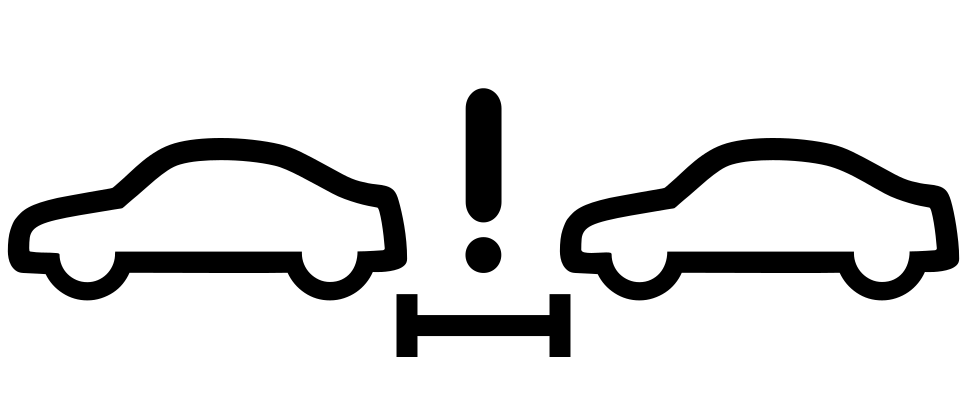 Front Assist detects if there is a safety hazard from following the vehicle ahead too closely.
The indicator light turns on. Increase the distance.
Advance warning
 Front Assist detects a possible collision and prepares the vehicle for possible emergency braking.
A warning tone sounds and the warning light turns on. Apply the brakes or maneuver to avoid the collision.
Immediate warning
If you do not respond to the advance warning, the brakes may be applied briefly to indicate the increasing risk of a collision. Apply the brakes or maneuver to avoid the collision.
Automatic braking
Autonomous Emergency Braking (Front Assist) can brake the vehicle automatically in several stages of increasing braking force. Reducing the vehicle speed may help to reduce the damage resulting from a collision.
Braking support
If the system detects that you are not braking enough before an impending collision, Front Assist can increase the braking force and thus help to reduce the risk of a collision. The braking support is only active as long as you are firmly pressing the brake pedal.
Front Assist limitations
Please read the introductory information and heed the Warnings and Notice ⇒ Introduction.
Front Assist has physical and system limitations. Therefore, always pay attention and be ready to intervene as necessary.
Delayed reaction
If the radar sensor is exposed to environmental conditions that limit its function, the system may have a delayed response to this. Therefore, the display that indicates that functions are restricted may be delayed when you first start driving or while driving ⇒ Introduction.
Unrecognizable objects
Autonomous Emergency Braking (Front Assist) may not react or may react with a delay to the following objects:
-
If vehicles are driving close to your vehicle but outside of the sensor range, for example vehicles that are staggered around your vehicle or motorcycles
-
If vehicles change to your lane close in front of your vehicle
-
If vehicles have objects or accessories projecting out of the vehicle
-
If there are oncoming vehicles or vehicles crossing the street
-
Stationary, oncoming or moving pedestrians in the direction of travel; generally no reaction to people without Pedestrian Monitoring.
-
Stationary cyclists, oncoming cyclists or cyclists crossing the street.
-
Pedestrians and cyclists who are not detected as such, for example because they are fully or partially hidden.
Functional limitations
Front Assist may not react, may react with a delay, or may react in a way that is not desired in the following situations:
-
When driving around tight curves
-
When driving in heavy rain, snow, or spray
-
When driving in parking garages or tunnels.
-
When driving on roads with embedded metal objects, such as railroad tracks
-
When driving in reverse
-
If ESC is regulating.
-
If the radar sensor is dirty or obstructed
-
If multiple brake lights on the vehicle are malfunctioning.
-
If the vehicle is accelerating very quickly or the accelerator pedal is pressed all the way down
-
In complex driving situations, such as around traffic islands
-
In unclear traffic situations, for example if vehicles driving ahead are braking quickly or are turning
-
If Front Assist is malfunctioning
Switching off Front Assist
Depending on the system, Front Assist may not be suitable in the following situations and must be switched off if they occur → :
-
If the vehicle is not being driven on public roads, for example during off-road driving or on a racetrack.
-
If the vehicle is being towed or transported
-
When attachments, for example an auxiliary headlight, obscure the radar sensor.
-
If the radar sensor is malfunctioning
-
Following a violent impact affecting components within the range of the radar sensor, e.g. following a rear-end collision.
-
If there are multiple unwanted activations
WARNING
If you do not switch off Front Assist in the these situations, accidents and serious injuries could occur.
Using Front Assist
Please read the introductory information and heed the Warnings and Notice ⇒ Introduction.
When you switch on the ignition, Front Assist will be automatically switched on.
Volkswagen recommends always leaving Front Assist, distance warning, and advance warning switched on. For exceptions to this, see ⇒ Front Assist limitations.
Switching on and off
You can switch Autonomous Emergency Braking on and off manually and view the switched on condition.
In the instrument cluster display:
-
Press the
 button.
 -
Switch Autonomous Emergency Braking on or off.
 If you switch off Front Assist, the advance warning and distance warning will also be switched off. The yellow indicator light turns on in the instrument cluster display.
Adjusting the distance and advance warning setting
If Front Assist is switched on, you can adjust the distance and advance warning setting as follows:
-
Switch on or off your desired function in the instrument cluster menus ⇒ Operating the analog instrument cluster.
Troubleshooting
Please read the introductory information and heed the Warnings and Notice ⇒ Introduction.
Front Assist is not available, and the radar sensor does not have sufficient visibility
-
The radar sensor is dirty. Clean the radar sensor ⇒ Vehicle care.
-
The visibility of the radar sensor is limited due to weather conditions, such as snow, or from soap residue or coatings. Clean the radar sensor ⇒ Vehicle care.
-
Radar sensor visibility is limited by attachments, decorative frames on license plate holders, or stickers. Clear the area around the radar sensor.
-
The radar sensor is misaligned or damaged, for example as a result of damage to the front of the vehicle. Check if there is noticeable damage ⇒ Repairs and technical modifications.
-
Painting work was carried out on or structural modifications were made to the front of the vehicle.
-
The original Volkswagen emblem is not used.
-
If the problem persists, turn off Autonomous Emergency Braking and contact suitably qualified professionals. Volkswagen recommends contacting your Volkswagen dealership.
Front Assist is not functioning as expected or has been triggered multiple times unnecessarily
-
The radar sensor is dirty. Clean the radar sensor ⇒ Vehicle care.
-
The system limitations are not adhered to ⇒ Front Assist limitations.
-
If the problem persists, turn off Autonomous Emergency Braking and contact suitably qualified professionals. Volkswagen recommends contacting your Volkswagen dealership.
Download Manual