TIRES
Replace or rotate tires in accordance with maintenance schedules and treadwear.CHECKING TIRESCheck if the treadwear indicators are showing on the tires. Also check the tires for uneven wear, such as excessive wear on one side of the tread.Check the spare tire condition and pressure if not rotated.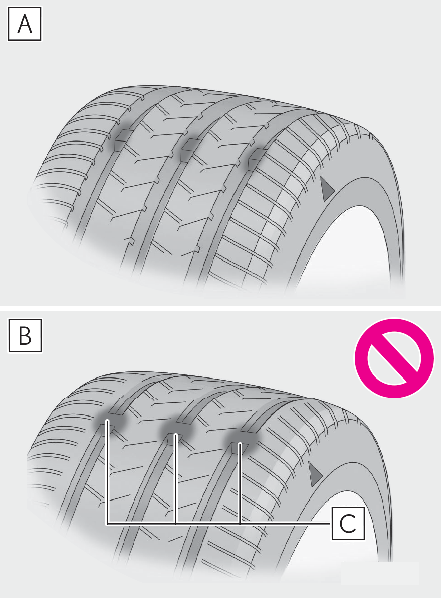
New treadWorn treadTreadwear indicatorThe location of treadwear indicators is shown by a “ TWI” or “ ” mark, etc., molded into the sidewall of each tire.Replace the tires if the treadwear indicators are showing on a tire.Note:When to replace your vehicle’s tiresTires should be replaced if:The treadwear indicators are showing on a tire.You have tire damage such as cuts, splits, cracks deep enough to expose the fabric, and bulges indicating internal damage.A tire goes flat repeatedly or cannot be properly repaired due to the size or location of a cut or other damage.If you are not sure, consult with your Lexus dealer.Tire lifeAny tire over 6 years old must be checked by a qualified technician even if it has seldom or never been used or damage is not obvious.Proper storage of the spare tire (RX350L)As an improperly stored spare tire may cause damage to the wire cable that holds it, check that the spare tire is stored properly on a daily basis.If the stored spare tire appears to be slanted or rattles while driving, the spare tire may not be properly stored. Store the spare tire again by performing the following tire change procedure correctly: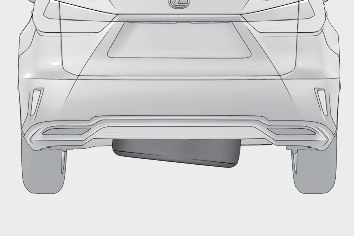
If the spare tire is slanted, the hoist assembly may be stuck in the wheel opening. If the spare tire rattles while driving, it may not be fully raised. Lower the spare tire to the ground and make sure that the hoist assembly is perpendicular to the wheel opening.Raise the tire slowly and steadily until a click is heard and the jack handle skips.If the spare tire cannot be lowered, the wire cable may be severed. Have the vehicle inspected at your Lexus dealer.Maximum load of tireCheck that the maximum load of the replacement tire is greater than 1/2 of the Gross Axle Weight Ratings (GAWR) of either the front axle or the rear axle, whichever is greater.For the GAWR, see the Certification Label.For the maximum load of the tire, see the load limit at maximum cold tire inflation pressure mentioned on the sidewall of the tire. (Tire information)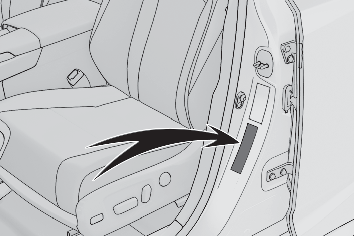
Tire typesSummer tiresSummer tires are high-speed performance tires best suited to highway driving under dry conditions. Since summer tires do not have the same traction performance as snow tires, summer tires are inadequate for driving on snow-covered or icy roads. For driving on snow-covered roads or icy roads, the use of snow tires is recommended. When installing snow tires, be sure to replace all four tires.All season tiresAll season tires are designed to provide better traction in snow and to be adequate for driving in most winter conditions as well as for use year-round. All season tires, however, do not have adequate traction performance compared with snow tires in heavy or loose snow. Also, all season tires fall short in acceleration and handling performance compared with summer tires in highway driving.Snow tiresFor driving on snow-covered roads or icy roads, we recommend using snow tires. If you need snow tires, select tires of the same size, construction and load capacity as the originally installed tires. Since your vehicle has radial tires as original equipment, make sure your snow tires also have radial construction. Do not install studded tires without first checking local regulations for possible restrictions. Snow tires should be installed on all wheels. (Winter driving tips)If the tread on snow tires wears down below 0.16 in. (4 mm)The effectiveness of the tires as snow tires is lost.WARNING:When inspecting or replacing tiresObserve the following precautions to prevent accidents.Failure to do so may cause damage to parts of the drive train as well as dangerous handling characteristics, which may lead to an accident resulting in death or serious injury.Do not mix tires of different makes, models or tread patterns.Also, do not mix tires of remarkably different treadwear.Do not use tire sizes other than those recommended by Lexus.Do not mix differently constructed tires (radial, bias-belted or bias-ply tires).Do not mix summer, all season and snow tires.Do not use tires that have been used on another vehicle.Do not use tires if you do not know how they were used previously.Do not tow if your vehicle has a compact spare tire installed.NOTICE:Driving on rough roadsTake particular care when driving on roads with loose surfaces or potholes.These conditions may cause losses in tire inflation pressure, reducing the cushioning ability of the tires. In addition, driving on rough roads may cause damage to the tires themselves, as well as the vehicle’s wheels and body.If tire inflation pressure of each tire becomes low while drivingDo not continue driving, or your tires and/or wheels may be ruined.TIRE ROTATIONRotate the tires in the order shown.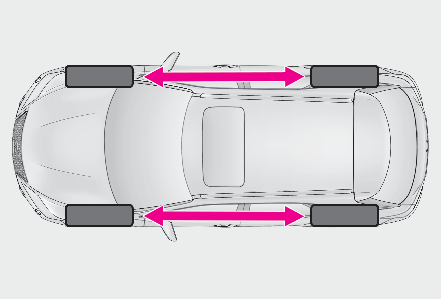
To equalize tire wear and extend tire life, Lexus recommends that tire rotation is carried out at the same interval as tire inspection.Do not fail to initialize the tire pressure warning system after tire rotation.TIRE PRESSURE WARNING SYSTEMYour vehicle is equipped with a tire pressure warning system that uses tire pressure warning valves and transmitters to detect low tire inflation pressure before serious problems arise.The tire pressure detected by the tire pressure warning system can be displayed on the multi-information display. (Multi-information display)The illustration used is intended as an example, and may differ from the image that is actually displayed on the multi-information display.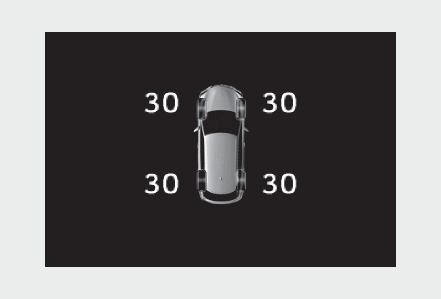
If the tire pressure drops below a predetermined level, the driver is warned by a screen display and a warning light. (Tire pressure warning light)The illustration used is intended as an example, and may differ from the image that is actually displayed on the multi-information display.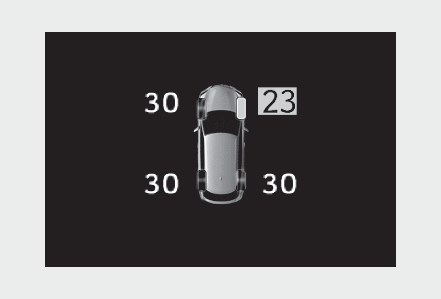
Note:Routine tire inflation pressure checksThe tire pressure warning system does not replace routine tire inflation pressure checks. Make sure to check tire inflation pressure as part of your routine of daily vehicle checks.Situations in which the tire pressure warning system may not operate properlyIn the following cases, the tire pressure warning system may not operate properly.If non-genuine Lexus wheels are used.A tire has been replaced with a tire that is not an OE (Original Equipment) tire.A tire has been replaced with a tire that is not of the specified size.Tire chains, etc. are equipped.If a window tint that affects the radio wave signals is installed.If there is a lot of snow or ice on the vehicle, particularly around the wheels or wheel housings.If the tire inflation pressure is extremely higher than the specified level.If wheel without the tire pressure warning valve and transmitter is used.If the ID code on the tire pressure warning valves and transmitters is not registered in the tire pressure warning computer.Performance may be affected in the following situations.Near a TV tower, electric power plant, gas station, radio station, large display, airport or other facility that generates strong radio waves or electrical noiseWhen carrying a portable radio, cellular phone, cordless phone or other wireless communication deviceIf tire position information is not correctly displayed due to the radio wave conditions, the display may be corrected by driving and changing the radio wave conditions.When the vehicle is parked, the time taken for the warning to start or go off could be extended.When tire inflation pressure declines rapidly for example when a tire has burst, the warning may not function.Warning performance of the tire pressure warning systemThe warning of the tire pressure warning system will change in accordance with the conditions under which it was initialized. For this reason, the system may give a warning even if the tire pressure does not reach a low enough level, or if the pressure is higher than the pressure that was adjusted to when the system was initialized.INSTALLING TIRE PRESSURE WARNING VALVES AND TRANSMITTERSWhen replacing tires or wheels, tire pressure warning valves and transmitters must also be installed.When new tire pressure warning valves and transmitters are installed, new ID codes must be registered in the tire pressure warning computer and the tire pressure warning system must be initialized. Have tire pressure warning valve and transmitter ID codes registered by your Lexus dealer. (Registering ID codes)Note:Replacing tires and wheelsIf the ID code of the tire pressure warning valve and transmitter is not registered, the tire pressure warning system will not work properly. After driving for about 20 minutes, the tire pressure warning light blinks for 1 minute and stays on to indicate a system malfunction.NOTICE:Repairing or replacing tires, wheels, tire pressure warning valves, transmitters and tire valve capsWhen removing or fitting the wheels, tires or the tire pressure warning valves and transmitters, contact your Lexus dealer as the tire pressure warning valves and transmitters may be damaged if not handled correctly.Make sure to install the tire valve caps. If the tire valve caps are not installed, water could enter the tire pressure warning valves and the tire pressure warning valves could be bound.When replacing tire valve caps, do not use tire valve caps other than those specified. The cap may become stuck.To avoid damage to the tire pressure warning valves and transmittersWhen a tire is repaired with liquid sealants, the tire pressure warning valve and transmitter may not operate properly. If a liquid sealant is used, contact your Lexus dealer or other qualified service shop as soon as possible. Make sure to replace the tire pressure warning valve and transmitter when replacing the tire. (Installing tire pressure warning valves and transmitters)INITIALIZING THE TIRE PRESSURE WARNING SYSTEMThe tire pressure warning system must be initialized in the following circumstances:When the tire inflation pressure is changed such as when changing traveling speed.When the tire inflation pressure is changed such as when the tire size is changed.When rotating the tires.When the tire pressure warning system is initialized, the current tire inflation pressure is set as the benchmark pressure.How to initialize the tire pressure warning systemPark the vehicle in a safe place and turn the engine switch off.Initialization cannot be performed while the vehicle is moving.Adjust the tire inflation pressure to the specified cold tire inflation pressure level.Make sure to adjust the tire pressure to the specified cold tire inflation pressure level. The tire pressure warning system will operate based on this pressure level.Turn the engine switch to IGNITION ON mode.Select on the multi-information display.Press or of the meter control switch, select the “ Vehicle Settings” screen and then press the .Press or of the meter control switch, select the “ TPMS” screen and then press and hold the until the tire pressure warning light blinks slowly 3 times.“- -” will be displayed for inflation pressure of each tire on the multi-information display while the tire pressure warning system determines the position of each tire.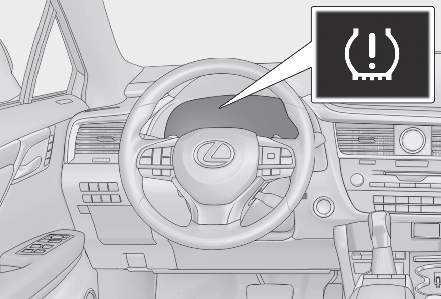
Drive the vehicle at approximately 25 mph (40 km/h) or more for approximately 10 to 30 minutes until the inflation pressure of each tire is displayed on the multi-information display.When position of each tire is determined, the inflation pressure of each tire will be displayed on the multi-information display.If tire inflation pressure becomes low before the inflation pressure is displayed, the tire pressure warning light will come on.Depending on the vehicle and driving conditions, initialization may take up to approximately 1 hour to complete.Note:Initializing the tire pressure warning systemInitialize the system with the tire inflation pressure adjusted to the specified level.If you press the tire pressure warning reset switch accidentallyIf initialization is performed, adjust the tire inflation pressure to the specified level and initialize the tire pressure warning system again.Initialization procedureMake sure to carry out initialization after adjusting the tire inflation pressure.Also, make sure the tires are cold before carrying out initialization or tire inflation pressure adjustment.If you have accidentally turned the engine switch off during initialization, it is not necessary to press the reset switch again as initialization will restart automatically when the engine switch has been turned to IGNITION ON mode for the next time.If you accidentally press the reset switch when initialization is not necessary, adjust the tire inflation pressure to the specified level when the tires are cold, and conduct initialization again.While the position of each tire is being determined and the inflation pressures are not being displayed on the multi-information display, if the inflation pressure of a tire drops, the tire pressure warning light will come on.When initialization of the tire pressure warning system has failedInitialization may take longer to complete if the vehicle is driven on an unpaved road. When performing initialization, drive on a paved road if possible. Depending on the driving environment and condition of the tires, initialization will be completed in approximately 10 to 30 minutes. If initialization is not complete after driving approximately 10 to 30 minutes, continue driving for a while.If the inflation pressure of each tire is not displayed after driving for approximately 1 hour, perform the following procedure.Park the vehicle in a safe place for approximately 20 minutes. Then drive straight (with occasional left and right turns) at approximately 25 mph (40 km/h) or more for approximately 10 to 30 minutes.However, in the following situations, the tire inflation pressure will not be recorded and the system will not operate properly. Perform initialization again.When operating the tire pressure warning reset switch, the tire pressure warning light does not blink 3 times.After performing initialization, the tire pressure warning light blinks for 1 minute then stays on while driving.If the inflation pressure of each tire is still not displayed, have the vehicle inspected by your Lexus dealer.WARNING:When initializing the tire pressure warning systemDo not initializing tire inflation pressure without first adjusting the tire inflation pressure to the specified level. Otherwise, the tire pressure warning light may not come on even if the tire inflation pressure is low, or it may come on when the tire inflation pressure is actually normal.REGISTERING ID CODESThe tire pressure warning valve and transmitter is equipped with a unique ID code. When replacing a tire pressure warning valve and transmitter, it is necessary to register the ID code. Have the ID code registered by your Lexus dealer.
Download Manual