Tire mobility set (Golf R)
 Introduction to the subject
In this chapter you will find information on the following subjects:
Your vehicle is equipped with a tire mobility set instead of a spare tire.
Tire damage caused by foreign objects or punctures up to about 3/16 in (4 mm) in diameter can be reliably sealed using the tire mobility set. Do not remove the foreign object (screw or nail, for example) from the tire!
After the sealant is filled into the tire, drive for about 10 minutes and check tire pressure again.
Never use the tire mobility set to fill a tire unless all of the following requirements have been met:
- The vehicle is parked at a safe spot.
- You are familiar with all the necessary procedures and safety precautions.
- You have the correct tire mobility set.
Otherwise, get expert assistance.
Tire sealant must not be used:
- If the wheel rim is damaged.
- At outside temperatures below -4 °F (-20 °C).
- If the cut or puncture damage of the tire is greater than 3/16 in. (4 mm) in diameter.
- If you were driving with very low tire pressure or a flat tire.
- If the foreign object has been removed from the tire.
- If the tire inflation cylinder has passed its expiration date or if the cylinder is damaged.
 WARNING
Using the tire mobility set on the side of the road can be dangerous. To help reduce the risk of serious personal injury:
- Always stop the vehicle as soon as it is safe to do so and move the vehicle a safe distance off the road where it is safe to use the tire mobility set.
- Always make sure that the ground is level and firm.
- All passengers and especially children must stay a safe distance away from you while you are working and keep out of the area you are working in.
- Turn on the emergency flashers and set up another warning device about 25 yards (25 meters) behind the vehicle to warn approaching traffic.
- Use the tire mobility set only if you are familiar with the necessary steps. Otherwise, contact an authorized Volkswagen dealer or authorized Volkswagen Service Facility for assistance.
- Use the tire mobility set only in emergencies and only until you can get professional help.
- Immediately replace a tire repaired with the tire mobility set according to the manufacturer’s specifications and with a tire matching the currently installed tires.
- Sealant is harmful and must immediately be removed in case of skin contact.
- Always store the tire mobility set out of reach of children.
- Never use a vehicle jack, even if the jack is approved for use with your vehicle.
- Always switch off the engine, engage the parking brake, and shift the transmission to Park (P) to help prevent the vehicle from moving unexpectedly.
WARNING
Improper use of the tire mobility set can cause a temporary tire to fail and lead to loss of vehicle control and serious personal injuries.
- Always remember that a tire filled with sealant does not handle as well as an undamaged tire without sealant.
- Never drive faster than 50 mph (80 km/h) with a sealed tire.
- Never use the tire mobility set if the outside temperature is below -4 °F (-20 °C).
- Never drive with a tire that has cuts or punctures, especially when they are larger than 3/16 in. (4 mm).
- Use the tire mobility set only for emergencies until you can get professional help within a short period of time.
- If the tire cannot be inflated to at least 29 psi (200 kPa), do not drive the vehicle. Contact the nearest authorized Volkswagen dealer, authorized Volkswagen Service Facility, or other qualified workshop for assistance.
- If the tire inflation pressure drops below 26 psi (180 kPa) after driving for 10 minutes, do not drive the vehicle any farther. Contact the nearest authorized Volkswagen dealer, authorized Volkswagen Service Facility, or other qualified workshop for assistance.
- Always replace a tire repaired with the tire mobility set immediately. Do not drive a tire that has been repaired with the tire mobility set longer or farther than is absolutely necessary.
- Avoid full throttle acceleration, hard braking, and fast cornering.
- Drive at slow speed for 10 minutes. Then get out and check the air pressure and condition of the sealed tire.

Obey all legal requirements when disposing of used or expired sealant.

New tire inflation cylinders are available from authorized Volkswagen dealers and authorized Volkswagen Service Facilities.
Read the separate user manual from the manufacturer of the tire mobility set.
Contents of the tire mobility set
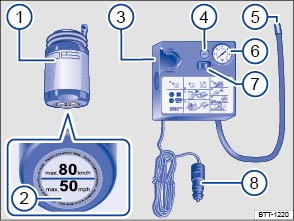
Fig. 198 Basic diagram: Contents of the tire mobility set.
Read and follow the introductory information and safety information first
The tire mobility set may be stored in one of several places in the luggage compartment (for example, in the side storage compartment or under the luggage compartment floor). It contains the following :
 Tire inflation cylinder with filling hose and sealant1)
 Label (on the bottom of the tire inflation cylinder) with speed instruction max. 80 km/h/max. 50 mph
 Air compressor
 Air release valve
 Inflation hose
 Tire pressure gauge
 ON/OFF switch2)
 12 Volt plug
The air compressor from the tire mobility set can be plugged into the 12 Volt socket on the vehicle, even if the maximum power draw listed on the air compressor exceeds the maximum power draw for the vehicle’s 12 Volt socket.
1) May also be integrated in the compressor.
2) May also be located on the side of the compressor.
Preparations
Read and follow the introductory information and safety information first
Checklist
Carry out the following steps in the order listed before starting to inflate a tire :

If you have a flat tire, move the vehicle as far away from traffic as possible. Park the vehicle on a flat, level surface at a safe spot.
-
Move the selector lever into Park (P) Automatic and DSG® transmission.
-
Set the parking brake to help prevent the vehicle from moving Parking brake.
-
Stop the engine and remove the key from the ignition switch Starting and stopping the engine.
-
Have all passengers exit and go to a safe place, such as behind a guard rail.
-
Switch on emergency flashers and use a warning triangle or other device to warn oncoming traffic In an emergency. Observe all legal requirements.
-
Check whether a repair with the tire mobility set is possible Tire sealant must not be used:.
-
If the luggage compartment is loaded: Remove the luggage.
-
Remove the tire mobility set from the luggage compartment.
-
Affix the label ② from the bottom of the tire inflation cylinder to the dashboard in the driver's field of vision, making sure the label does not cover the instrument cluster or other warning lights and signals on the instrument panel.
-
Do not remove the foreign object (screw or nail, for example) from the tire!
WARNING
Disregarding the safety-related checklist may lead to accidents and serious injuries.
- Always review and follow the checklist. Follow accepted safety practices and use common sense.
Sealing and inflating the tire
Read and follow the introductory information and safety information first
Sealing and inflating the tire
- Unscrew the valve cap from the tire valve.
- Vigorously shake the tire inflation cylinder a few times back and forth.
- Tightly screw the inflation hose on the air compressor to the valve on the top of the sealant cylinder.
- Tightly screw the filling hose from the tire inflation cylinder to the tire valve.
- Hold the cylinder with the bottom pointing up and insert the top of the cylinder into the notch in the air compressor .
- Place the air compressor (with cylinder) on a flat surface.
- Insert the 12 Volt plug into one of the vehicle's 12 Volt sockets .
- Switch the air compressor on using the ON/OFF switch .
- Let the air compressor run until a pressure of 29–36 psi (200–250 kPa) is reached . Maximum run time 8 minutes .
- Switch off the air compressor.
- If a tire pressure of 29–36 psi (200–250 kPa) is reached, unscrew the filling hose from the tire valve. Continue driving right away and drive at a speed of no more than 50 mph (80 km/h).
- Pull over to a safe location and check tire pressure again after 10 minutes of driving .
If an air pressure of 29–36 psi (200–250 kPa) cannot be reached
- If an air pressure of 29–36 psi (200–250 kPa) cannot be reached, unscrew the filling hose from the tire valve.
- Drive about 30 feet (10 meters) forward or in reverse so that the sealant can be distributed inside the tire.
- Connect the tire inflation hose of the air compressor directly to the tire valve and repeat the inflation process.
- If a tire pressure of 29–36 psi (200–250 kPa) is reached, unscrew the inflation hose from the tire valve. Continue driving right away and drive at a speed of no more than 50 mph (80 km/h). Check the tire pressure again after 10 minutes of driving .
- If the required tire pressure still cannot be reached, the tire is too badly damaged. The tire cannot be sealed using the tire mobility set. Do not drive the vehicle. Contact an authorized Volkswagen dealer, authorized Volkswagen Service Facility, or other qualified workshop for assistance .
WARNING
The tire inflation hose and air compressor can get hot during inflation.
- Protect hands and skin from hot parts.
- Do not place the hot tire inflation hose or hot air compressor on flammable material.
- Let the equipment cool off almost completely before stowing it.
- If the tire cannot be inflated to at least 29 psi (200 kPa), the damage is too great to be repaired with the tire mobility set. The sealant is not able to seal the tire. Do not drive the vehicle. Contact an authorized Volkswagen dealer, authorized Volkswagen Service Facility, or other qualified workshop for assistance.
 NOTE
NOTE
Do not let the compressor run for more than 8 minutes to help prevent overheating and damage. Let the compressor cool down for a few minutes before switching it on again. Let it cool down almost completely before stowing it in the repair kit.
Check after 10 minutes of driving
Read and follow the introductory information and safety information first
Connect the inflation hose from the air compressor to the tire valve and read the tire pressure on the tire pressure gauge ⑥.
19 psi (130 kPa) and lower:
- Stop! The tire cannot be sealed sufficiently using the tire mobility set.
- Contact an authorized Volkswagen dealer, authorized Volkswagen Service Facility, or other qualified workshop for assistance .
20 psi (140 kPa) and higher:
- Correct the tire pressure again to the proper value .
- Carefully drive on to the nearest authorized Volkswagen dealer, authorized Volkswagen Service Facility, or other qualified workshop at a speed of no more than 50 mph (80 km/h).
- Have the damaged tire replaced.
WARNING
Driving with a tire that cannot be sealed is dangerous and can cause accidents and serious injuries.
- Do not continue driving if the tire pressure is 19 psi (130 kPa) or lower.
- Contact an authorized Volkswagen dealer, authorized Volkswagen Service Facility, or other qualified workshop for assistance.
Download Manual