Braking assistance systems
 Introduction to the subject
In this chapter you will find information on the following subjects:
The braking assistance systems are the Anti-Lock Brake System (ABS), Brake Assist System (BAS), Electronic Differential Lock (EDL), Anti-Slip Regulation (ASR), and Electronic Stability Control (ESC).
 WARNING
Driving with bad brakes can cause a collision and serious personal injury.
- If the brake warning light
or
does not go out, or lights up when driving, either the brake fluid level in the reservoir is too low or there is a fault in the brake system. Stop the vehicle as soon as you can do so safely and get expert assistance .
- If the brake warning light
or
, the ABS may not be working properly. This could cause the rear wheels to lock up relatively quickly during braking. Rear wheel brake lock-up can cause loss of vehicle control.
- If you believe the vehicle is safe to drive, drive slowly and very carefully to the nearest authorized Volkswagen dealer, authorized Volkswagen Service Facility, or other qualified workshop and have the brake system inspected. Avoid sudden hard braking and steering.
- If the ABS indicator light
- If the brake pads are worn or you notice changes in the way the vehicle brakes, immediately contact an authorized Volkswagen dealer or authorized Volkswagen Service Facility to have the brake pads checked and, if necessary, replaced.
- Vehicles with brake wear indicator: If the symbol
or
lights up in the instrument cluster display, whether alone or together with a text message, immediately contact an authorized Volkswagen dealer or authorized Volkswagen Service Facility to have the brake pads checked and, if necessary, replaced.
Braking assistance systems
Read and follow the introductory information and safety information first
The ESC, ABS, BAS, ASR, and EDL braking assistance systems work only when the engine is running. These systems can significantly improve active driving safety.
Electronic Stability Control (ESC)
ESC helps to improve road holding and vehicle dynamics to help reduce the probability of skidding and loss of vehicle control. It works only when the engine is running. ESC detects certain difficult driving situations, including when the vehicle is beginning to spin (yaw) out of control. ESC then helps you to get the vehicle back under control by selectively braking the wheels and/or reducing engine power and by providing steering assistance to help hold the vehicle on the driver's intended course.
ESC has limitations. It is important to remember that ESC cannot overcome the laws of physics. It will not always be able to help out under all conditions you may come up against. For example, ESC may not always be able to help you master situations where there is a sudden change in the coefficient of friction of the road surface. When there is a section of dry road that is suddenly covered with water, slush or snow, ESC cannot perform the same way it would on a dry surface. If the vehicle hydroplanes (rides on a cushion of water instead of the road surface), ESC will not be able to help you steer the vehicle because contact with the pavement has been interrupted and the vehicle cannot be braked or steered. During fast cornering, particularly on winding roads, ESC cannot always deal as effectively with difficult driving situations as it can at lower speeds.
Always adjust your speed and driving style to visibility, road, traffic, and weather conditions. ESC cannot override the vehicle's physical limits, increase the available traction, or keep a vehicle on the road if road departure is a result of driver inattention. Instead, ESC improves the possibility of keeping the vehicle under control and on the road during extreme maneuvers by using the driver's steering inputs to help keep the vehicle going in the intended direction. If you are traveling at a speed that causes you to run off the road before ESC can provide any assistance, you may not experience the benefits of ESC.
ESC includes and/or works together with the ABS, BAS, ASR, EDL, and XDL systems (see below). ESC is switched on all the time.
In certain situations when you need less traction or additional traction cannot be achieved, you can switch off Anti-Slip Regulation (ASR) in the Infotainment system .
Golf GTI and Golf R only: If the vehicle is equipped with a button in the lower center console , ASR can also be switched off by pressing the button. ESC Sport mode can also be switched on via this button or in the Infotainment system.
Golf R only: ESC can be switched off via the button in the lower center console or in the Infotainment system.
Be sure to switch ASR on again when you no longer need less traction.
Anti-Lock Brake System (ABS)
ABS helps to keep the wheels from locking up and helps to maintain the driver's ability to steer and control the vehicle. This means the vehicle is less likely to skid, even during hard braking:
- Push the brake pedal down hard and hold it there. Don't take your foot off the pedal or reduce the force on the pedal!
- Do not pump the brake pedal or let up on it!
- Steer the vehicle while pushing down hard on the brake pedal.
- ABS stops working if you release or let up on the brake.
When ABS is doing its job, you will notice a slight vibration through the brake pedal and hear a noise. ABS cannot shorten the stopping distance under all conditions. The stopping distance may even be longer, for instance, when driving on gravel or on newly fallen snow covering an icy or slippery surface.
Brake Assist (BAS)
The Brake Assist System can help to reduce stopping distances. If you press the brake pedal very quickly, BAS detects an emergency situation. It then very quickly builds up full brake system pressure, maximizing braking power and reducing the stopping distance. This way, ABS can be activated more quickly and efficiently.
Do not reduce pressure on the brake pedal! BAS switches off automatically as soon as you release or let up on the brake.
Anti-Slip Regulation (ASR)
ASR reduces engine power directed to spinning wheels and adjusts power to the road conditions. Even under poor road conditions, ASR can make it easier to get moving, accelerate, and climb hills.
ASR can be switched on and off manually .
Electronic Differential Lock (EDL and XDL)
EDL is applied during regular straight-line acceleration. EDL gently brakes a drive wheel that has lost traction (spinning) and redirects the drive force to other drive wheels. In extreme cases, EDL automatically switches off to keep the brake from overheating. As soon as the brake has cooled down, EDL automatically switches on again.
XDL is an extension of the Electronic Differential Lock system. XDL does not react to drive wheel slippage when driving straight ahead. Instead, XDL detects slippage of the inside front wheel during fast cornering. XDL applies enough brake pressure to this wheel in order to stop the slippage. This improves traction, which helps the vehicle stay on track.
Automatic Post-Collision Braking System
In an accident, the Automatic Post-Collision Braking System can help the driver to reduce the risk of skidding and the danger of secondary collisions through automatic braking.
The Automatic Post-Collision Braking System only works in collisions if the airbag control unit registers the corresponding triggering threshold during the accident, and the accident occurs at a speed greater than 6 mph (10 km/h).
The ESC brakes the vehicle automatically, provided that the hydraulic braking system, the ESC, and the electrical system are undamaged and still work properly.
The following actions override automatic braking in the event of an accident:
- When the driver depresses the accelerator. No automatic braking occurs.
- When the brake pressure transmitted through the depressed brake pedal is greater than the brake pressure provided by the system. The vehicle is braked manually.
WARNING
Driving fast on icy, slippery, or wet roads can lead to a loss of control and result in serious personal injury for you and your passengers.
- Always adjust your speed and driving style to road, traffic, weather, and visibility conditions. Never let the additional safety that ESC, ABS, BAS, ASR, and EDL can provide tempt you into taking extra risks.
- Braking assistance systems cannot overcome the laws of physics and always prevent loss of vehicle control. Slippery and wet roads are still dangerous even with ESC and the other systems!
- Driving too fast on wet roads can cause the wheels to lose contact with the road and hydroplane. A vehicle that has lost road contact cannot be braked, steered, or controlled.
- These systems cannot reduce the risk of accident, for example if you drive too fast for conditions or if you do not keep your distance from the vehicle in front of you.
- Although these systems are very effective and can help you control the vehicle in many difficult situations, always remember that vehicle handling and control is limited by tire traction.
- When accelerating on a slippery surface, for example on ice and snow, depress the accelerator carefully. Even with these systems, the wheels may start to spin, leading to a loss of vehicle control.
WARNING
The effectiveness of ESC can be significantly reduced if other components and systems that affect vehicle dynamics, including but not limited to brakes, tires, and other systems mentioned above, are not properly maintained or are not working properly.
- Always remember that vehicle alterations or modifications can affect how the ABS, BAS, ASR, EDL, and ESC systems work.
- Changing the vehicle suspension or using an unapproved tire/wheel combination can change the way the ABS, BAS, ASR, EDL, and ESC systems work and reduce their effectiveness.
- The effectiveness of ESC is also determined by the tires installed .
WARNING
Driving without braking assistance systems can greatly increase the distance necessary to stop the vehicle, which can lead to a loss of control and result in serious personal injury for you and your passengers.
- Never let the vehicle coast when the engine is switched off.
- When the braking assistance systems are not working or when the vehicle is being towed, the brake must be depressed harder because the braking distance is longer.
Switching Anti-Slip Regulation (ASR) and ESC Sport mode on and off
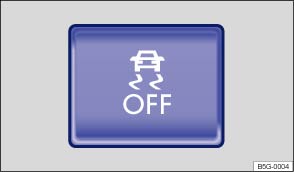
Fig. 130 In the lower center console: Button for switching ASR or ESC Sport mode on and off manually (if equipped).
Read and follow the introductory information and safety information first
The Electronic Stability Control (ESC) only works when the engine is running. This system includes ABS, EDL, and ASR.
Switch off ASR only in situations where there is not enough traction, such as the following:
- When driving in deep snow or on loose surfaces.
- When rocking the vehicle back and forth when you are stuck.
Afterward, activate ASR again.
Switching ASR on and off
- You can switch ASR off and on in the Vehicle settings menu in the Infotainment system .
- OR: If the vehicle is equipped with a
button in the lower center console , ASR can be switched off by pressing the button when the ignition is on. Press the
When ASR is switched off, a driver information message appears in the instrument cluster display and the indicator light in the instrument cluster lights up .
Switching ESC Sport on and off (Golf GTI and Golf R)
Depending on the vehicle model, when switching off the ASR, the ESC can also be switched off or the ESC sport mode (ESC Sport) can be switched on.
The brake intervention functions of ESC are limited when ESC Sport is switched on. It can be switched on and off by pressing the button .
| Button |
Golf GTI | Golf R |
|---|---|---|
| Press for about 1 second | ASR switched off | ASR switched off, ESC Sport switched on |
| Press and hold longer than 3 seconds | ASR switched off, ESC Sport switched on | ASR and ESC switched off |
| Press again | ASR (with ESC) switched on | ASR (with ESC) switched on |
- You can also switch ESC Sport and ESC off and on in the Vehicle settings menu in the Infotainment system .
When ESC Sport mode is switched on or when ESC is switched off, a driver information message appears in the instrument cluster display and the indicator light in the instrument cluster lights up .
Tips and troubleshooting
Read and follow the introductory information and safety information first
When the ignition is switched on, several warning and indicator lights come on briefly for a function check. They go out after a few seconds.
OR 

 Brake system malfunction or brake fluid level too low
The red warning light comes on.
- Stop! Pull off the road as soon as you can safely do so.
- Check the brake fluid level .
- Get professional assistance immediately .
OR Together with OR ABS failure
The red warning light and the yellow indicator light come on.
- See an authorized Volkswagen dealer or an authorized Volkswagen Service Facility.
- The vehicle brakes will work without ABS.
 OR Brake pads worn
Vehicles with brake wear indicator: The red warning light or the yellow indicator light come on.
- If you believe that it is safe to do so, immediately take the vehicle to an authorized Volkswagen dealer or authorized Volkswagen Service Facility. Check, and if necessary replace, all brake pads .
OR together with  ABS malfunction
The yellow indicator light comes on.
- See an authorized Volkswagen dealer or an authorized Volkswagen Service Facility.
- The vehicle brakes will work without ABS.
ESC or ASR is operating, the vehicle battery has been reconnected, or there is an ESC malfunction
The yellow indicator light flashes.
ESC or ASR is operating.
- Take foot off accelerator pedal. Adapt driving to road conditions.
The yellow indicator light comes on.
ESC malfunction, OR vehicle battery has been reconnected, OR ESC switched off by the system.
- Switch the ignition off and on again.
- If necessary, drive a short distance at a speed of 10–12 mph (15–20 km/h).
- If the indicator light stays on, see an authorized Volkswagen dealer or an authorized Volkswagen Service Facility.
ASR manually deactivated, ESC Sport mode manually activated, or ESC switched off by the system
The yellow indicator light comes on.
- Switch ASR on again .
- OR: Switch ignition off and on again.
- You may have to drive a short distance.
- If the indicator light stays on, see an authorized Volkswagen dealer or an authorized Volkswagen Service Facility.
If the braking assistance systems make noises
You may hear noises when these systems are active. This is normal and no cause for concern.
If there is an unexpected reduction in engine power
All 4 wheels must be equipped with identical tires in order for ESC and ASR to work properly. Differences in the tread circumference of the tires can cause the system to reduce the engine power when it is not expected.
WARNING
Failure to heed warning lights and instrument cluster text messages can cause the vehicle to break down in traffic and result in a collision and serious personal injury.
- Never ignore warning lights or text WARNINGS.
- Always stop the vehicle as soon as it is safe to do so.
- Whenever stalled or stopped for repair, move the vehicle a safe distance off the road, stop the engine, turn on the emergency flashers, and use other warning devices to warn approaching traffic.
- Never park the vehicle in areas where the hot catalytic converter and exhaust system could come into contact with dry grass, brush, spilled fuel, oil, or other material that can catch fire.
- A broken-down vehicle presents a high accident risk for itself and others. Switch on emergency flashers and set up a warning triangle to warn oncoming traffic.
WARNING
- If the brake warning light
- If the ABS indicator light
 NOTE
NOTE
Failure to heed warning lights or text WARNINGS can result in vehicle damage.
Download Manual