If your vehicle overheats
The following may indicate that your vehicle is overheating.
- The needle of the engine coolant temperature gauge Enters the red zone or a loss of engine power is experienced. (For example, the vehicle speed does not increase.)
- Steam comes out from under the hood.
Correction procedures
- Stop the vehicle in a safe place and turn off the air conditioning system, and then stop the engine.
- If you see steam: carefully lift the hood after the steam subsides.
If you do not see steam: carefully lift the hood.
- After the engine has cooled down sufficiently, inspect the hoses and radiator core (radiator) for any leaks.
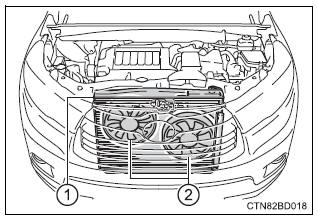
- Radiator
- Cooling fans
If a large amount of coolant leaks, immediately contact your toyota dealer.
- The coolant level is satisfactory if it is between the “full” and “low” lines on the reservoir.
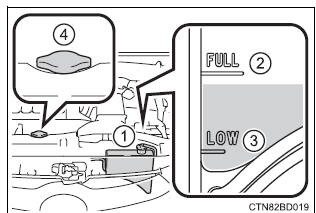
- Reservoir
- “full”
- “low”
- radiator cap
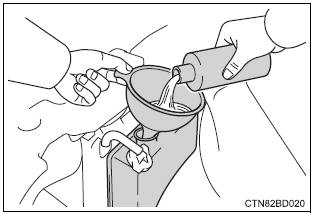
- Add coolant if necessary.
Water can be used in an emergency if coolant is unavailable.
- Start the engine and turn the air conditioning system on to check that the radiator cooling fans operate and to check for coolant leaks from the radiator or hoses.
The fans operate when the air conditioning system is turned on immediately after a cold start. Confirm that the fans are operating by checking the fan sound and air flow. If it is difficult to check these, turn the air conditioning system on and off repeatedly. (The fans may not operate in freezing temperatures.)
- If the fans are not operating: stop the engine immediately and contact your toyota dealer.
If the fans are operating: have the vehicle inspected at the nearest toyota dealer.
 Warning Warning
Observe the following precautions. Failure to do so may result in serious injury such as burns.
|
 Notice Notice
Add coolant slowly after the engine has cooled down sufficiently. Adding cool coolant to a hot engine too quickly can cause damage to the engine. To prevent damage to the cooling system
Observe the following precautions:
|
Download Manual