Before driving
Driving the vehicle
The following procedures should be observed to ensure safe driving:
Starting the engine
Driving
- With the brake pedal depressed, shift the shift lever to d.
- Release the parking brake.
- Gradually release the brake pedal and gently depress the accelerator pedal to accelerate the vehicle.
Stopping
- With the shift lever in d, depress the brake pedal.
- If necessary, set the parking brake.
If the vehicle is to be stopped for an extended period of time, shift the shift lever to p or n.
Parking the vehicle
- With the shift lever in d, depress the brake pedal.
- Shift the shift lever to p.
- Set the parking brake.
- Vehicles without a smart key system: turn the engine switch to the "lock" position to stop the engine.
Vehicles with a smart key system: press the engine switch to stop the engine.
- Lock the door, making sure that you have the key on your person.
If parking on a hill, block the wheels as needed.
Starting off on a steep uphill
- Make sure that the parking brake is set and shift the shift lever to d.
- Gently depress the accelerator pedal.
- Release the parking brake.
When starting off on an uphill
The hill-start assist control will activate.
Driving in the rain
- Drive carefully when it is raining, because visibility will be reduced, the windows may become fogged-up, and the road will be slippery.
- Drive carefully when it starts to rain, because the road surface will be especially slippery.
- Refrain from high speeds when driving on an expressway in the rain, because there may be a layer of water between the tires and the road surface, preventing the steering and brakes from operating properly.
Engine speed while driving
In the following conditions, the engine speed may become high while driving.
This is due to automatic up-shifting control or down-shifting implementation to meet driving conditions. It does not indicate sudden acceleration.
- The vehicle is judged to be driving uphill or downhill
- when the accelerator pedal is released
Breaking in your new toyota
To extend the life of the vehicle, observing the following precautions is recommended:
- for the first 186 miles (300 km): avoid sudden stops.
- For the first 500 miles (800 km): do not tow a trailer.
- For the first 621 miles (1000 km):
- Do not drive at extremely high speeds.
- Avoid sudden acceleration.
- Do not drive continuously in low gears.
- Do not drive at a constant speed for extended periods.
Drum-in-disc type parking brake system
Your vehicle has a drum-in-disc type parking brake system. This type of brake system needs bedding-down of the brake shoes periodically or whenever the parking brake shoes and/or drum are replaced. Have your toyota dealer perform the bedding down operation.
Operating your vehicle in a foreign country
Comply with the relevant vehicle registration laws and confirm the availability of the correct fuel.
 Warning Warning
Failure to do so may result in death or serious injury. When starting the vehicle
Always keep your foot on the brake pedal while stopped with the engine running. This prevents the vehicle from creeping. When driving the vehicle
Observe the following precautions. Failure to do so may result in death or serious injury. When driving the vehicle
When driving on slippery road surfaces
Observe the following precautions. Failure to do so may result in death or serious injury. When shifting the shift lever
Observe the following precautions. Failure to do so may result in death or serious injury. If you hear a squealing or scraping noise (brake pad wear limit indicators)
Have the brake pads checked and replaced by your toyota dealer as soon as possible. Rotor damage may result if the pads are not replaced when needed. It is dangerous to drive the vehicle when the wear limits of the brake pads and/or those of the brake discs are exceeded. When the vehicle is stopped
Observe the following precautions. Failure to do so may result in death or serious injury. When the vehicle is parked
When taking a nap in the vehicle
Always turn the engine off. Otherwise, if you accidentally move the shift lever or depress the accelerator pedal, this could cause an accident or fire due to engine overheating. Additionally, if the vehicle is parked in a poorly ventilated area, exhaust gases may collect and enter the vehicle, leading to death or a serious health hazard. Observe the following precautions. Failure to do so may result in death or serious injury. When braking
If the vehicle becomes stuck (awd models)
Do not spin the wheels excessively when any of the tires is up in the air, or the vehicle is stuck in sand, mud, etc. This may damage the driveline components or propel the vehicle forward or backward, causing an accident. |
 Notice Notice
When parking the vehicle
Always shift the shift lever to p. Failure to do so may cause the vehicle to move or the vehicle may accelerate suddenly if the accelerator pedal is accidentally depressed. Avoiding damage to vehicle parts
If you get a flat tire while driving
A flat or damaged tire may cause the following situations. Hold the steering wheel firmly and gradually depress the brake pedal to slow down the vehicle.
Information on what to do in case of a flat tire When encountering flooded roads
Do not drive on a road that has flooded after heavy rain etc. Doing so may cause the following serious damage to the vehicle:
In the event that you drive on a flooded road and the vehicle is flooded, be sure to have your toyota dealer check the following:
|
Cargo and luggage
Take notice of the following information about storage precautions, cargo capacity and load:
Capacity and distribution
Cargo capacity depends on the total weight of the occupants.
(Cargo capacity) = (total load capacity) — (total weight of occupants) steps for determining correct load limit —
- Locate the statement "the combined weight of occupants and cargo should never exceed xxx kg or xxx lbs.¡¨ on your vehicle's placard.
- Determine the combined weight of the driver and passengers that will be riding in your vehicle.
- Subtract the combined weight of the driver and passengers from xxx kg or xxx lbs.
- The resulting figure equals the available amount of cargo and luggage load capacity.
For example, if the "xxx" amount equals 1400 lbs. And there will be five 150 lb passengers in your vehicle, the amount of available cargo and luggage load capacity is 650 lbs. (1400 ƒ{ 750 (5ƒN„eƒn150) = 650 lbs.)
- Determine the combined weight of luggage and cargo being loaded on the vehicle. That weight may not safely exceed the available cargo and luggage load capacity calculated in step 4.
- If your vehicle will be towing a trailer, load from your trailer will be transferred to your vehicle. Consult this manual to determine how this reduces the available cargo and luggage load capacity of your vehicle.
Calculation formula for your vehicle
- Cargo capacity
- Total load capacity (vehicle capacity weight)
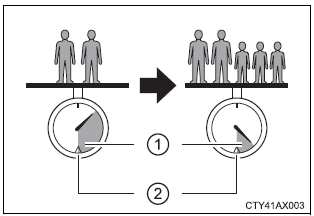
When 2 people with the combined weight of a lb. (Kg) are riding in your vehicle, which has a total load capacity (vehicle capacity weight) of b lb. (Kg), the available amount of cargo and luggage load capacity will be c lb. (Kg) as follows: b*2 lb. (Kg) - a*1 lb. (Kg) = c*3 lb. (Kg)
*1: a =weight of people *2: b =total load capacity *3: c =available cargo and luggage load
In this condition, if 3 more passengers with the combined weight of d lb. (Kg) get on, the available cargo and luggage load will be reduced e lb. (Kg) as follows: c lb. (Kg) - d*4 lb. (Kg) = e*5 lb. (Kg)
*4: d =additional weight of people *5: e =available cargo and luggage load
As shown in the example above, if the number of occupants increases, the cargo and luggage load will be reduced by an amount that equals the increased weight due to the additional occupants. In other words, if an increase in the number of occupants causes an excess of the total load capacity (combined weight of occupants plus cargo and luggage load), you must reduce the cargo and luggage on your vehicle.
 Warning Warning
The following things may cause a fire if loaded in the luggage compartment:
Storage precautions
Observe the following precautions. Failure to do so may prevent the pedals from being depressed properly, may block the driver's vision, or may result in items hitting the driver or passengers, possibly causing an accident.
Capacity and distribution
Roof luggage carrier precautions (vehicles with roof rails)
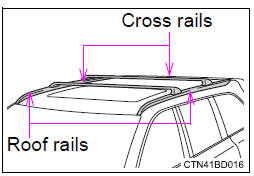
To use the roof rails as a roof luggage carrier, you must fit the roof rails with two or more genuine toyota cross rails or their equivalent. When you load cargo on the roof luggage carrier, observe the following:
When installing cross rails (vehicles with roof rails)
Make sure the cross bars are installed securely by pushing them forward and rearward. Failure to do so may cause an unexpected accident. |
 Notice Notice
Be careful not to scratch the surface of the moon roof or panoramic moon roof. |
Vehicle load limits
Vehicle load limits include total load capacity, seating capacity, twr (trailer weight rating) and cargo capacity.
Total load capacity (vehicle capacity weight):
Total load capacity means the combined weight of occupants, cargo and luggage.
Seating capacity: 7 or 8 occupants (front 2, rear 5 or 6)
Seating capacity means the maximum number of occupants whose estimated average weight is 150 lb. (68 Kg) per person.
Twr (trailer weight rating):
Twr means the maximum gross trailer weight (trailer weight plus its cargo weight) that your vehicle is able to tow.
Cargo capacity
Cargo capacity may increase or decrease depending on the weight and the number of occupants.
Total load capacity and seating capacity
These details are also described on the tire and loading information label.
 Warning Warning
Do not overload the vehicle. It may not only cause damage to the tires, but also degrade steering and braking ability, resulting in an accident. |
Download Manual