Driving procedures
Engine (ignition) switch (vehicles without a smart key system)
Starting the engine
- Check that the parking brake is set.
- Check that the shift lever is set in p.
- Firmly depress the brake pedal.
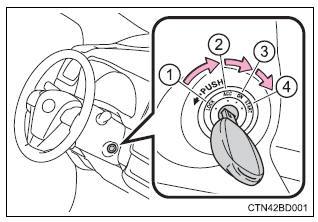
- Turn the engine switch to the “start” position and start the engine.
Changing the engine switch positions
- “Lock”
the steering wheel is locked and the key can be removed. (The key can be removed only when the shift lever is in p.) - “Acc”
some electrical components such as the power outlet can be used. - “On”
all electrical components can be used. - “Start”
for starting the engine.
Turning the key from “acc” to “lock”
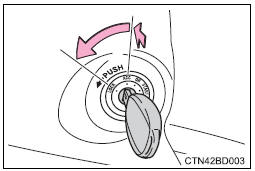
- Shift the shift lever to p.
- Push in the key and turn it to the “lock” position.
If the engine does not start
The engine immobilizer system may not have been deactivated. Contact your toyota dealer.
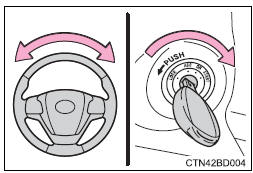
When the steering lock cannot be released
When starting the engine, the engine switch may seem stuck in the “lock” position. To free it, turn the key while turning the steering wheel slightly left and right.
Key reminder function
A buzzer sounds if the driver’s door is opened while the engine switch is in the “lock” or “acc” position to remind you to remove the key.
 Warning Warning
Always start the engine while sitting in the driver's seat. Do not depress the accelerator pedal while starting the engine under any circumstances. Doing so may cause an accident resulting in death or serious injury. Caution when driving
Do not turn the engine switch to the “lock” position while driving. If, in an emergency, you must turn the engine off while the vehicle is moving, turn the engine switch only to the “acc” position to stop the engine. An accident may result if the engine is stopped while driving. |
 Notice Notice
Do not leave the engine switch in the "acc" or "on" position for long periods of time without the engine running. When starting the engine
|
Engine (ignition) switch (vehicles with a smart key system)
Performing the following operations when carrying the electronic key on your person starts the engine or changes engine switch modes.
Starting the engine
- Check that the parking brake is set.
- Check that the shift lever is set in p.
- Firmly depress the brake pedal.
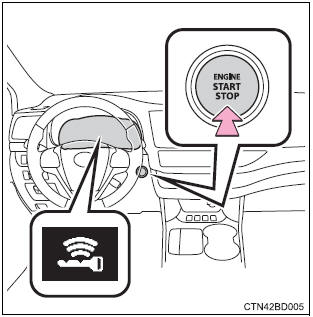
Vehicles with monochrome display:
 Will be displayed
on the multi-information display.
If it is not displayed, the engine cannot be started.
Vehicles with color display:
 And a message will
be displayed on the multi-information display.
If it is not displayed, the engine cannot be started.
- Press the engine switch.
The engine will crank until it starts or for up to 30 seconds, whichever is less.
Continue depressing the brake pedal until the engine is completely started.
The engine can be started from any engine switch mode.
Stopping the engine
- Stop the vehicle.
- Shift the shift lever to p.
- Set the parking brake.
- Press the engine switch.
- Release the brake pedal and check that "accessory" or "ignition on" on the multi-information display is off.
Changing engine switch modes
Modes can be changed by pressing the engine switch with brake pedal released. (The mode changes each time the switch is pressed.)
- Off*
the emergency flashers can be used.The multi-information display will not be displayed.
- Accessory mode
some electrical components such as the power outlet can be used.“Accessory” will be displayed on the multi-information display.
- Ignition on mode
all electrical components can be used.“Ignition on” will be displayed on the multi-information display.
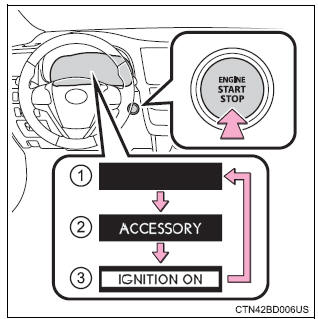
*: If the shift lever is in a position other than p when turning off the engine, the engine switch will be turned to accessory mode, not to off.
When stopping the engine with the shift lever in a position other than p
If the engine is stopped with the shift lever in a position other than p, the engine switch will not be turned off but instead be turned to accessory mode. Perform the following procedure to turn the switch off:
- Check that the parking brake is set.
- Shift the shift lever to p.
- Check that “turn power off” is displayed on the multi-information display and then press the engine switch once.
- Check that “turn power off” on the multi-information display is off.
Message displays
Message illustrations used in this section are intended as examples, and may differ from the image that is actually displayed on the multi-information display.
Auto power off function
If the vehicle is left in accessory mode for more than 20 minutes or ignition on mode (the engine is not running) for more than an hour with the shift lever in p, the engine switch will automatically turn off. However, this function cannot entirely prevent battery discharge. Do not leave the vehicle with the engine switch in accessory or ignition on mode for long periods of time when the engine is not running.
Electronic key battery depletion
C
onditions affecting operation
Note for the entry function
If the engine does not start
- The engine immobilizer system may not have been deactivated. Contact your toyota dealer.
- Check that the shift lever is securely set in p. The engine may not start if the shift lever is displaced out of p.
Steering lock
After turning the engine switch off and opening and closing the doors, the steering wheel will be locked due to the steering lock function. Operating the engine switch again automatically cancels the steering lock.
When the steering lock cannot be released
“Steering lock active” will be displayed on the multi-information display.
Check that the shift lever is set in p. Press the engine switch while turning the steering wheel left and right.
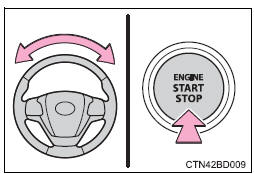
Steering lock motor overheating prevention
To prevent the steering lock motor from overheating, operation of the motor may be suspended if the engine is turned on and off repeatedly in a short period of time. In this case, refrain from operating the engine switch. After about 10 seconds, the steering lock motor will resume functioning.
When "check smart key system" is displayed on the multi-information display
The system may be malfunctioning. Have the vehicle inspected by your toyota dealer immediately.
If the electronic key battery is depleted
Operation of the engine switch
- When operating the engine switch, one short, firm press is enough. If the switch is pressed improperly, the engine may not start or the engine switch mode may not change. It is not necessary to press and hold the switch.
- If attempting to restart the engine immediately after turning the engine switch off, the engine may not start in some cases. After turning the engine switch off, please wait a few seconds before restarting the engine.
If the smart key system has been deactivated in a customized setting
 Warning Warning
Always start the engine while sitting in the driver's seat. Do not depress the accelerator pedal while starting the engine under any circumstances. Doing so may cause an accident resulting in death or serious injury. Caution while driving
If engine failure occurs while the vehicle is moving, do not lock or open the doors until the vehicle reaches a safe and complete stop. Activation of the steering lock in this circumstance may lead to an accident, resulting in death or serious injury. Stopping the engine in an emergency
If you want to stop the engine in an emergency while driving the vehicle, press and hold the engine switch for more than 2 seconds, or press it briefly 3 times or more in succession. However, do not touch the engine switch while driving except in an emergency. Turning the engine off while driving will not cause loss of steering or braking control, but the power assist to these systems will be lost. This will make it more difficult to steer and brake, so you should pull over and stop the vehicle as soon as it is safe to do so. |
 Notice Notice
When starting the engine
Symptoms indicating a malfunction with the engine switch
If the engine switch seems to be operating somewhat differently than usual, such as the switch sticking slightly, there may be a malfunction. Contact your toyota dealer immediately. |
Automatic transmission
Shifting the shift lever
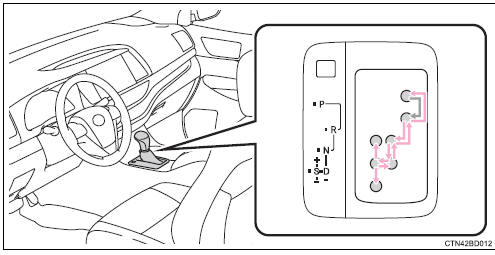
 Vehicles without a
smart key system: while the engine switch is in the “on” position, depress the brake pedal and move the shift lever.
When shifting the shift lever between p and d, make sure that the vehicle is completely stopped.
Vehicles with a smart key system: while the engine switch is in ignition on mode, depress the brake pedal and move the shift lever.
When shifting the shift lever between p and d, make sure that the vehicle is completely stopped.
Shift position purpose
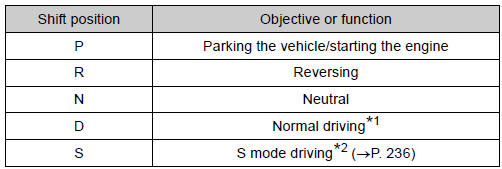
*1: Shifting the shift lever to d allows the system to select a gear suitable for the driving conditions.
Setting the shift lever to d is recommended for normal driving.
*2: Selecting shift ranges using s mode restricts the upper limit of the possible gear ranges, controls engine braking force, and prevents unnecessary upshifting.
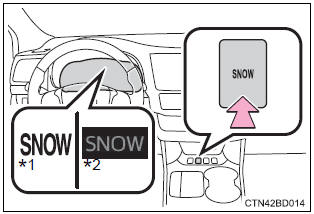
Selecting snow mode
Use snow mode for accelerating and driving on slippery road surfaces, such as on snow.
Press the “snow” button to select snow mode.
The “snow” indicator will come on*1 or will be displayed on the multi-information display*2.
Press the button again to cancel snow mode.
*1: Vehicles with monochrome display *2: vehicles with color display
Selecting shift ranges in the s position
To enter s mode, shift the shift lever to s. Shift ranges can be selected by operating the shift lever, allowing you to drive in the shift range of your choosing. The shift range can be selected by the shift lever.
- Upshifting
- Downshifting
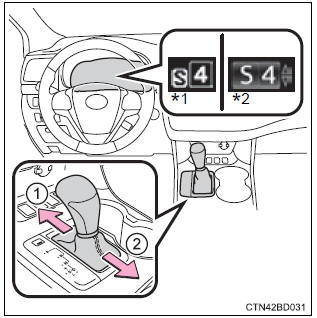
The selected shift range, from 1 to 6, will be displayed on the multIInformation display.
The initial shift range in s mode is set automatically to 5 or 4 according to vehicle speed. However, the initial shift range may be set to 3 if ai-shift has operated while the shift lever was in d.
*1: Vehicles with monochrome display *2: vehicles with color display
Shift ranges and their functions
- Automatically selecting shift ranges between 1 and 6 according to vehicle speed and driving conditions. But the gear is limited according to selected range.
- You can choose from 6 levels of engine braking force.
- A lower shift range will provide greater engine braking force than a higher shift range, and the engine speed will also increase.
Message displays
Message illustrations used in this section are intended as examples, and may differ from the image that is actually displayed on the multi-information display.
S mode
- When the shift range is 5 or lower, holding the shift lever toward "+" sets the shift range to 6.
- To prevent excessive engine speed, a function was adopted that automatically selects a higher shift range before engine speed becomes too high.
- To protect the automatic transmission, a function is adopted that automatically selects a higher shift range when the fluid temperature is high.
Downshifting restrictions warning buzzer
To help ensure safety and driving performance, downshifting operation may sometimes be restricted. In some circumstances, downshifting may not be possible even when the shift lever is operated. (A buzzer will sound twice.)
Snow mode automatic deactivation
Snow mode is automatically deactivated if the engine is turned off after driving in snow mode.
When driving with cruise control or dynamic radar cruise control activated
Even when performing the following actions with the intent of enabling engine braking, engine braking will not activate while driving in s mode and downshifting to 5 or 4 because cruise control or dynamic radar cruise control will not be canceled.
If the shift lever cannot be shifted from p
If the s indicator does not come on or the d indicator is displayed even after shifting the shift lever to s
This may indicate a malfunction in the automatic transmission system. Have the vehicle inspected by your toyota dealer immediately.
(In this situation, the transmission will operate in the same manner as when the shift lever is in d.)
If the automatic transmission fluid temperature warning message is displayed
If the automatic transmission fluid temperature warning message is displayed while driving, make sure to return to d position driving and reduce speed by easing off the accelerator pedal. Stop the vehicle in a safe place, shift the shift lever to p and let the engine idle until the warning message goes out.
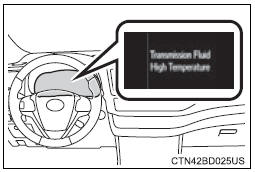
When the warning message goes out, the vehicle can be driven again.
If the warning message does not go out after waiting a while, have your vehicle inspected by your toyota dealer.
Ai-shift
The ai-shift automatically selects the suitable gear according to driver performance and driving conditions.
The ai-shift automatically operates when the shift lever is in d. (Shifting the shift lever to s cancels the function.)
 Warning Warning
Do not accelerate or shift gears suddenly. Sudden changes in engine braking may cause the vehicle to spin or skid, resulting in an accident. |
Turn signal lever
Operating instructions
- Right turn
- Lane change to the right (move the lever partway and release it) the right hand signals will flash 3 times.
- Lane change to the left (move the lever partway and release it) the left hand signals will flash 3 times.
- Left turn
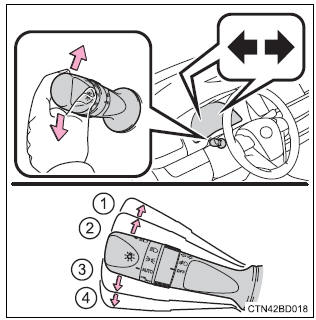
Turn signals can be operated when
- Vehicles without a smart key system the engine switch is in the "on" position.
- vehicles with a smart key system the engine switch is in ignition on mode.
If the indicator flashes faster than usual
Check that a light bulb in the front or rear turn signal lights has not burned out.
Customization
The number of times the turn signals flash during a lane change can be changed. (Customizable feature )
Parking brake
Operating instructions
To set the parking brake, fully depress the parking brake pedal with your left foot while depressing the brake pedal with your right foot.
(Depressing the pedal again releases the parking brake.)
*1: For u.S.A.
*2: For canada
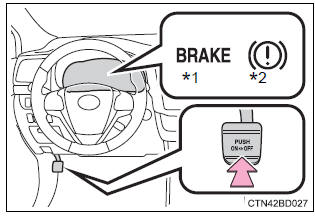
Parking brake engaged warning buzzer
Usage in winter time
 Notice Notice
Fully release the parking brake. Driving the vehicle with the parking brake set will lead to brake components overheating, which may affect braking performance and increase brake wear. |
Download Manual