Bsm (blind spot monitor)
Summary of the blind spot monitor
The blind spot monitor is a system that has 2 functions;
- the blind spot monitor function assists the driver in making the decision when changing lanes
- the rear cross traffic alert function assists the driver when backing up
These functions use same sensors.
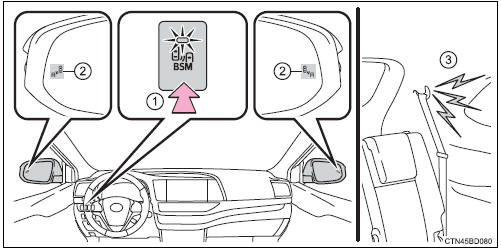
- Bsm main switch
Pressing the switch turns the system on or off. When the switch is set to on, the switch’s indicator illuminates and the buzzer sounds. Common switch for blind spot monitor function and rear cross traffic alert function.
- Outside rear view mirror indicators
Blind spot monitor function: when a vehicle is detected in the blind spot, the outside rear view mirror indicator comes on while the turn signal lever is not operated and the outside rear view mirror indicator flashes while the turn signal lever is operated.
Rear cross traffic alert function: when a vehicle approaching from the right or left rear of the vehicle is detected, the outside rear view mirror indicators flash.
- Rear cross traffic alert buzzer (rear cross traffic alert function only)
When a vehicle approaching from the right or left rear of the vehicle is detected, a buzzer sounds from behind the left-hand third seat.
The outside rear view mirror indicators visibility
When under strong sunlight, the outside rear view mirror indicator may be difficult to see.
Rear cross traffic alert buzzer hearing
Rear cross traffic alert function may be difficult to hear over loud noises such as high audio volume.
When there is a malfunction in the blind spot monitor
If a system malfunction is detected due to any of the following reasons, warning message will be displayed:
- There is a malfunction with the sensors
- the sensors have become dirty
- the outside temperature is extremely high or low
- the sensor voltage has become abnormal
Certification for the blind spot monitor
- For vehicles sold in the u.S.A.
Fcc id: oaysrr2a
This device complies with part 15 of the fcc rules. Operation is subject to the following two conditions:
- this device may not cause harmful interference, and
- this device must accept any interference received, including interference that may cause undesired operation.
Fcc warning
Changes or modifications not expressly approved by the party responsible for compliance could void the user's authority to operate the equipment.
- for vehicles sold in canada
Applicable law: canada 310
This device complies with industry canada licence-exempt rss standard(s).
Operation is subject to the following two conditions: (1) this device may not cause interference, and (2) this device must accept any interference, including interference that may cause undesired operation of the device.
Frequency bands: 24.05-24.25 Ghz output power: less than 20 milliwatts
 Warning Warning
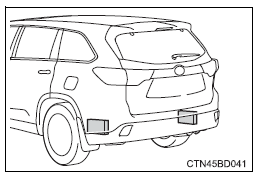
One blind spot monitor sensor is installed inside the left and right side of the vehicle rear bumper respectively. Observe the following to ensure the blind spot monitor can function correctly.
|
The blind spot monitor function
The blind spot monitor function uses radar sensors to detect vehicles that are traveling in an adjacent lane in the area that is not reflected in the outside rear view mirror (the blind spot), and advises the driver of the vehicles existence via the outside rear view mirror indicator.
The blind spot monitor function detection areas
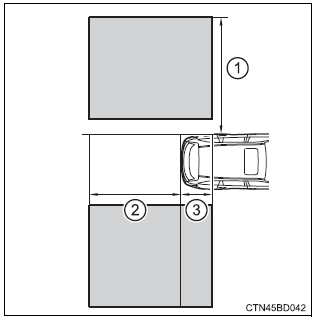
The areas that vehicles can be detected in are outlined below.
The range of the detection area extends to:
- approximately 11.5 Ft. (3.5 M) from the side of the vehicle the first 1.6 Ft. (0.5 M) from the side of the vehicle is not in the detection area
- approximately 9.8 Ft. (3 M) from the rear bumper
- approximately 3.3 Ft. (1 M) forward of the rear bumper
 Warning Warning
The driver is solely responsible for safe driving. Always drive safely, taking care to observe your surroundings. The blind spot monitor function is a supplementary function which alerts the driver that a vehicle is present in the blind spot. Do not overly rely on the blind spot monitor function. The function cannot judge if it is safe to change lanes, therefore over reliance could cause an accident resulting in death or serious injury. According to conditions, the system may not function correctly. Therefore the driver’s own visual confirmation of safety is necessary. |
The blind spot monitor function is operational when
- The bsm main switch is set to on
- vehicle speed is greater than approximately 10 mph (16 km/h).
The blind spot monitor function will detect a vehicle when
- A vehicle in an adjacent lane overtakes your vehicle.
- Another vehicle enters the detection area when it changes lanes.
Conditions under which the blind spot monitor function will not detect a vehicle
The blind spot monitor function is not designed to detect the following types of vehicles and/or objects:
- small motorcycles, bicycles, pedestrians etc.*
- Vehicles traveling in the opposite direction
- guardrails, walls, signs, parked vehicles and similar stationary objects*
- following vehicles that are in the same lane*
- vehicles driving 2 lanes across from your vehicle*
*: depending on conditions, detection of a vehicle and/or object may occur.
Conditions under which the blind spot monitor function may not function correctly
- The blind spot monitor function may not detect vehicles correctly in the following conditions:
- During bad weather such as heavy rain, fog, snow etc.
- When ice or mud etc. Is attached to the rear bumper
- When driving on a road surface that is wet due to rain, standing water etc.
- When there is a significant difference in speed between your vehicle and the vehicle that enters the detection area
- When a vehicle is in the detection area from a stop and remains in the detection area as your vehicle accelerates
- When driving up or down consecutive steep inclines, such as hills, a dip in the road etc.
- When multiple vehicles approach with only a small gap between each vehicle
- When vehicle lanes are wide, and the vehicle in the next lane is too far away from your vehicle
- When the vehicle that enters the detection area is traveling at about the same speed as your vehicle
- When there is a significant difference in height between your vehicle and the vehicle that enters the detection area
- Directly after the bsm main switch is set to on
- When towing a trailer
- Instances of the blind spot monitor function unnecessarily detecting a vehicle and/or object may increase under the following conditions:
- When there is only a short distance between your vehicle and a guardrail, wall etc.
- When there is only a short distance between your vehicle and a following vehicle
- When vehicle lanes are narrow and a vehicle driving 2 lanes across from your vehicle enters the detection area
- When items such as a bicycle carrier are installed on the rear of the vehicle
The rear cross traffic alert function
The rear cross traffic alert functions when your vehicle is in reverse.
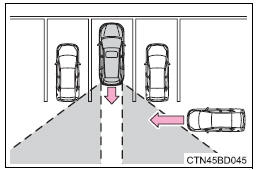
It can detect other vehicles approaching from the right or left rear of the vehicle. It uses radar sensors to alert the driver of the other vehicle’s existence through flashing the outside rear view mirror indicators and sounding a buzzer.
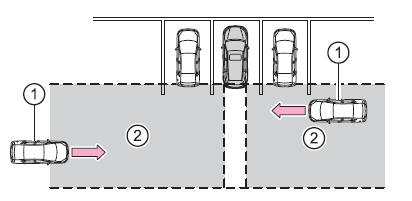
- Pproaching vehicles
- Detection areas
 Warning Warning
The driver is solely responsible for safe driving. Always drive safely, taking care to observe your surroundings. The rear cross traffic alert function is only an assist and is not a replacement for careful driving. Driver must be careful when backing up, even when using rear cross traffic alert function. The driver’s own visual confirmation of behind you and your vehicle is necessary and be sure there are no pedestrians, other vehicles etc. Before backing up. Failure to do so could cause death or serious injury. According to conditions, the system may not function correctly. Therefore the driver’s own visual confirmation of safety is necessary. |
The rear cross traffic alert function detection areas
The areas that vehicles can be detected in are outlined below.
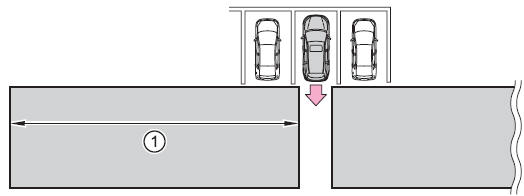
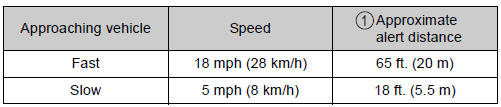
To give the driver a more consistent time to react, the buzzer can alert for faster vehicles from farther away.
Example:
The rear cross traffic alert function is operational when
- The bsm main switch is set to on.
- The shift lever is in r.
- Vehicle speed is less than approximately 5 mph (8 km/h).
- Approaching vehicle speed is between approximately 5 mph (8 km/h) and 18 mph (28 km/h).
Conditions under which the rear cross traffic alert function will not detect a vehicle
The rear cross traffic alert function is not designed to detect the following types of vehicles and/or objects.
- Small motorcycles, bicycles, pedestrians etc.*
- Vehicles approaching from directly behind
- guardrails, walls, signs, parked vehicles and similar stationary objects*
- vehicles moving away from your vehicle
- vehicles approaching from the parking spaces next to your vehicle*
- vehicles backing up in the parking space next to your vehicle*
*: depending on conditions, detection of a vehicle and/or object may occur.
Conditions under which the rear cross traffic alert function may not function correctly
The rear cross traffic alert function may not detect vehicles correctly in the following conditions:
- when ice or mud etc. Is attached to the rear bumper
- during bad weather such as heavy rain, fog, snow etc.
- When multiple vehicles approach continuously
- shallow angle parking
- when a vehicle is approaching at high speed
- when parking on a steep incline, such as hills, a dip in the road etc.
- Directly after the bsm main switch is set to on
- directly after the engine is started with the bsm main switch on
- when towing a trailer
- vehicles that the sensors cannot detect because of obstacles
Download Manual