Driving tips
Winter driving tips
Carry out the necessary preparations and inspections before driving the vehicle in winter. Always drive the vehicle in a manner appropriate to the prevailing weather conditions.
Preparation for winter
- Use fluids that are appropriate to the prevailing outside temperatures.
- Engine oil
- Engine coolant
- Washer fluid
- Have a service technician inspect the condition of the battery.
- Have the vehicle fitted with four snow tires or purchase a set of tire chains for the front tires.
Ensure that all tires are the same size and brand, and that chains match the size of the tires.
Before driving the vehicle
Perform the following according to the driving conditions:
- do not try to forcibly open a window or move a wiper that is frozen.
Pour warm water over the frozen area to melt the ice. Wipe away the water immediately to prevent it from freezing.
- To ensure proper operation of the climate control system fan, remove any snow that has accumulated on the air inlet vents in front of the windshield.
- Check for and remove any excess ice or snow that may have accumulated on the exterior lights, vehicle's roof, chassis, around the tires or on the brakes.
- Remove any snow or mud from the bottom of your shoes before getting in the vehicle.
When driving the vehicle
Accelerate the vehicle slowly, keep a safe distance between you and the vehicle ahead, and drive at a reduced speed suitable to road conditions.
When parking the vehicle
Park the vehicle and move the shift lever to p without setting the parking brake. The parking brake may freeze up, preventing it from being released. If necessary, block the wheels to prevent inadvertent sliding or creeping.
Selecting tire chains
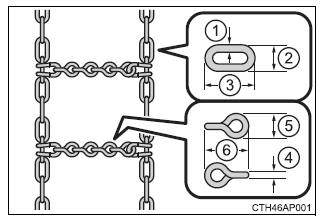
Use the correct tire chain size when mounting the snow chains.
Chain size is regulated for each tire size.
Side chain:
- 0.12 In. (3 Mm) in diameter
- 0.39 In. (10 Mm) in width
- 1.18 In. (30 Mm) in length
Cross chain:
- 0.16 In. (4 Mm) in diameter
- 0.55 In. (14 Mm) in width
- 0.98 In. (25 Mm) in length
Regulations on the use of tire chains
Regulations regarding the use of tire chains vary depending on location and type of road. Always check local regulations before installing chains.
Tire chain installation
Observe the following precautions when installing and removing chains:
- install and remove tire chains in a safe location.
- Install tire chains on the front tires. Do not install tire chains on the rear tires.
- Install tire chains on front tires as tightly as possible. Retighten chains after driving 1/4 „o 1/2 mile (0.5 „O 1.0 Km).
- Install tire chains following the instructions provided with the tire chains.
 Warning Warning
Observe the following precautions to reduce the risk of accidents. Failure to do so may result in a loss of vehicle control and cause death or serious injury.
Driving with tire chains
Observe the following precautions to reduce the risk of accidents. Failure to do so may result in the vehicle being unable to be driven safely, and may cause death or serious injury.
|
 Notice Notice
Request repairs or replacement of snow tires from toyota dealers or legitimate tire retailers. This is because the removal and attachment of snow tires affects the operation of the tire pressure warning valves and transmitters. Fitting tire chains
The tire pressure warning valves and transmitters may not function correctly when tire chains are fitted. |
Utility vehicle precautions
This vehicle belongs to the utility vehicle class, which has higher ground clearance and narrower tread in relation to the height of its center of gravity.
Utility vehicle feature
- Specific design characteristics give it a higher center of gravity than ordinary passenger cars. This vehicle design feature causes this type of vehicle to be more likely to rollover. And, utility vehicles have a significantly higher rollover rate than other types of vehicles.
- An advantage of the higher ground clearance is a better view of the road allowing you to anticipate problems.
- It is not designed for cornering at the same speeds as ordinary passenger cars any more than low-slung sports cars are designed to perform satisfactorily under off-road conditions. Therefore, sharp turns at excessive speeds may cause the vehicle to rollover.
 Warning Warning
Always observe the following precautions to minimize the risk of death, serious injury or damage to your vehicle:
|
Off-road driving
Your vehicle is not designed to be driven off-road. However, in the event that off-road driving cannot be avoided, please observe the following precautions to help avoid the areas prohibited to vehicles.
- Drive your vehicle only in areas where off-road vehicles are permitted to travel.
- Respect private property. Get owner's permission before entering private property.
- Do not enter areas that are closed. Honor gates, barriers and signs that restrict travel.
- Stay on established roads. When conditions are wet, driving techniques should be changed or travel delayed to prevent damage to roads.
- Avoid driving on very steep, slippery roads and other surfaces, such as sand, where the tires are liable to lose traction. Your vehicle may not perform as well as conventional awd on-road vehicles on these surfaces.
Additional information for off-road driving
- For owners in u.S. Mainland, hawaII and puerto rico:
To obtain additional information pertaining to driving your vehicle off-road, consult the following organizations.
- State and local parks and recreation departments
- state motor vehicle bureau
- recreational vehicle clubs
- U.S. Forest service and bureau of land management
 Warning Warning
Always observe the following precautions to minimize the risk of death, serious injury or damage to your vehicle:
To prevent water damage
Take all necessary safety measures to ensure that water damage to the engine or other components does not occur.
When you drive through water
If driving through water, such as when crossing shallow streams, first check the depth of the water and the bottom of the riverbed for firmness. Drive slowly and avoid deep water. Inspection after off-road driving
|
Download Manual