Garage door opener
The garage door opener can be programmed to operate garage doors, gates, entry doors, door locks, home lighting systems, security systems, and other devices.
The garage door opener (homelink„µ universal transceiver) is manufactured under license from homelink„µ.
Programming the homelink
The homelink® compatible transceiver in your vehicle has 3 buttons which can be programmed to operate 3 different devices. Refer to the programming method below appropriate for the device.
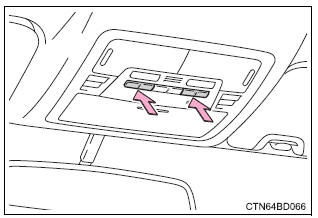
- Buttons
- Homelink® indicator light
- Garage door operation indicators
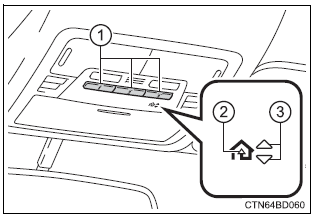
Before programming homelink
- During programming, it is possible that garage doors, gates, or other devices may operate. For this reason, make sure that people and objects are clear of the garage door or other devices to prevent injury or other potential harm.
- It is recommended that a new battery be placed in the remote control transmitter for more accurate programming.
- Garage door openers manufactured after 1995 may be equipped with rolling code protection. If this is the case, you will need a stepladder or other sturdy, safe device to reach the "learn" or "smart" button on the garage door opener motor.
Programming homelink
- Point the remote control transmitter for the device 1 to 3 in. (25 To 75 mm) from the homelink® buttons.
Keep the homelink® indicator light in view while programming.
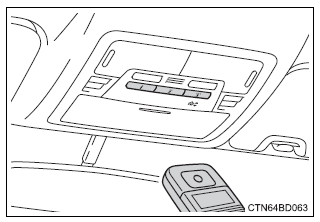
- For u.S.A. Owner’s
- Press and hold the homelink® button you want to program and the handheld transmitter button simultaneously.
When the homelink® indicator light changes from slowly flashing orange to rapidly flashing green (rolling code) or continuously lit green (fixed code), release both buttons.
- Programming an entry gate (for u.S.A. Owners)/programming a device in the canadian market
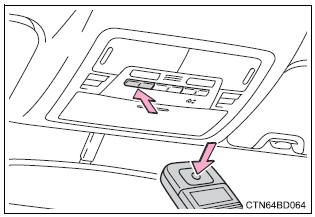
- With one hand, press and hold the homelink® button you want to program. With your other hand, press and release the remote control transmitter every 2 seconds and repeat this cycle until the homelink® indicator light starts to flash rapidly. Then, release the buttons.
- Test the homelinkr operation by pressing the newly programmed button and observing the indicator light:
- if the indicator light is solid/continuous, programming has been completed and your device should activate when the homelinkr button is pressed and released.
- If the indicator light blinks rapidly for 2 seconds and then turns into a solid/continuous light, proceed to the heading "programming a rolling code system".
- Repeat the steps above to program another device for any of the remaining homelinkr buttons.
Programming a rolling code system
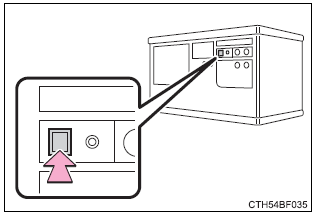
- Locate the “learn” or “smart” button on the garage door opener motor in the garage.
This button can usually be found where the hanging antenna wire is attached to the unit. The name and color of the button may vary by manufacturer.
Please refer to the owner’s manual supplied with the garage door opener motor for details.
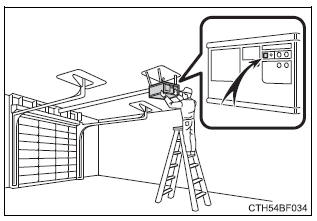
- Press and release the “learn” or “smart” button.
Perform 3 within 30 seconds after performing 2.
- Press and hold the programmed homelink® button (located inside the vehicle) for 2 seconds and release it.
Repeat this sequence (press/ hold/release) up to 3 times to complete programming.
If the garage door opener motor activates when the homelink® button is pressed, the garage door opener motor recognizes the homelink® signal.
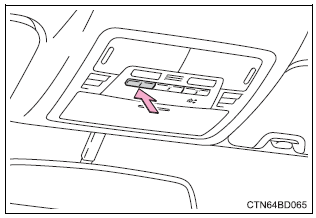
Enabling 2-way communication with a garage door (only available for compatible devices)
When enabled, 2-way communication allows you to check the status of the opening and closing of the garage door through indicators in your vehicle.
2-Way communication is only available if the garage door opener motor used is a compatible device. (To check device compatibility, refer to the owner's manual supplied with the garage door opener motor.)
- Press a programmed homelinkr button to operate a garage door.
- Within 1 minute of pressing the homelinkr button, after the garage door operation has stopped, press the "learn" or "smart" button on the garage door opener motor. Within 5 seconds of the establishment of 2-way communication with the garage door opener, both garage door operation indicators in the vehicle will flash rapidly (green).
Reprogramming a single homelinkr button
When the following procedure is performed, buttons which already have devices registered to them can be overwritten:
- With one hand, press and hold the desired homelink® button.
- When the homelink® indicator starts flashing, continue to hold the homelink® button and perform “programming homelink®” from 1 (it takes 20 seconds for the homelink® indicator to start flashing).
Operating homelink
Press the appropriate homelink® button. The homelink® indicator light should turn on.
Garage door operation indicators
The status of the opening and closing of a garage door is shown by the indicators.
- Opening
- Closing
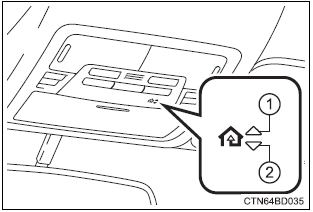
This function is only available if the garage door opener motor used is a compatible device. (To check device compatibility, refer to the owner’s manual supplied with the garage door opener motor.)
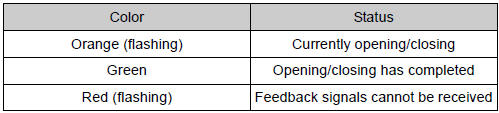
The indicators can operate within approximately 820 ft. (250 M) of the garage door. However, if there are obstacles between the garage door and the vehicle, such as houses and trees, feedback signals from the garage door may not be received.
To recall the previous door operation status, press and release either homelink® buttons “1” and “2” or “2” and “3” simultaneously for 2 seconds.
The last recorded status will be displayed for 5 seconds.
Erasing the entire homelink® memory (all three programs)
Press and hold the 2 outside buttons for 10 seconds until the homelink® indicator light changes from continuously lit (orange) to rapidly flashing (green).
If you sell your vehicle, be sure to erase the programs stored in the homelink® memory.
Programs stored in the homelink® memory
- The registered codes are not erased even if the battery cable is disconnected.
- If learning failed when registering a different code to a homelinkr button that already has a code registered to it, the already registered code is not erased.
Before programming
- Install a new battery in the transmitter.
- The battery side of the transmitter must be pointed away from the homelink.
Certification for the garage door opener
This device complies with fcc rules part 15 and industry canada rss-210.
Operation is subject to the following two conditions: (1) this device may not cause harmful interference, and (2) this device must accept any interference that may be received including interference that may cause undesired operation.
Warning
: the transmitter has been tested and complies with fcc and ic rules.
Changes or modifications not expressly approved by the party responsible for compliance could void the user’s authority to operate the device. The term “ic:” before the certification/registration number only signifies that industry canada technical specifications were met.
Ic: 279b-440ahl5 model/fcc id: cb2440ahl5
Cet appareil est conforme aux normes fcc partie 15 et industry canada rss-210.
Son fonctionnement est soumis aux deux conditions suivantes: (1) cet appareil ne doit pas causer d’interférences nuisibles et (2) cet appareil doit accepter toute interférence qui peuvent être reçues y compris les interférences pouvant provoquer un fonctionnement indésirable.
Avertissement: l’émetteur a été testé et est conforme aux régles de la fcc et ic. Les changements ou modifications non expressément approuvés par la partie responsable de la conformité pourrait annuler l’autorité de l’utilisateur de faire fonctionner le dispositif.
Le terme “ic:” devant le numéro de certification / enregistrement signifie seulement que les spécifications techniques d’industry canada ont été respectées.
Ic: 279b-440ahl5 model/fcc id: cb2440ahl5
For additional programming assistance with your homelink® universal transceiver
Visit on the web
 Warning Warning
The garage door may operate, so ensure people and objects are out of danger to prevent potential harm. Conforming to federal safety standards
Do not use the homelink„µ compatible transceiver with any garage door opener or device that lacks safety stop and reverse features as required by federal safety standards. This includes any garage door that cannot detect an obstruction object. A door or device without these features increases the risk of death or serious injury. When operating or programming homelink
Never allow a child to operate or play with the homelink® buttons. |
Safety connect
Safety connect is a subscription-based telematics service that uses global positioning system (gps) data and embedded cellular technology to provide safety and security features to subscribers.
Safety connect is supported by toyota’s designated response center, which operates 24 hours per day, 7 days per week.
Safety connect service is available by subscription on select, telematics hardware-equipped vehicles.
By using the safety connect service, you are agreeing to be bound by the telematics subscription service agreement and its terms and conditions, as in effect and amended from time to time, a current copy of which is available at toyota.Com. All use of the safety connect service is subject to such then-applicable terms and conditions.
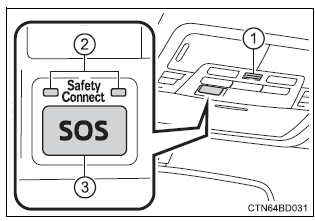
System components
- Microphone
- Led light indicators
- “Sos” button
Services
Subscribers have the following safety connect services available: ¢´ automatic collision notification*
- lps drivers receive necessary response from emergency service providers.
*: U.S. Patent no. 7,508,298 B2
- stolen vehicle location helps drivers in the event of vehicle theft.
- Emergency assistance button (sos) connects drivers to response-center support.
- Enhanced roadside assistance provides drivers various on-road assistance.
Subscription
After you have signed the telematics subscription service agreement and are enrolled, you can begin receiving services.
A variety of subscription terms are available for purchase. Contact your toyota dealer, call 1-800-331-4331, or push the “sos” button in your vehicle for further subscription details.
Safety connect services information
- Phone calls using the vehicle's bluetoothr technology will not be possible during safety connect.
- Safety connect is available beginning fall 2009 on select toyota models.
Contact with the safety connect response center is dependent upon the telematics device being in operative condition, cellular connection availability, and gps satellite signal reception, which can limit the ability to reach the response center or receive emergency service support. Enrollment and telematics subscription service agreement are required. A variety of subscription terms are available; charges vary by subscription term selected.
- Automatic collision notification, emergency assistance, stolen vehicle location, and enhanced roadside assistance will function in the united states, including hawaii and alaska, and in canada. No safety connect services will function outside of the united states in countries other than canada.
- Safety connect services are not subject to section 255 of the telecommunications act and the device is not tty compatible.
Languages
The safety connect response center will offer support in multiple languages.
The safety connect system will offer voice prompts in english and spanish.
Please indicate your language of choice when enrolling.
When contacting the response center
You may be unable to contact the response center if the network is busy.
Safety connect led light indicators
When the engine switch is turned to ignition on mode, the red indicator light comes on for 2 seconds then turns off. Afterward, the green indicator light comes on, indicating that the service is active.
The following indicator light patterns indicate specific system usage conditions:
- green indicator light on = active service
- green indicator light flashing = safety connect call in process
- red indicator light (except at vehicle start-up) = system malfunction (contact your toyota dealer)
- no indicator light (off) = safety connect service not active
Safety connect services
Automatic collision notification
In case of either airbag deployment or severe rear-end collision, the system is designed to automatically call the response center. The responding agent receives the vehicle’s location and attempts to speak with the vehicle occupants to assess the level of emergency.
If the occupants are unable to communicate, the agent automatically treats the call as an emergency, contacts the nearest emergency services provider to describe the situation, and requests that assistance be sent to the location.
Stolen vehicle location
If your vehicle is stolen, safety connect can work with local authorities to assist them in locating and recovering the vehicle. After filing a police report, call the safety connect response center at 1-800- 331-4331 and follow the prompts for safety connect to initiate this service.
In addition to assisting law enforcement with recovery of a stolen vehicle, safety-connect-equipped vehicle location data may, under certain circumstances, be shared with third parties to locate your vehicle. Further information is available at toyota.Com.
Emergency assistance button ("sos")
In the event of an emergency on the road, push the "sos" button to reach the safety connect response center. The answering agent will determine your vehicle's location, assess the emergency, and dispatch the necessary assistance required.
If you accidentally press the "sos" button, tell the response-center agent that you are not experiencing an emergency.
Enhanced roadside assistance
Enhanced roadside assistance adds gps data to the already included warranty-based toyota roadside service.
Subscribers can press the “sos” button to reach a safety connect response-center agent, who can help with a wide range of needs, such as: towing, flat tire, fuel delivery, etc. For a description of the enhanced roadside assistance services and their limitations, please see the safety connect terms and conditions, which are available at toyota.Com.
Safety information for safety connect
Important! Read this information before using safety connect.
Exposure to radio frequency signals
The safety connect system installed in your vehicle is a low-power radio transmitter and receiver. It receives and also sends out radio frequency (rf) signals.
In august 1996, the federal communications commission (fcc) adopted rf exposure guidelines with safety levels for mobile wireless phones. Those guidelines are consistent with the safety standards previously set by the following u.S. And international standards bodies.
- Ansi (american national standards institute) c95.1 [1992]
- Ncrp (national council on radiation protection and measurement) report 86 [1986]
- Icnirp (international commission on non-ionizing radiation protection) [1996]
Those standards were based on comprehensive and periodic evaluations of the relevant scientific literature. Over 120 scientists, engineers, and physicians from universities, and government health agencies and industries reviewed the available body of research to develop the ansi standard (c95.1).
The design of safety connect complies with the fcc guidelines in addition to those standards.
Certification for safety connect
Fcc id: o6y-cdmrf101
Fcc id: xoecdmrf101b
Fcc id: n7ngtm2
Note
: this device complies with part 15 of the fcc rules. Operation is subject to the following two conditions: (1) this device may not cause harmful interference, and (2) this device must accept any interference received, including interference that may cause undesired operation. Fcc warning: changes or modifications not expressly approved by the party responsible for compliance could void the user's authority to operate the equipment.
Compass
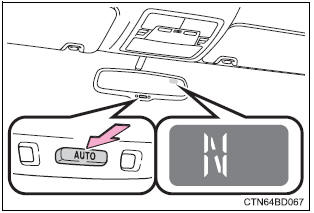
The compass on the inside rear view mirror indicates the direction in which the vehicle is heading.
Operation
To turn the compass on or off, press and hold “auto” for 3 seconds.
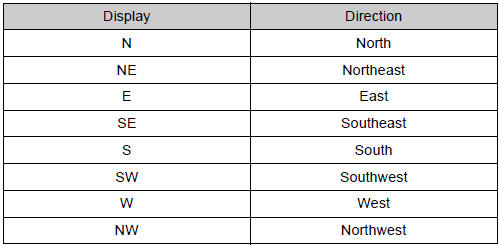
Displays and directions
Calibrating the compass
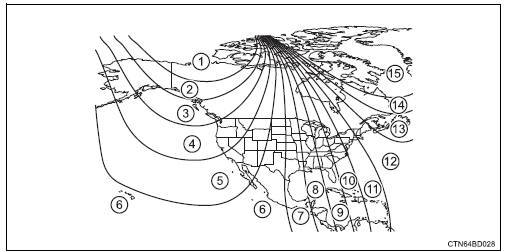
The direction display deviates from the true direction determined by the earth's magnetic field. The amount of deviation varies according to the geographic position of the vehicle.
If you cross over a map boundary shown in illustration, the compass will deviate.
To obtain higher precision or perfect calibration, refer to the following.
Deviation calibration
- Stop the vehicle.
- Press and hold “auto” for 6 seconds.
A number (1 to 15) appears on the compass display.
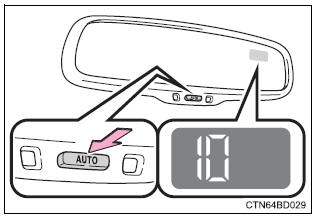
- Press the switch and referring to the map above, select the number of the zone where you are.
If the direction is displayed several seconds after adjustment, the calibration is complete.
Circling calibration
- Stop the vehicle in a place where it is safe to drive in a circle.
- Press and hold “auto” for 9 seconds.
“C” appears on the compass display.
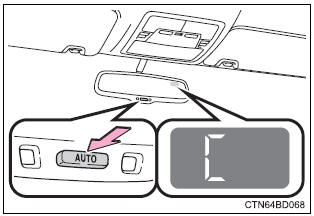
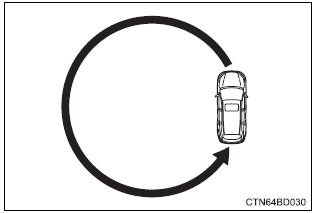
- Drive the vehicle at 5 mph (8 km/h) or less in a circle until a direction is displayed.
If there is not enough space to drive in a circle, drive around the block until the direction is displayed.
Conditions unfavorable to correct operation
The compass may not show the correct direction in the following conditions:
- the vehicle is stopped immediately after turning.
- The vehicle is on an inclined surface.
- The vehicle is in a place where the earth's magnetic field is subject to interference by artificial magnetic fields (underground car park/parking lot, under a steel tower, between buildings, roof car park/parking lot, near an intersection, near a large vehicle, etc.).
- The vehicle has become magnetized.
(There is a magnet or metal object near the inside rear view mirror.)
- The battery has been disconnected.
- A door is open.
 Warning Warning
Do not adjust the display. Adjust the display only when the vehicle is stopped. When doing the circling calibration
Secure a wide space, and watch out for people and vehicles in the neighborhood. Do not violate any local traffic rules while performing circling calibration. |
 Notice Notice
Do not place magnets or any metal objects near the inside rear view mirror. Doing this may cause the compass sensor to malfunction. To ensure normal operation of the compass
|
Download Manual