Dynamic radar cruise control
Summary of functions
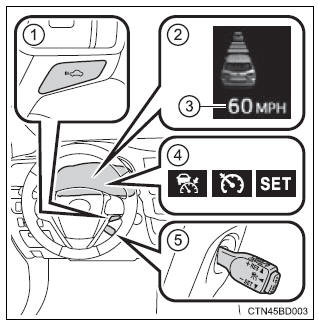
Dynamic radar cruise control supplements conventional cruise control with a vehicle-to-vehicle distance control. In vehicle-to-vehicle distance control mode, the vehicle automatically accelerates or decelerates in order to maintain a set following distance from vehicles ahead.
- Vehicle-to-vehicle distance button
- display
- set speed
- indicators
- cruise control switch
Setting the vehicle speed (vehicle-to-vehicle distance control mode)
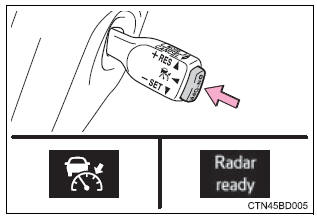
- Press the “on-off” button to activate the cruise control.
Radar cruise control indicator will be displayed.
Press the button again to deactivate the cruise control.
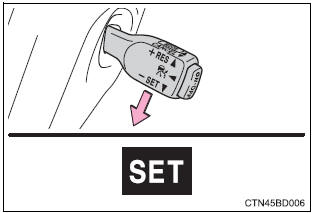
- Accelerate or decelerate the vehicle to the desired speed, and push the lever down to set the speed.
“Set” indicator will be displayed.
The vehicle speed at the moment the lever is released becomes the set speed.
Adjusting the set speed
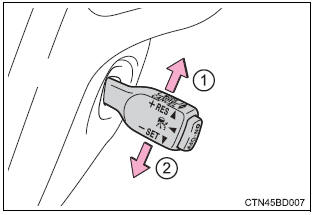
To change the set speed, operate the lever until the desired set speed is displayed.
- Increases the speed
- Decreases the speed
Fine adjustment: momentarily move the lever in the desired direction.
Large adjustment: hold the lever in the desired direction.
In the vehicle-to-vehicle distance control mode, the set speed will be increased or decreased as follows:
- when the set speed is shown in "mph" fine adjustment: by approximately 1 mph (1.6 Km/h) each time the lever is operated large adjustment: by approximately 5 mph (8 km/h) for each 0.75 Seconds the lever is held
- when the set speed is shown in "km/h" fine adjustment: by approximately 0.6 Mph (1 km/h) each time the lever is operated large adjustment: by approximately 3.1 Mph (5 km/h) for each 0.75 Seconds the lever is held
In the constant speed control mode , The set speed will be increased or decreased as follows:
Fine adjustment: by approximately 1 mph (1.6 Km/h) each time the lever is operated large adjustment: the set speed can be increased or decreased continually until the lever is released.
Changing the vehicle-to-vehicle distance
Pressing the button changes the vehicle-to-vehicle distance as follows:
- long
- medium
- short
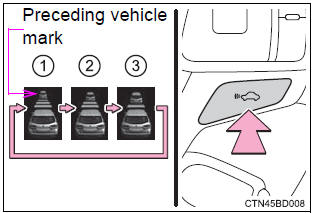
The vehicle-to-vehicle distance is set automatically to long mode when the engine switch is turned to ignition on mode.
If a vehicle is running ahead of you, the preceding vehicle mark will also be displayed.
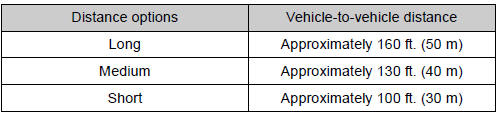
Vehicle-to-vehicle distance settings
Select a distance from the table below. Note that the distances shown correspond to a vehicle speed of 50 mph (80 km/h). Vehicle-to-vehicle distance increases/decreases in accordance with vehicle speed.
Canceling and resuming the speed control
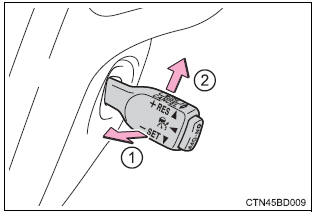
- Pulling the lever toward you cancels the cruise control.
The speed setting is also canceled when the brakes are applied.
- Pushing the lever up resumes the cruise control and returns vehicle speed to the set speed.
Resuming is available when the vehicle speed is more than approximately 25 mph (40 km/h).
Driving in vehicle-to-vehicle distance control mode
This mode employs a radar sensor to detect the presence of vehicles up to approximately 400 ft. (120 M) ahead, determines the current vehicle-to-vehicle following distance, and operates to maintain a suitable following distance from the vehicle ahead.
Note that vehicle-to-vehicle distance will close in when traveling on long downhill slopes.
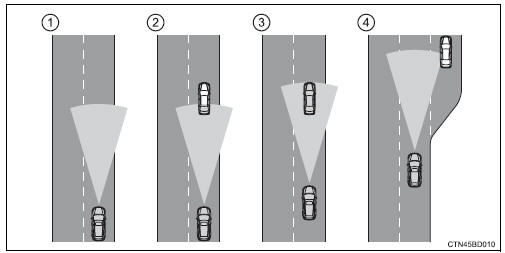
- Example of constant speed cruising when there are no vehicles ahead
The vehicle travels at the speed set by the driver. The desired vehicle-tovehicle distance can also be set by operating the vehicle-to-vehicle distance control.
- Example of deceleration cruising when the vehicle ahead is driving slower than the set speed
When a vehicle is detected running ahead of you, the system automatically decelerates your vehicle. When a greater reduction in vehicle speed is necessary, the system applies the brakes. A warning tone warns you when the system cannot decelerate sufficiently to prevent your vehicle from closing in on the vehicle ahead.
- Example of follow-up cruising when following a vehicle driving slower than the set speed
The system continues follow-up cruising while adjusting for changes in the speed of the vehicle ahead in order to maintain the vehicle-to-vehicle distance set by the driver.
- Example of acceleration when there are no longer any vehicles ahead driving slower than the set speed
The system accelerates until the set speed is reached. The system then returns to constant speed cruising.
Approach warning
When your vehicle is too close to a vehicle ahead, and sufficient automatic deceleration via the cruise control is not possible, the display will flash and the buzzer will sound to alert the driver. An example of this would be if another driver cuts in front of you while you are following a vehicle. Apply the brakes to ensure an appropriate vehicle-tovehicle distance.
Warnings may not occur when
In the following instances, there is a possibility that the warnings will not occur:
- when the speed of the vehicle ahead matches or exceeds your vehicle speed
- when the vehicle ahead is traveling at an extremely slow speed
- immediately after the cruise control speed was set
- at the instant the accelerator is applied
Selecting conventional constant speed control mode
Constant speed control mode differs from vehicle-to-vehicle distance control mode. When constant speed control mode is selected, your vehicle will maintain a set speed regardless of whether or not there are other vehicles in the lane ahead.
- Press the “on-off” button to activate the cruise control.
Press the button again to deactivate the cruise control.
- Switch to constant speed control mode.
(Push the lever forward and hold for approximately one second.)
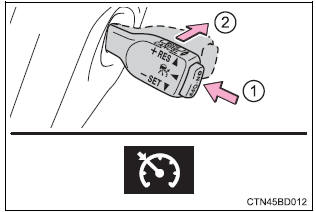
Constant speed control mode indicator will be displayed.
When in constant speed control mode, to return to vehicle-to-vehicle distance control mode, push the lever forward again and hold for approximately 1 second.
After the desired speed has been set, it is not possible to return to vehicleto- vehicle distance control mode.
If the engine switch is turned off and then turned to ignition on mode again, the vehicle will automatically return to vehicle-to-vehicle distance control mode.
Adjusting the speed setting: Canceling and resuming the speed setting:
Dynamic radar cruise control can be set when
- The shift lever is in the d or range 4 or higher of s has been selected.
- Vehicle speed is above approximately 30 mph (50 km/h).
Accelerating after setting the vehicle speed
The vehicle can accelerate normally. After acceleration, the set speed resumes. However, during vehicle-to-vehicle distance control mode, the vehicle speed may decrease below the set speed in order to maintain the distance to the vehicle ahead.
Automatic cancelation of vehicle-to-vehicle distance control
Vehicle-to-vehicle distance control driving is automatically canceled in the following situations:
- actual vehicle speed falls below approximately 25 mph (40 km/h).
- Enhanced vsc is activated.
- Vsc is activated.
- The sensor cannot operate correctly because it is covered in some way.
- The windshield wipers are operating at high speed (when the wiper switch is set to the high speed wiper operation position).
If vehicle-to-vehicle distance control driving is automatically canceled for any other reason, there may be a malfunction in the system. Contact your toyota dealer.
Automatic cancelation of constant speed control
The cruise control will stop maintaining the vehicle speed in the following situations:
- actual vehicle speed is more than approximately 10 mph (16 km/h) below the set vehicle speed.
At this time, the memorized set speed is not retained.
- Vehicle speed falls below approximately 25 mph (40 km/h).
- Enhanced vsc is activated.
- Vsc is activated.
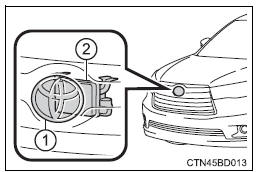
Radar sensor and grille cover
Always keep the sensor and grille cover clean to ensure that the vehicle-tovehicle distance control operates properly. (Some obstructions, such as snow, ice and plastic objects, cannot be detected by the obstruction sensor.) Dynamic radar cruise control is canceled if an obstruction is detected.
- Grille cover
- Radar sensor
Operation guide display
When the dynamic radar cruise control switch is operated, a guidance display is shown on the multi-information display for a few seconds as to how to operate the dynamic radar cruise control switch or distance switch.
Warning messages and buzzers for dynamic radar cruise control
Warning messages and buzzers are used to indicate a system malfunction or to inform the driver of the need for caution while driving.
Certification for dynamic radar cruise control
- For vehicles sold in the u.S.A.
Fcc id: hyqdnmwr007
This device complies with part 15 of the fcc rules. Operation is subject to the following two conditions : (1) this device may not cause harmful interference, and (2) this device must accept any interference received, including interference that may cause undesired operation.
Fcc warning
Changes or modifications not expressly approved by the party responsible for compliance could void the user's authority to operate the equipment.
Radiofrequency radiation exposure information: this equipment complies with fcc radiation exposure limits set forth for an uncontrolled environment.
This equipment should be installed and operated with minimum distance of 20 cm between the radiator (antenna) and your body.
This transmitter must not be co-located or operating in conjunction with any other antenna or transmitter.
- for vehicles sold in canada
Operation is subject to the following two conditions: (1) this device may not cause interference, and (2) this device must accept any interference, including interference that may cause undesired operation of the device.
 Warning Warning
Do not overly rely on vehicle-to-vehicle distance control. Be aware of the set speed. If automatic deceleration/acceleration is not appropriate, adjust the vehicle speed, as well as the distance between your vehicle and vehicles ahead by applying the brakes etc. Cautions regarding the driving assist systems
Observe the following precautions. Failure to do so may cause an accident resulting in death or serious injury.
To avoid inadvertent cruise control activation
Switch the cruise control off using the “on-off” button when not in use. Situations unsuitable for dynamic radar cruise control
Do not use dynamic radar cruise control in any of the following situations. Doing so may result in inappropriate speed control and could cause an accident resulting in death or serious injury.
When the sensor may not be correctly detecting the vehicle ahead
Apply the brakes as necessary when any of the following types of vehicles are in front of you. As the sensor may not be able to correctly detect these types of vehicles, the approach warning Will not be activated, and a fatal or serious accident may result.
Conditions under which the vehicle-to-vehicle distance control may not function correctly
Apply the brakes as necessary in the following conditions as the radar sensor may not be able to correctly detect vehicles ahead, and a fatal or serious accident may result:
H andling the radar sensor
Observe the following to ensure the cruise control system can function effectively. Otherwise, the system may not function correctly and could result in an accident.
|
Download Manual