Connecting a trailer
CONNECTING A TRAILER PRECAUTIONS
Do not tow a trailer until you drive your vehicle at least 1,000 mi (1,600 km).
Consult your local motor vehicle laws for towing a trailer.
See the instructions included with towing accessories for the proper installation and adjustment specifications.
Service your vehicle more frequently if you tow a trailer. See Normal Scheduled Maintenance.
If you use a rental trailer, follow the instructions the rental agency gives you.
When attaching the trailer wiring connector to your vehicle, only use a proper fitting connector that works with the vehicle and trailer functions.
Account for the trailer coupler weight as part of your vehicle load when calculating the total vehicle weight.
Do not exceed the load limits. See Normal Scheduled Maintenance.
INSTALLING A HITCH
 WARNING: Do not cut, drill, weld or modify the trailer hitch. Modifying the trailer hitch could reduce the hitch rating. WARNING: Do not cut, drill, weld or modify the trailer hitch. Modifying the trailer hitch could reduce the hitch rating. |
Do not use a hitch that either clamps onto the bumper or attaches to the axle. You must distribute the load in your trailer so that 10-15% of the total weight of the trailer is on the tongue. Do not exceed the tongue load rating indicated on the hitch receiver.
TRAILER HITCH COVER
Your vehicle has a removable trailer hitch cover. To remove the trailer hitch cover:
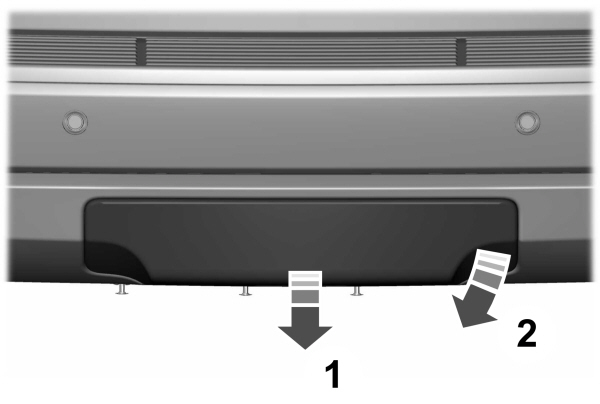
- Grab the trailer hitch cover at the bottom and pull towards the rear of the vehicle until the bottom of the trailer hitch cover unsnaps from the bumper.
- Grab the trailer hitch cover at the edge and rotate until the top of the trailer hitch cover unsnaps from the bumper, then remove the trailer hitch cover.
To install the trailer hitch cover:
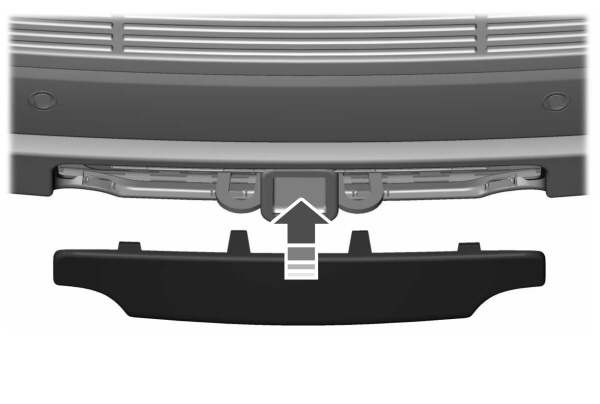
- Line up the snaps on the trailer hitch cover to the holes on the bumper and push forward until it snaps into place.
HOOKING UP A TRAILER USING A WEIGHT-DISTRIBUTING HITCH
| WARNING: Do not adjust the spring bars so that your vehicle's rear bumper is higher than before attaching the trailer. Doing so will defeat the function of the weight-distributing hitch, which may cause unpredictable handling, and could result in serious personal injury. |
A weight-distributing hitch helps distribute tongue load to all towing vehicle and trailer wheels. For more information, visit the links in the following table.
| Market | Website |
|---|---|
| United States of America | https://www.fleet.ford.com/towing-guides/ |
| Canada | https://www.fleet.ford.ca/towing-guides/ |
CONNECTING A TRAILER
RECOGNIZING A TRAILER
- Attach the trailer and wiring connector to your vehicle.
- Switch on your vehicle.
- Set up a profile for the trailer using the touchscreen.
Note: If your vehicle does not recognize the trailer, press and hold the brake pedal for a few seconds.
Note: Trailer profiles store trailer types, dimensions, preferences, trailer specific mileage and fuel economy.
Note: Disabling the trailer detection notification makes the default trailer profile active when a connection is detected.
Note: Trailer profiles allows you to setup several trailer maintenance reminders and maintenance intervals for multiple trailer components by specifying miles and months in service.
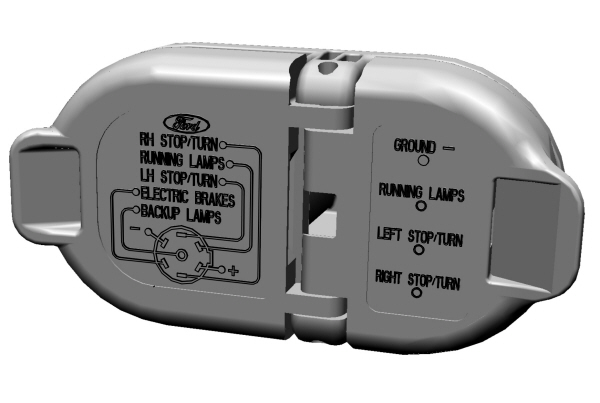
When attaching the trailer wiring connector to your vehicle, only use a proper fitting connector that works with the vehicle and trailer functions.
TRAILER LIGHT CHECK
| WARNING: Never connect any trailer lamp wiring to the vehicle's tail lamp wiring; this may damage the electrical system resulting in fire. Contact your authorized dealer as soon as possible for assistance in proper trailer tow wiring installation. Additional electrical equipment may be required. |
Most towed vehicles require trailer lamps. Make sure all running lights, brake lights, turn signals and hazard lights are working.
SAFETY CHAINS
Install trailer safety chains to the trailer hitch as recommended by the manufacturer. Cross the chains under the trailer coupler and allow enough slack for turning tight corners. Do not allow the chains to drag on the ground.
Note: Do not attach safety chains to the bumper. Always connect the safety chains to the frame or hook retainers of your trailer hitch.
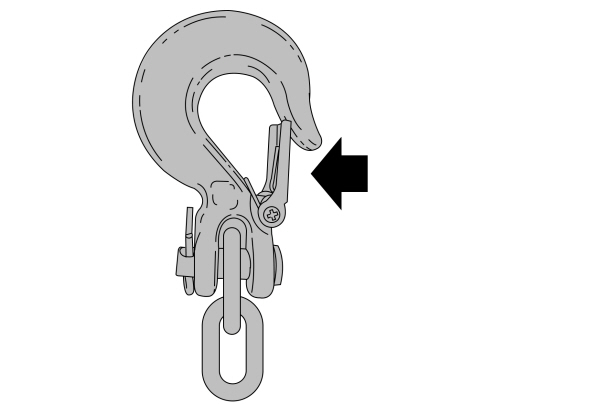
If the trailer safety chain hook has a latch, make sure to fully close the latch.
CONNECTING A TRAILER – INFORMATION MESSAGES
| Message | Description |
|---|---|
|
Trailer Disconnected |
The system senses a trailer connection becomes disconnected, either intentionally or unintentionally, during a given ignition cycle. |
|
Trailer Wiring Fault |
There are certain faults in your vehicle wiring and trailer wiring or brake system. |
|
Trailer Battery Not Charging See Manual |
The vehicle battery voltage is low, there is a fault with your trailer battery, your trailer battery voltage is below 8V or your trailer battery is connected in reverse polarity |
|
Trailer Tire Low Specified: |
One or more tires on your trailer is below the specified tire pressure. |
|
Trailer Tire Over Temperature |
Displays when one or more tires on the trailer is above the recommended temperature. |
|
Trailer Tire Pressure Sensor Fault |
A trailer tire pressure sensor is malfunctioning. If the warning stays on or continues to come on, have the system checked as soon as possible. |
|
Trailer Tire Pressure Monitor Fault |
The trailer tire pressure monitoring system is malfunctioning. If the warning stays on or continues to come on, have the system checked. |
|
Trailer Tire Pressure Monitor Capability Not Detected |
The system cannot detect the trailer tire pressure monitoring system. |
|
Trailer Tire Pressure Indication Not Setup See Manual |
The trailer tire pressure monitoring system is not setup. |
Download Manual