Automatic transmission
AUTOMATIC TRANSMISSION PRECAUTIONS
 WARNING: Apply the parking brake, shift into park (P), switch the vehicle off and remove the key or remote control before you leave your vehicle. Failure to follow this instruction could result in personal injury or death. WARNING: When your vehicle is stationary, keep the brake pedal fully pressed when shifting gears. Failure to follow this instruction could result in personal injury, death or property damage. WARNING: Do not apply the brake pedal and accelerator pedal simultaneously. Applying both pedals simultaneously for more than a few seconds limits vehicle performance, which may result in difficulty maintaining speed in traffic and could lead to serious injury. WARNING: Apply the parking brake, shift into park (P), switch the vehicle off and remove the key or remote control before you leave your vehicle. Failure to follow this instruction could result in personal injury or death. WARNING: When your vehicle is stationary, keep the brake pedal fully pressed when shifting gears. Failure to follow this instruction could result in personal injury, death or property damage. WARNING: Do not apply the brake pedal and accelerator pedal simultaneously. Applying both pedals simultaneously for more than a few seconds limits vehicle performance, which may result in difficulty maintaining speed in traffic and could lead to serious injury. |
PARK (P)
| WARNING: Shift into park (P) only when your vehicle is stationary. |
In park (P) power is not transmitted to the driven wheels.
Note: A tone sounds if you attempt to exit your vehicle without the vehicle in park (P).
Note: Your vehicle may not shift out of park (P) if the 12 V battery has run out of charge.
Note: Your vehicle may not shift out of park (P) if a fuse is blown.
Note: Your vehicle may not shift out of park (P) unless the key or remote control is inside your vehicle.
Note: The electronic parking brake could apply when you power your vehicle on with the selector in park (P).
Note: The electronic parking brake could apply if you shift to park (P) without fully pressing the brake pedal.
Note: The electronic parking brake could apply if you shift to park (P) on a slope.
Note: Do not manually release the parking brake when the selector is in park (P). See Automatically Releasing the Electric Parking Brake.
Note: Your vehicle could shift into park (P) if you attempt to exit your vehicle without the vehicle in park (P). See What Is Temporary Neutral Mode.
Note: A tone could sound when you select park (P).
REVERSE (R)
| WARNING: Shift into reverse (R) only when your vehicle is stationary. |
In reverse (R) power is transmitted to the driven wheels.
NEUTRAL (N)
| WARNING: In neutral (N) your vehicle is free to roll. |
In neutral (N) power is not transmitted to the driven wheels.
DRIVE (D)
In drive (D) power is transmitted to the driven wheels.
SHIFTING YOUR VEHICLE INTO GEAR
The transmission selector is on the center stack.
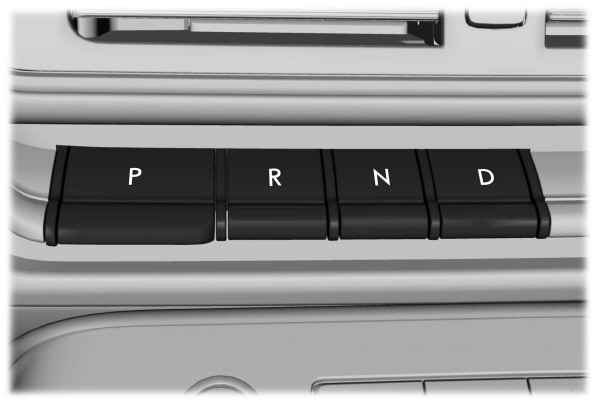
- Press and hold the brake pedal.
- Press a button to select a position.
Note: The position illuminates on the transmission selector.
AUTOMATIC TRANSMISSION POSITION INDICATORS
The instrument cluster displays the current position.

Note: The position could illuminate on the selector.
AUTOMATIC TRANSMISSION AUDIBLE WARNINGS
TRANSMISSION NOT IN PARK (P) AUDIBLE WARNING
Sounds if you open the driver door before shifting into park (P).
PARK SELECTION AUDIBLE WARNING
Sounds when you shift into park (P).
SHIFTING USING THE PADDLE SHIFTERS
The instrument cluster displays the current gear. The current gear flashes when your vehicle cannot shift into the requested gear. Your vehicle will not shift if the requested gear raises or lowers the engine speed beyond the limit.
Your vehicle could shift when you fully press the accelerator or brake pedal.
Note: Prolonged driving with high engine speed could cause vehicle damage not covered by the vehicle warranty.
Note: Drive modes could affect when the vehicle shifts into the requested gear.
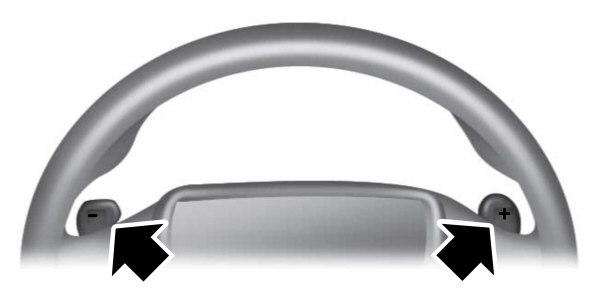
MANUALLY SHIFTING GEARS IN DRIVE (D)
Use this feature to temporarily change gear.
Note: We recommend using this feature for engine braking or driving on hilly or mountainous roads.
- Pull any paddle to switch the feature on.
- Pull the right (+) paddle to upshift.
- Pull the left (-) paddle to downshift.
- Hold the + paddle for a few seconds to switch the feature off.
Note: The feature switches off after a short period of time if neither paddle is pulled.
WHAT IS TEMPORARY NEUTRAL MODE
This mode keeps your vehicle in neutral (N), for a limited time, when you exit your vehicle or switch your vehicle off.
Note: Do not tow your vehicle in this mode.
TEMPORARY NEUTRAL MODE LIMITATIONS
This mode could be unavailable if your 12 V battery charge level is low. Connect an external power source and attempt the procedure again.
Your vehicle could shift to park (P) after 30 minutes, or when the vehicle battery charge level is low. Prolonged use of this mode can cause the 12 V battery to run out of charge.
This mode could be unavailable if your vehicle is below operating temperature. Warm up your vehicle and attempt the procedure again.
Do not tow your vehicle in this mode. Failure to follow these instructions could result in vehicle damage not covered by the vehicle warranty.
ENTERING TEMPORARY NEUTRAL MODE
- Bring your vehicle to a complete stop.
- Press and hold the brake pedal.
- Power your vehicle on.
- Shift into neutral (N).
Note: An instructional message appears.
- Shift into neutral (N) again.
Note: A confirmation message appears when your vehicle enters the mode.
- Release the brake pedal.
Note: Your vehicle is free to roll.
- Switch your vehicle off.
Note: Do not tow your vehicle in this mode.
Note: The neutral (N) indicator on the selector may flash in this mode.
EXITING TEMPORARY NEUTRAL MODE
- Press the brake pedal.
- Shift into park (P), or power your vehicle on and shift into drive (D) or reverse (R).
WHAT IS AUTOMATIC RETURN TO PARK (P)
Your vehicle shifts into park (P) if you attempt to exit your vehicle without the transmission in park (P).
HOW DOES AUTOMATIC RETURN TO PARK (P) WORK
Your vehicle shifts into park (P) if you attempt to exit your vehicle without the vehicle in park (P).
Your vehicle shifts into park (P) when your vehicle is stationary and any of the following occur:
- You switch the vehicle off.
- You open the driver door with the driver seatbelt unfastened.
- You unfasten the driver seatbelt when the driver door is open.
Note: Do not use automatic return to park (P) when your vehicle is moving, except in an emergency. See Starting and Stopping the Engine.
AUTOMATIC RETURN TO PARK (P) LIMITATIONS
Automatic return to park (P) may not work if any of the following occur:
- The driver door ajar sensor is malfunctioning.
- The driver seatbelt sensor is malfunctioning.
See an authorized dealer if any of the following occur:
- Seatbelt indicator illuminates or tone sounds with the driver seatbelt fastened.
- Door ajar indicator does not illuminate with the driver door open.
- Door ajar indicator illuminates with the driver door closed.
- Transmission not in park message appears, with the driver door closed, after you shift out of park (P).
Download Manual