Replacing components
Onboard vehicle tool kit
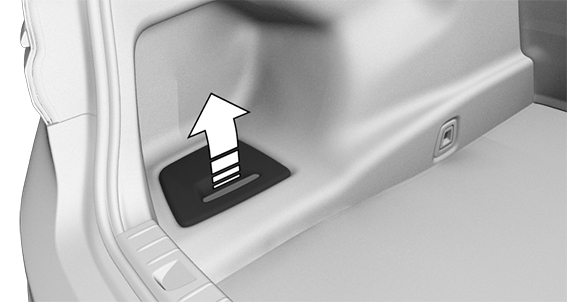
The onboard vehicle tool kit is located in the left storage compartment of the cargo area.
Wiper blades
Safety information

Do not fold in or switch on wipers without wiper blades
Fold in wipers before opening the hood
Replacing the wiper blades
To change the wiper blades, bring wipers into fold-out position.
Fold-out position of the wipers.
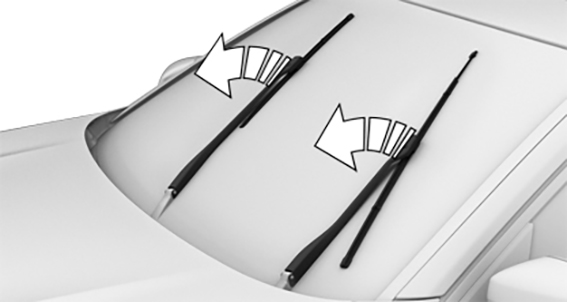
Lift the wiper off of the windshield and hold.
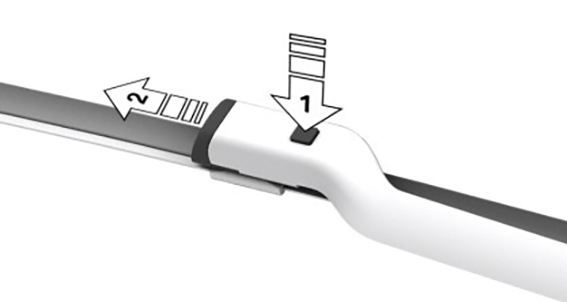
Press the button, arrow 1, and pull out the wiper blade, arrow 2.
Insert the new wiper blade and press it on until it you hear it snap into the holder.
Fold in the wipers.
Lights and bulbs
General information
Lights and bulbs make an essential contribution to driving safety.
All headlights and lights are made using LED or laser technology.
In the event of a malfunction, the vehicle manufacturer recommends having an authorized service center or another qualified service center or repair shop perform any necessary work.
Safety information
Do not look into light sources
Headlight glass
The inside of the headlight glass can fog up in cool or humid weather. When driving with the lights switched on, the condensation evaporates after a short time. The headlight glass does not need to be changed.
If, despite driving with the headlights switched on, moisture such as water droplets increasingly forms in the light, have the headlights checked.
Vehicle battery
General information
The battery is maintenance-free.
More information on the battery can be requested from an authorized service center or another qualified service center or repair shop.
Safety information
Do not touch live parts
Use compatible vehicle batteries
Registering the battery to the vehicle
The vehicle manufacturer recommends having an authorized service center or another qualified service center or repair shop register the vehicle battery to the vehicle after the battery has been changed. Once the battery has been registered again, all comfort features will be available without limitation and any Check Control messages displayed which relate to comfort features will disappear.
Charging the battery
General information
Make sure that the battery is always sufficiently charged to guarantee that the battery remains usable for its full service life.
Charge the battery when acceleration is insufficient.
The maximum charging voltage is 14.4 volts.
The following circumstances can have a negative effect on the performance of the battery:
Frequent short-distance drives.
Stationary periods of more than one month.
Safety information
Use suitable battery chargers
Do not connect battery chargers to the sockets in the vehicle
Charging the battery
Charge the battery only when the engine is off and via the jump-start terminals in the engine compartment.
Additional information:
Jump-start terminals.
Long stationary periods
General information
The vehicle battery permits stationary periods of approx. 6 weeks.
If the vehicle is stationary for a longer period, charge the vehicle battery every 6 weeks to avoid excessive discharge.
Low battery charge
If the battery charge is very low, the vehicle battery is automatically disconnected from the vehicle electrical system.
If the vehicle battery is discharged, all electrical components are deactivated. The vehicle can no longer be operated.
To reactivate, charge the vehicle battery via the jump start terminals.
Deeply discharged vehicle battery
If the vehicle battery is not charged in time, it will be deeply discharged. The battery can then no longer be charged.
Power interruption
After a power interruption, some equipment needs to be newly initialized or individual settings updated, for example:
With Memory function: store the positions again.
Time: update.
Date: update.
Disposing of old batteries

Have old batteries disposed of by an authorized service center or another qualified service center or repair shop, or take them to a collection point.
Fuses
General information
The fuses are located at different places in the vehicle.
Safety information
Observe when using fuses
In the car's interior
The fuses are located in the car's interior in the front passenger footwell behind a cover.
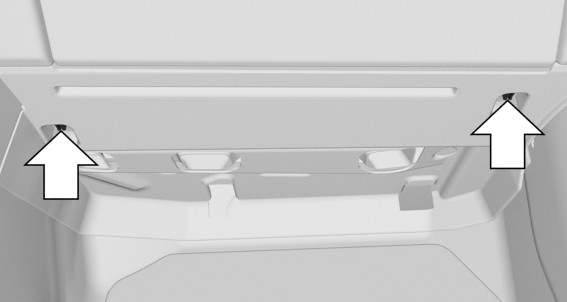
Loosen fasteners, arrows, and open cover.
The fuse box is located on the front right.
In the cargo area
The fuses are located in the cargo area on the right side behind a cover.
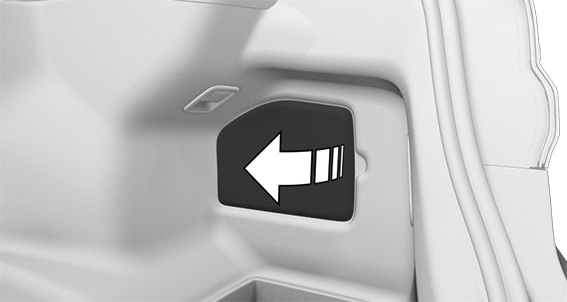
Remove the cover on the right side trim panel.
The fuse box may be located behind the sound insulation.
Information on the fuse layout as well as the positions of other fuse boxes is available on the Internet: fusecard.bmw.com.
Additional fuse boxes
Additional fuse boxes are located in the vehicle. In the event of a malfunction, contact an authorized service center or another qualified service center or repair shop.
Replacing fuses
The vehicle manufacturer recommends having the fuses replaced by an authorized service center or another qualified service center or repair shop.
Download Manual