Things to remember when driving
Break-in procedures
General information
Moving parts need to work together smoothly.
The following instructions will help you to achieve a long vehicle life and good efficiency.
During break-in, do not use the Launch Control.
Safety information

Observe the break-in procedures
Warning
Due to new parts and components, safety and driver assistance systems can react with a delay. There is a risk of accident. After installing new parts or with a new vehicle, drive conservatively and intervene early if necessary. Observe the break-in procedures of the respective parts and components.
Engine, transmission, and axle drive
Up to 600 miles/1,000 km
Drive at varying engine and road speeds, but do not exceed 5000 rpm and 106 mph/170 km/h.
Avoid full throttle or kickdown under all circumstances.
From 600 miles/1,000 km to 1,200 miles/2,000 km
Drive at varying engine and road speeds, but do not exceed 6000 rpm and 130 mph/210 km/h.
Avoid full load in gears 1 to 3.
At 1,200 miles/2,000 km
Have break-in service maintenance performed.
Tires
Tire traction is not optimal due to manufacturing circumstances when tires are brand new.
Drive conservatively for the first 200 miles/300 km.
Brake system
M Compound brake disks and brake pads must be run in to avoid possible brake noise. Drive cautiously for the first approx. 300 miles/500 km.
Following part replacement
Observe the break-in procedures again if components mentioned above are replaced.
General driving notes
Closing the trunk lid
Safety information
Driving with the trunk lid closed
Driving with the trunk lid open
If the vehicle still needs to be driven with the trunk lid open:
Greatly increase the blower output.
Drive moderately.
Hot exhaust system
Do not touch the hot exhaust system
Avoid contact with hot parts of the vehicle
Mobile radio in the vehicle
Observe when using mobile communication devices
Aquaplaning
On wet or slushy roads, a wedge of water can form between the tires and road surface.
This phenomenon is referred to as aquaplaning. It is characterized by a partial or complete loss of contact between the tires and the road surface, ultimately undermining your ability to steer and brake the vehicle.
Driving through water
General information
When driving through water, follow the following:
Deactivate Auto Start/Stop function.
Drive through calm water only.
Drive through water only up to a maximum height of 9.8 inches/25 cm.
Drive through water at a maximum of walking speed, up to 3 mph/5 km/h.
Safety information
Observe water level and speed
Braking safely
General information
The vehicle is equipped with an Antilock Braking System as a standard feature.
Perform emergency braking in situations that require such.
Steering is still responsive. You can still avoid any obstacles with a minimum of steering movement.
Sounds from the hydraulic circuits indicate that the Antilock Braking System is regulating.
In certain braking situations, the perforated brake disks can emit function-related noises. However, function-related noises have no effect on the performance and operational reliability of the brake.
Objects in the travel path of the pedals
No objects in the travel path of the pedals
Driving in wet conditions
In case of wet roads, exposure to road salt or in heavy rain, gently depress the brake pedal every few kilometers.
Ensure that this action does not endanger other road users.
The heat generated during braking dries brake disks and brake pads and protects them against corrosion.
In this way the brake force will be available when you need it.
Hills
General information
Drive long or steep downhill gradients in the gear that requires least braking effort. Otherwise, the brake system may overheat and reduce braking effect.
You can increase the engine's braking effect by downshifting, going all the way to first gear, if needed.
Safety information
Avoid stressing the brakes
Do not drive in Neutral
Brake disk corrosion
Corrosion on the brake disks and contamination on the brake pads are increased by the following circumstances:
Low mileage.
Extended stationary periods.
Infrequent use of the brakes.
Aggressive, acidic, or alkaline cleaning agents.
Corrosion buildup on the brake disks will cause a pulsating effect on the brakes when braking slowly - generally this cannot be corrected.
Condensation water under the parked vehicle
When using the automatic climate control, condensation water develops and collects underneath the vehicle.
Ground clearance
Ensure sufficient ground clearance
Roof-mounted luggage rack
General information
Roof-mounted luggage racks are available as optional accessories.
Safety information
Do not deactivate DSC when driving with roof load
Roof strip with flaps
The mounting points are located in the roof strip above the doors.
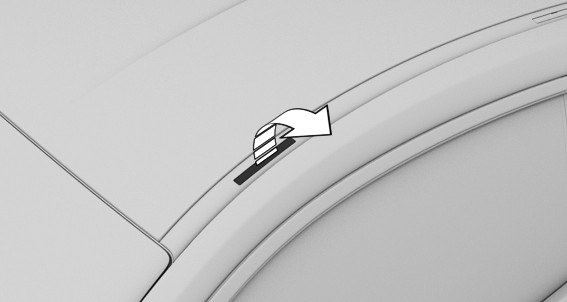
Fold the cover outward.
Installation
Follow the assembly instructions of the roof rack.
Loading
Because roof-mounted luggage racks raise the vehicle's center of gravity when loaded, they have a major effect on vehicle handling and steering response.
Therefore, note the following when loading and driving:
Do not exceed the approved roof/axle weights and the approved gross vehicle weight.
Distribute the roof load uniformly.
The roof load should not extend past the loading area.
Always place the heaviest pieces on the bottom.
Secure the roof luggage firmly, for instance using luggage straps.
Do not let objects project into the swiveling range of the trunk lid.
Drive cautiously and avoid driving off and braking with jerky movements or fast cornering.
Driving on racetracks
Race track operation
Higher mechanical and thermal loads during racetrack operation lead to increased wear. Use of the vehicle in M Sport or motor sport type competition is an improper use of the vehicle and may affect your warranty coverage. Please consult the “New Vehicle Limited Warranty” Booklet for further information on warranty matters.
When driving on a racetrack, increase the duration of the load slowly.
The standard brake linings and the wear indicators are not designed for racetrack operation.
Download Manual