Cargo area
Loading
Safety information

Overheating of the tires if the vehicle is overloaded
Warning
High gross vehicle weight can overheat the tires, damage them internally and cause a sudden tire pressure loss. Driving characteristics may be negatively impacted, reducing directional stability, lengthening the braking distances and changing the steering response. There is a risk of accident. Pay attention to the permitted load-carrying capacity of the tires and never exceed the permitted gross vehicle weight.
Secure loose objects in the interior
Warning
Devices connected to the vehicle via a cable, such as mobile phones or loose objects, can be thrown through the vehicle interior while driving, such as in the event of an accident, braking or evasive maneuver. There is a risk of injury. Secure loose objects or devices that are connected to the vehicle via a cable.
Stow objects and cargo properly
Warning
Improperly stowed objects can slip and be thrown into the car's interior, for instance in the event of an accident, braking or an evasive maneuver. Vehicle occupants can be hit and injured. There is a risk of injury. Stow and secure objects and cargo properly.
Observe with fluids in the cargo area
NOTICE
Fluids in the cargo area can cause damage. There is a risk of damage to property. Make sure that no fluids leak in the cargo area.
Steps for determining correct load limit
Locate the statement “The combined weight of occupants and cargo should never exceed XXX kg or XXX lbs” on your vehicle’s placard.
Determine the combined weight of the driver and passengers that will be riding in your vehicle.
Subtract the combined weight of the driver and passengers from XXX kg or XXX lbs
The resulting figure equals the available amount of cargo and luggage load capacity. For example, if the “XXX” amount equals 1,400 lbs and there will be five 150 lbs passengers in your vehicle, the amount of available cargo and luggage load capacity is 650 lbs (1,400 - 750 (5 x 150) = 650 lbs)
Determine the combined weight of luggage and cargo being loaded on the vehicle. That weight may not safely exceed the available cargo and luggage load capacity calculated in Step 4.
If your vehicle will be towing a trailer, load from your trailer will be transferred to your vehicle. Consult this manual to determine how this reduces the available cargo and luggage load capacity of your vehicle.
Payload
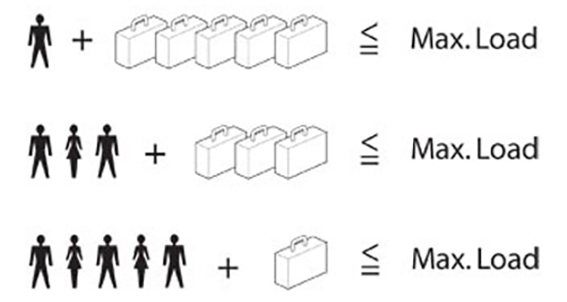
The maximum payload is the sum of the weight of the occupants and the cargo.
The greater the weight of the occupants, the less cargo that can be transported.
Stowing and securing cargo
Cover sharp edges and corners on the cargo.
Heavy cargo: stow as far forward as possible, directly behind and at the bottom of the rear seat backrests.
Very heavy cargo: stow as far forward as possible, directly behind and at the bottom of the rear seat backrests. When the rear seat is not occupied, secure each of the outer seat belts in the opposite buckle.
Fold down the rear seat backrests completely to stow large cargo.
Do not stack cargo above the upper edge of the backrests.
Fasten the aids for securing the load to the lashing eyes in the cargo area.
Small and light cargo: secure with luggage straps or, depending on the equipment, with a cargo net or draw straps.
Larger and heavy cargo: secure with cargo straps.
Lashing eyes in the cargo area
General information
Attach auxiliary materials to secure the cargo, such as lashing straps, tensioning straps, draw straps or cargo nets, to the lashing eyes in the cargo area.
Lashing eyes
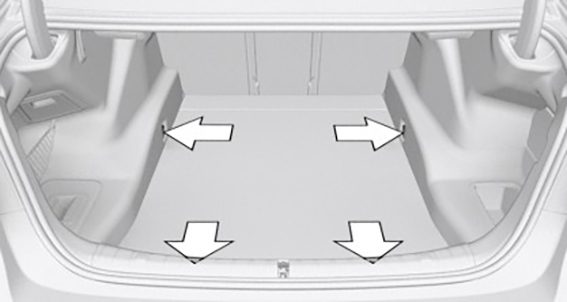
There are four lashing eyes in the cargo area for securing cargo.
Multifunction hook
General information
A multifunction hook is located on the left side in the cargo area.
Safety information
Only hang lightweight objects from the multifunction hooks
Folding out the multifunction hook
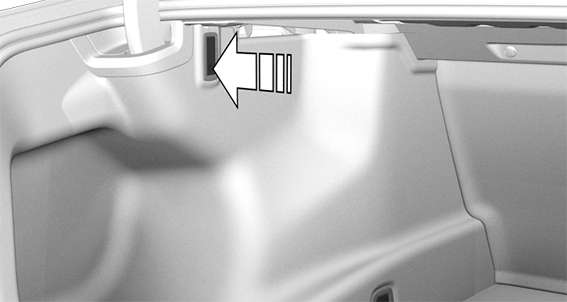
Press on the multifunction hook and turn until it engages.
Net
Small objects can be stowed in the net on the left side.
Storage compartment on the right side
A storage compartment is available on the right side of the cargo area.
Storage compartment on the left side
General information
A storage compartment is located on the left side in the cargo area.
Opening the storage compartment
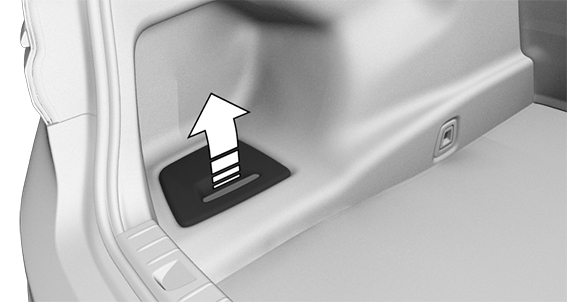
Pull the handle.
Through-loading system
Principle
The cargo area can be enlarged by folding down the rear seat backrests.
General information
The rear seat backrest is divided at a ratio of 40–20–40. The side rear seat backrests and the center section can be folded down separately.
The rear seat backrests can be folded down from the cargo area. The center section can be separately folded down from the rear.
Safety information
Keep the travel path of the rear seat backrest unobstructed when folding down the backrests
Lock the rear seat backrest correctly
Ensuring the stability of the child restraint seat
Keep the travel path of the rear seat backrest unobstructed
Folding down the rear seat backrest from the cargo area
Unlock the belt lock of the center seat belt in the rear using the buckle tongue of another seat belt.
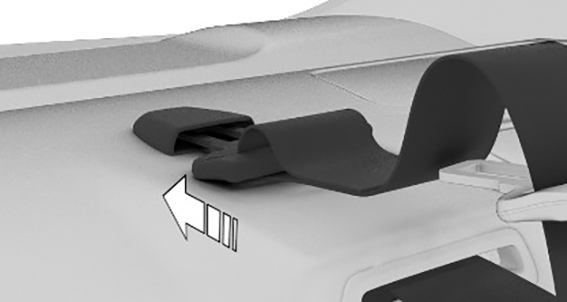
Insert the buckle tongue at the end of the belt into the specially designated fixture on the rear shelf.
Push the corresponding head restraint down as far as it will go.
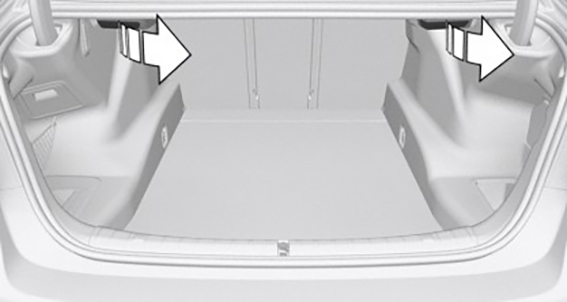
Pull the corresponding lever in the cargo area to release the rear seat backrest. The unlocked rear seat backrest moves forward slightly.
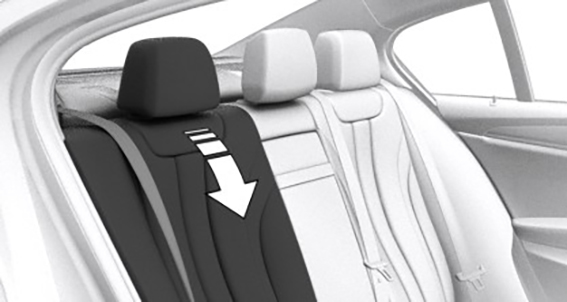
Fold the rear seat backrest forward.
Folding back the backrest
Return the rear seat backrest to the upright seat position and engage it.
Release the buckle tongue from the fixture on the rear shelf.
Insert the buckle tongue in the belt lock of the center seat belt. Make sure you hear the buckle tongue engage.
Folding down the center section
Fold down the center head restraint.
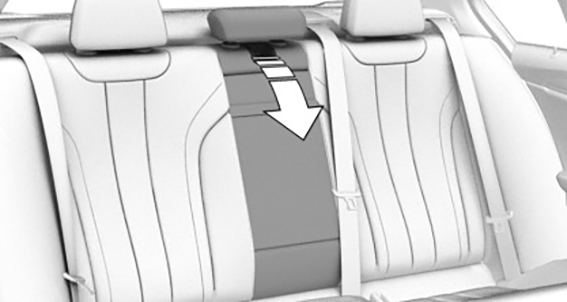
Download Manual