Recreational towing is not allowed on SRT vehicles.
These vehicles may be towed on a flatbed or vehicle trailer provided all four wheels are OFF the ground.
NOTE:
When towing your vehicle, always follow applicable state and provincial laws. Contact state and provincial Highway Safety offices for additional details.
Vehicles equipped with Quadra-Lift must be placed in Transport Mode before tying them down (from the body) on a trailer or flatbed truck. Refer to “Quadra-Lift” in “Starting and Operating” for more information. If the vehicle cannot be placed in Transport mode (for example, engine will not run), tie-downs should be fastened over the tires using specific straps (not to the body). Failure to follow these instructions may cause fault codes to be set and/or cause loss of proper tie-down tension.
DO NOT flat tow this vehicle. Damage to the drivetrain will result.
Recreational towing (for two-wheel drive models) is allowed ONLY if the rear wheels are OFF the ground. This may be accomplished using a tow dolly or vehicle trailer. If using a tow dolly, follow this procedure:
Properly secure the dolly to the tow vehicle, following the dolly manufacturer's instructions.
NOTE:
If vehicle is equipped with Quadra-Lift air suspension, ensure the vehicle is set to Normal Ride Height.
Drive the rear wheels onto the tow dolly.
Firmly apply the parking brake. Shift the transmission into PARK (P).
Turn the ignition OFF. 5
Properly secure the rear wheels to the dolly, following the dolly manufacturer’s instructions.
Install a suitable clamping device, designed for towing, to secure the front wheels in the straight position.
Recreational towing is not allowed. These models do not have a NEUTRAL (N) position in the transfer case.
NOTE:
This vehicle may be towed on a flatbed or vehicle trailer provided all four wheels are OFF the ground.
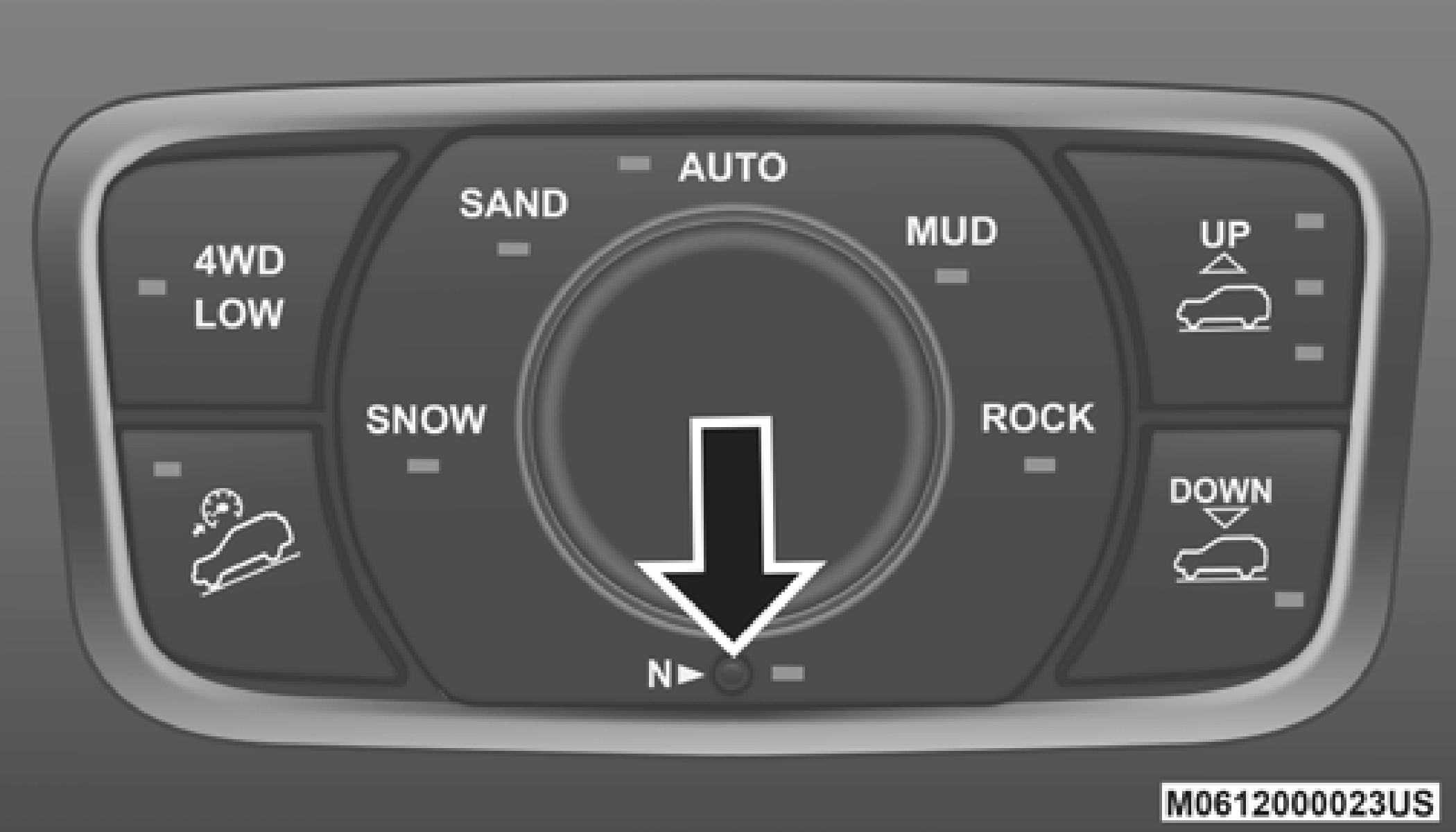
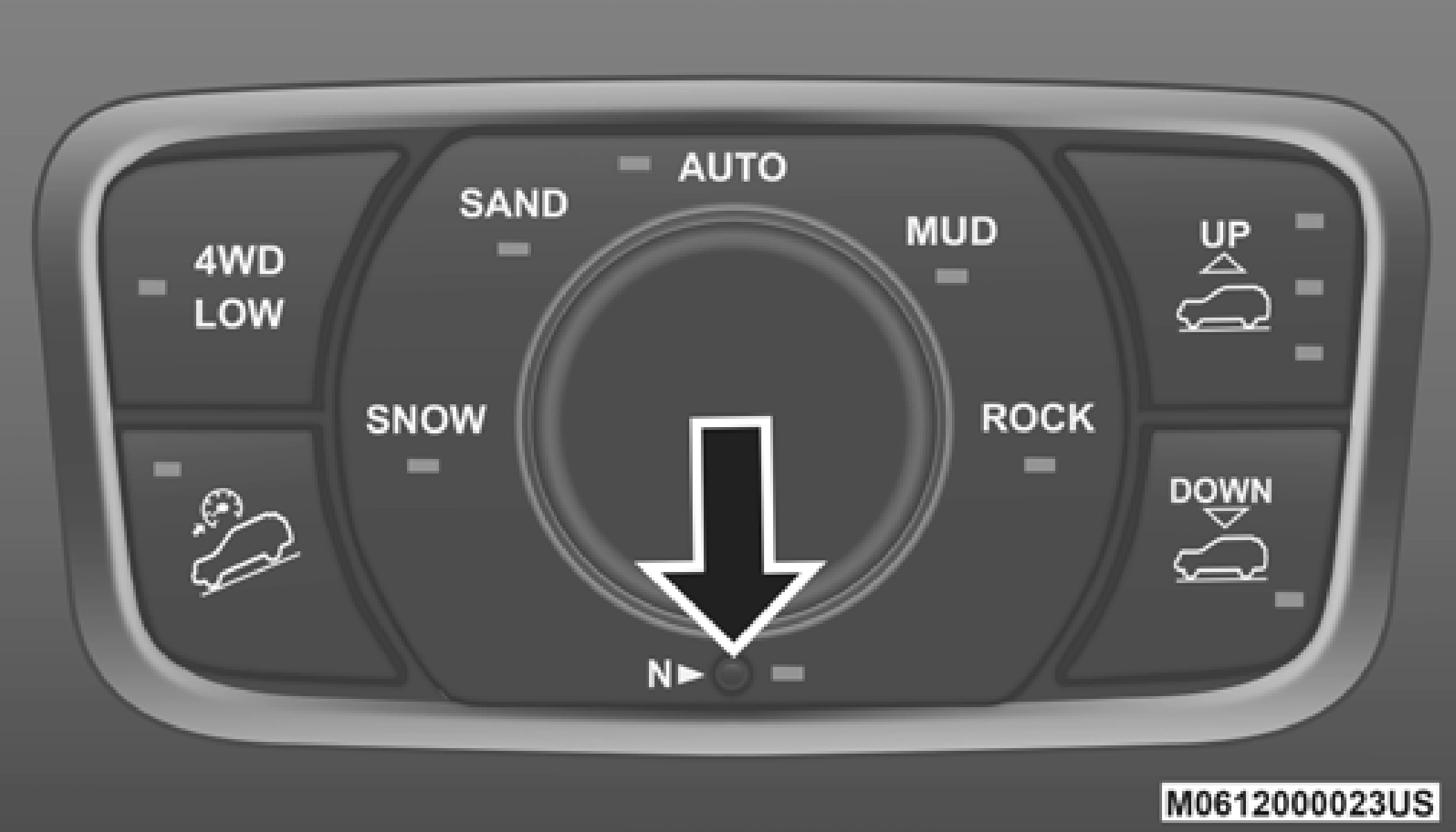
The transfer case must be shifted into NEUTRAL (N) and the transmission must be in PARK (P) for recreational towing. The NEUTRAL selection button is adjacent to the transfer case selector switch. Shifts into and out of transfer case NEUTRAL can take place with the selector switch in any mode position.
CAUTION!
DO NOT dolly tow any 4WD vehicle. Towing with only one set of wheels on the ground (front or rear) will cause severe transmission and/or transfer case damage. Tow with all four wheels either ON the ground, or OFF the ground (using a vehicle trailer).
Tow only in a forward direction. Towing this vehicle backwards can cause severe damage to the transfer case.
The transmission must be in PARK for recreational towing.
Before recreational towing, perform the procedure outlined under “Shifting into NEUTRAL (N)” to be certain that the transfer case is fully in NEUTRAL (N). Otherwise, internal damage will result.
Towing this vehicle in violation of the above require- ments can cause severe transmission and/or transfer case damage. Damage from improper towing is not covered under the New Vehicle Limited Warranty.
Do not use a bumper-mounted clamp-on tow bar on your vehicle. The bumper face bar will be damaged.
Use the following procedure to prepare your vehicle for recreational towing:
Bring the vehicle to a complete stop on level ground, with the engine running.
Press and hold the brake pedal.
Shift the transmission into NEUTRAL.
If vehicle is equipped with Quadra-Lift air suspension, ensure the vehicle is set to Normal Ride Height.
Using a ballpoint pen or similar object, push and hold the recessed transfer case NEUTRAL (N) button (located by the selector switch) for four seconds. The light behind the N symbol will blink, indicating shift in progress. The light will stop blinking (stay on solid) when the shift to NEUTRAL (N) is complete. A “FOUR WHEEL DRIVE SYSTEM IN NEUTRAL” message will appear in the instrument cluster.
5
NEUTRAL (N) Button
After the shift is completed and the NEUTRAL (N) light stays on, release the NEUTRAL (N) button.
Shift the transmission into REVERSE.
Release the brake pedal for five seconds and ensure that there is no vehicle movement.
Press and hold the brake pedal. Shift the transmission back into NEUTRAL.
Firmly apply the parking brake.
With the transmission and transfer case in NEUTRAL, push and hold the ENGINE START/STOP button until the engine turns off.
Place the transmission gear selector in PARK. Release the brake pedal.
Push the ENGINE STOP/START button twice (without pressing the brake pedal), to turn the ignition to the OFF mode.
Attach the vehicle to the tow vehicle using a suitable tow bar.
Release the parking brake.
NOTE:
Steps 1 through 4 are requirements that must be met before pushing the NEUTRAL (N) button, and must continue to be met until the shift has been completed. If any of these requirements are not met before pushing the NEUTRAL
(N) button or are no longer met during the shift, then the NEUTRAL (N) indicator light will flash continuously until all requirements are met or until the NEUTRAL (N) button is released.
The ignition must be in the ON/RUN mode for a shift to take place and for the position indicator lights to be oper- able. If the ignition is not in the ON/RUN mode, the shift will not take place and no position indicator lights will be on or flashing.
A flashing NEUTRAL (N) position indicator light indi- cates that shift requirements have not been met.
If the vehicle is equipped with Quadra-Lift air suspension, the engine should be started and left running for a minimum of 60 seconds (with all the doors closed) at least once every 24 hours. This process allows the air suspen- sion to adjust the vehicle’s ride height to compensate for temperature effects.
Use the following procedure to prepare your vehicle for normal usage:
Bring the vehicle to a complete stop, leaving it connected to the tow vehicle.
Firmly apply the parking brake.
Start the engine.
Press and hold the brake pedal.
Shift the transmission into NEUTRAL.
Using a ballpoint pen or similar object, push and hold the recessed transfer case NEUTRAL (N) button (located by the selector switch) for one second.
NEUTRAL (N) Switch
When the NEUTRAL (N) indicator light turns off, release the NEUTRAL (N) button. After the NEUTRAL (N) button has been released, the transfer case will shift to the position indicated by the selector switch.
Shift the transmission into PARK. Turn the engine OFF.
Release the brake pedal.
Disconnect vehicle from the tow vehicle.
Start the engine.
Press and hold the brake pedal.
Release the parking brake.
Shift the transmission into DRIVE, release the brake pedal, and check that the vehicle operates normally.
NOTE:
Steps 1 through 5 are requirements that must be met before pushing the NEUTRAL (N) button, and must continue to be met until the shift has been completed. If any of these requirements are not met before pushing the NEUTRAL
(N) button or are no longer met during the shift, the NEUTRAL (N) indicator light will flash continuously until all requirements are met or until the NEUTRAL (N) button is released.
The ignition must be in the ON/RUN mode for a shift to take place and for the position indicator lights to be oper- able. If the ignition is not in the ON/RUN mode, the shift will not take place and no position indicator lights will be on or flashing.
A flashing NEUTRAL (N) position indicator light indi- cates that shift requirements have not been met.