CLIMATE CONTROLS
The Climate Control System allows you to regulate the temperature, air flow, and direction of air circulating throughout the vehicle. The controls are located on the
touchscreen (if equipped) and on the instrument panel 3
below the radio.
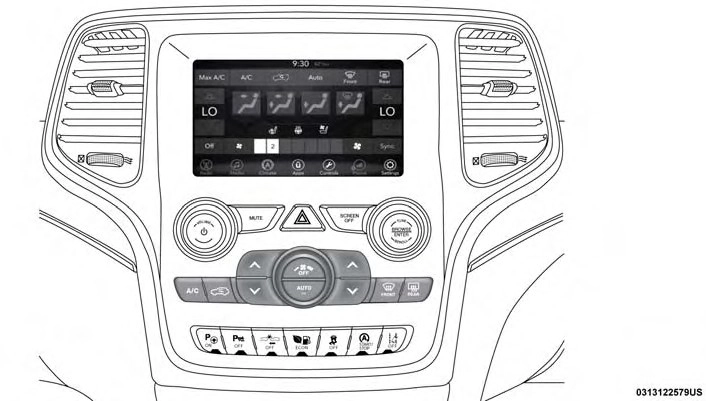
Uconnect 4 With 7–inch Display Automatic Climate Controls
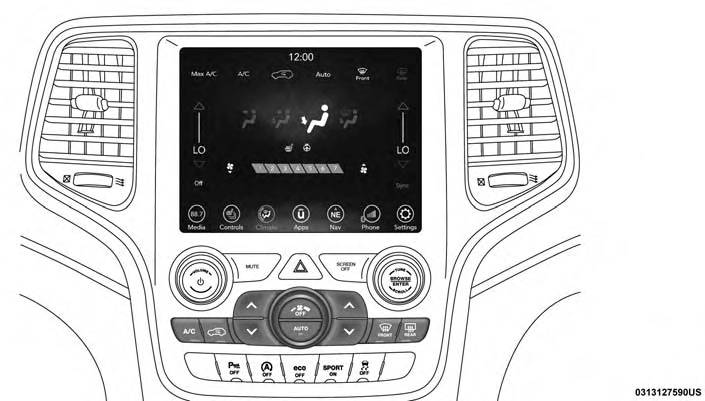
Uconnect 4C/4C NAV With 8.4–inch Display Automatic Climate Controls
Control Descriptions
|
Icon |
Description |
|
|
MAX A/C Button Press and release to change the current setting, the indicator illuminates when MAX A/C is on. Performing this function again will cause the MAX A/C operation to switch into manual mode and the MAX A/C indicator will turn off. NOTE: The MAX A/C setting is only available on the touchscreen. |
|
|
A/C Button Press and release to change the current setting. The indicator illuminates when A/C is on. |
|
|
Recirculation Button Press and release this button on the touchscreen, or push the button on the faceplate, to change the system between recirculation mode and outside air mode. Recirculation can be used when outside conditions, such as smoke, odors, dust, or high humidity are present. Recirculation can be used in all modes. Recirculation may be unavailable (button on the touchscreen greyed out) if conditions exist that could create fogging on the inside of the windshield. The A/C can be deselected manually without disturbing the mode control selection. Continuous use of the Recir- culation mode may make the inside air stuffy and window fogging may occur. Extended use of this mode is not recommended. |


|
Icon |
Description |
|
|
SYNC Button Press the SYNC button on the touchscreen to toggle the SYNC feature on/off. The SYNC indica- tor is illuminated when this feature is enabled. SYNC is used to synchronize the passenger tem- perature setting with the driver temperature setting. Changing the passenger’s temperature set- ting while in SYNC will automatically exit this feature. NOTE: The SYNC setting is only available on the touchscreen. |
|
Faceplate Knob
Touchscreen Buttons
|
Blower Control Blower Control is used to regulate the amount of air forced through the climate system. There are seven blower speeds available. The speeds can be selected using either the blower control knob on the faceplate or the buttons on the touchscreen. Faceplate: The blower speed increases as you turn the blower control knob clockwise from the lowest blower setting. The blower speed decreases as you turn the blower control knob counterclockwise.
Touchscreen: Use the small blower icon to reduce the blower setting and the large blower icon to increase the blower setting. The blower can also be selected by pressing the blower bar area between the icons.
|


|
Icon |
Description |
|
Mix Mode
|
Mix Mode Air is directed through the floor, defrost, and side window demister outlets. This setting works best in cold or snowy conditions that require extra heat to the windshield. This setting is good for maintaining comfort while reducing moisture on the windshield. |
|
|
Climate Control OFF Button This button turns the Climate Control System off. |


Climate Control Functions
A/C (Air Conditioning)
The Air Conditioning (A/C) button allows the operator to manually activate or deactivate the air conditioning sys- tem. When the air conditioning system is turned on, cool dehumidified air will flow through the outlets into the cabin. For improved fuel economy, press the A/C button to turn off the air conditioning and manually adjust the blower and airflow mode settings. Also, make sure to select only Panel, Bi-Level, or Floor modes.
NOTE:
For Manual Climate Controls, if the system is in Mix, Floor or Defrost Mode, the A/C can be turned off, but the A/C system shall remain active to prevent fogging of the windows.
If fog or mist appears on the windshield or side glass, select Defrost mode, and increase blower speed if needed.
If your air conditioning performance seems lower than expected, check the front of the A/C condenser (located in front of the radiator), for an accumulation of dirt or insects. Clean with a gentle water spray from the front of the radiator and through the condenser.
MAX A/C
MAX A/C sets the control for maximum cooling perfor- mance.
2. Next, adjust the temperature that you would like the system to maintain by adjusting the driver and passen- ger temperature control buttons. Once the desired tem- perature is displayed, the system will achieve and
Press and release to toggle between MAX A/C and the automatically maintain that comfort level. 3
prior settings. The button illuminates when MAX A/C is on.
In MAX A/C, the blower level and mode position can be adjusted to desired user settings. Pressing other settings will cause the MAX A/C operation to switch to the selected setting and MAX A/C to exit.
Recirculation
In cold weather, use of Recirculation mode may lead to excessive window fogging. The Recirculation feature may be unavailable (button on the touchscreen greyed out) if conditions exist that could create fogging on the inside of the windshield.
Automatic Operation
1. Push the AUTO button on the faceplate, or the AUTO button on the touchscreen on the Automatic Tempera- ture Control (ATC) Panel.
3. When the system is set up for your comfort level, it is not necessary to change the settings. You will experience the greatest efficiency by simply allowing the system to function automatically.
NOTE:
It is not necessary to move the temperature settings for cold or hot vehicles. The system automatically adjusts the temperature, mode, and blower speed to provide comfort as quickly as possible.
The temperature can be displayed in U.S. or Metric units by selecting the US/Metric customer-programmable fea- ture. Refer to the “Uconnect Settings” in “Multimedia” for further information.
To provide you with maximum comfort in the Automatic mode during cold start-ups, the blower fan will remain on low until the engine warms up. The blower will increase in speed and transition into Auto mode.
Manual Operation Override
This system offers a full complement of manual override features. The AUTO symbol in the front ATC display will be turned off when the system is being used in the manual mode.
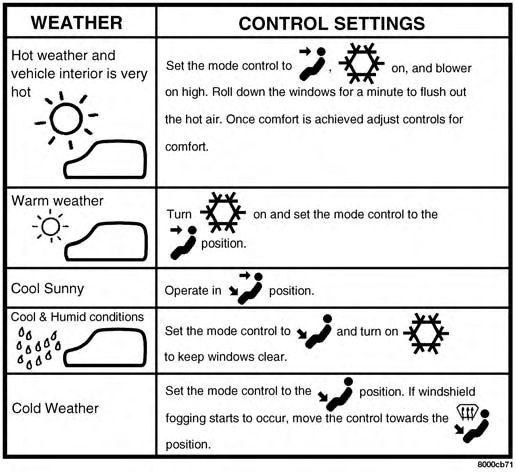
NOTE: Refer to the chart at the end of this section for suggested control settings for various weather conditions.
Summer Operation
The engine cooling system must be protected with a high-quality antifreeze coolant to provide proper corrosion protection and to protect against engine overheating. OAT coolant (conforming to MS.90032) is recommended.
Winter Operation
To ensure the best possible heater and defroster perfor- mance, make sure the engine cooling system is functioning properly and the proper amount, type, and concentration of coolant is used. Use of the Air Recirculation mode during Winter months is not recommended, because it may cause window fogging.
Vacation/Storage
Before you store your vehicle, or keep it out of service (i.e., vacation) for two weeks or more, run the air conditioning system at idle for about five minutes, in fresh air with the blower setting on high. This will ensure adequate system lubrication to minimize the possibility of compressor dam- age when the system is started again.
Window Fogging
Vehicle windows tend to fog on the inside in mild, rainy, and/or humid weather. To clear the windows, select De- frost or Mix mode and increase the front blower speed. Do not use the Recirculation mode without A/C for long periods, as fogging may occur.
(Continued)
Outside Air Intake
Make sure the air intake, located directly in front of the windshield, is free of obstructions, such as leaves. Leaves collected in the air intake may reduce airflow, and if they enter the plenum, they could plug the water drains. In Winter months, make sure the air intake is clear of ice, slush, and snow.
Cabin Air Filter
The climate control system filters out dust and pollen from the air. Contact an authorized dealer to service your cabin air filter, and to have it replaced when needed.
Operating Tips Chart
Download Manual