High-Performance
Driving
Your Acura NSX is designed, built and equipped with systems and features to provide you with exceptional driving performance, including the ability to engage in high-performance driving. However, due to the risks to both you and other road users, including the risk of injury or death from a high-speed loss of control or crash, if you engage in high-performance driving, Acura recommends you only do so where conditions are controlled, such as at a track or other closed-course venue. When driving on public roads you should always obey the posted speed limits and other traffic laws, reduce speed as needed for traffic and environmental conditions, and not engage in driving behaviors (including, for instance, use of Launch Control) that may create heightened risks for yourself and any other road users who may be present (even if you are unaware of them).
NSX Track Mode (see "Integrated Dynamics System (IDS)"), Launch Control (see "Integrated Dynamics System (IDS)") and other systems are designed for increased performance, both in terms of acceleration and handling, up to near-performance-limit conditions. They are most appropriately used on closed courses and they should not be used on public roads. Use of these systems may delay the intervention of vehicle safety systems designed to minimize the risk of a loss of traction or steering control, and can cause the NSX to handle differently than you might expect or would experience under normal driving conditions.
Use of these systems will not make up for a lack of appropriate driver experience and skill, and will not allow the driver to overcome risks created by:
- A lack of proper vehicle maintenance
- Less than ideal road conditions and/or unfamiliarity with the driving environment
- Other traffic or road users
High-performance driving requires special skills, knowledge and experience, as the safety risks are greatly increased when the NSX is operated at its upper performance abilities. As a responsible NSX driver, you should not drive above your skill limits or training, even if the NSX's performance levels would otherwise allow you to do so. If you intend to engage in high-performance driving, Acura strongly recommends that:
- You first obtain appropriate, professional training
- Wear the appropriate driving clothing and gear (e.g., helmet, gloves and driving shoes)
High-performance driving in general, and the use of Track Mode and Launch Control in particular, puts very high loads on the NSX and its components, and results in greater wear and tear on the vehicle. Because of these high loads, if your NSX is not in top condition or if certain components, such as the brakes or tires, have undue wear, those components could experience a loss of performance, or fail, when subjected to the additional loads. Therefore, Acura highly recommends that you undertake more proactive and frequent maintenance than that required under normal use and have your vehicle inspected at an authorized Acura NSX dealer (and all necessary repairs or adjustments made) before you engage in any high-performance driving.
In addition to any required maintenance, there are certain NSX specific items and protocols that you should pay special attention to before, during and after engaging in any high-performance driving. Ultimately, the decision whether to engage in high-performance driving is yours, and depending on your NSX's condition and prior usage, the items and protocols listed below may or may not be sufficient to ensure a safe driving experience.
BEFORE DRIVING
- With the vehicle parked on level ground, properly bleed brake system after replacing with new Honda DOT 4 brake fluid or equivalent.
- Inspect brake pad thickness and replace if 6.0mm or less.
- Burnish the brake pads so that they have the performance characteristics necessary to repeatedly and quickly slow the NSX when it is being operated at significantly high speeds. (While the NSX's brake pads are properly burnished for the demands expected in ordinary day-to-day driving, high performance driving puts unique demands on the brake system which require further burnishing.) A high performance burnish at the driving venue prior to the first session of the day is highly recommended.
- Inspect ALL cooling openings to confirm they are open and free of debris such as leaves, etc. Cooling openings include engine undercover ducts, heat resistance ducts, brake ducts, radiators, and intercoolers.
- Remove Tire Repair Kit from the trunk, along with any other cargo area contents.
- Check tire wear and tire pressure, and make certain wheel lug bolts are properly torqued, as driving at high speed puts additional strain on tires and wheels. Never use slick tires, and do not use Summer Only tires and Ultra High Performance tires if temperatures will be lower than 45°F (7°C).
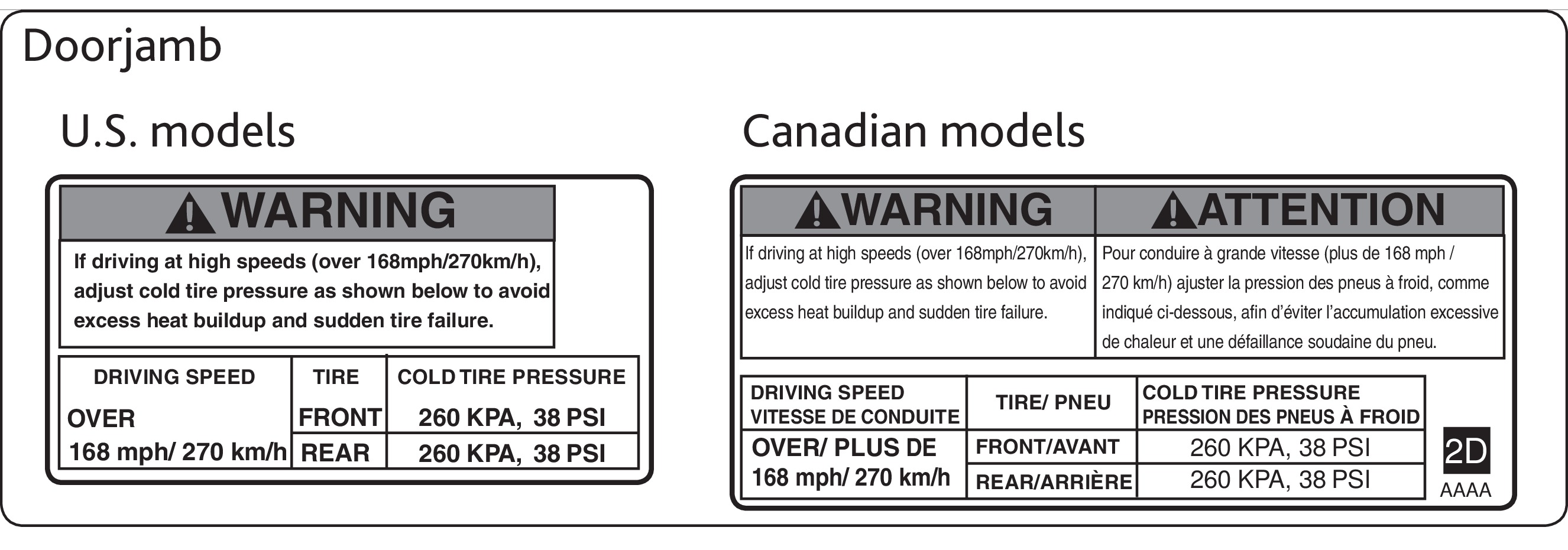
- If you anticipate sustained driving at speeds greater than 168 mph/270 km/h, adjust the cold tire pressure as shown on the driver door jamb warning label. This will help avoid heat build-up and sudden tire failure.
- Inspect all exhaust mounts for cracks or signs of wear.
- Inspect tailpipe active exhaust valves to ensure they are functioning correctly. You can do this by cycling the IDS switch between SPORT and TRACK modes, while the engine is idling.
Use of slick tires/racing slicks may subject the chassis and body components to higher dynamic loads than they were designed for.
Higher than intended dynamic loads could result in component failure, loss of control, and serious injury or death to you or others.
Do not install slick tires on the NSX.
While Driving
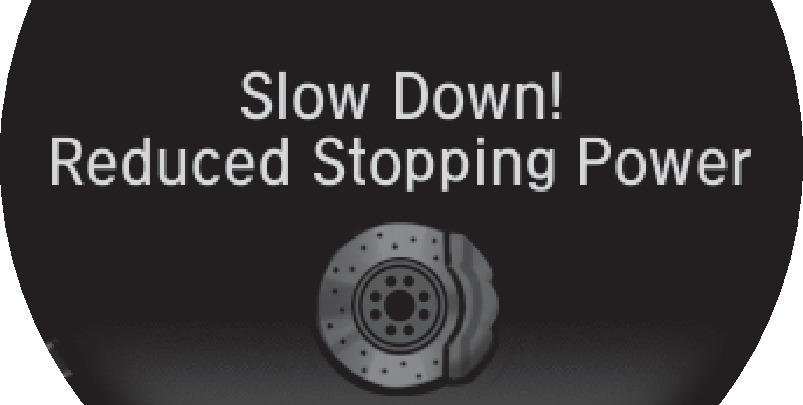
- You may see a brake warning message in the Driver Information Interface (and warning message chime) and/or experience increased brake pedal stroke. If either occurs, immediately slow down and allow for increased stopping distances. The message will disappear once the brakes have cooled and the system has returned to normal operating condition.
- After high-performance driving, it is critical to allow your vehicle to properly cool down. Do not immediately stop your vehicle. Instead, continue driving at reduced speeds, allowing for increased braking distances until your vehicle returns to normal operating temperatures. Once you stop and safely park the NSX, open the hatch to aid cooling. If the engine oil temperature reaches the H mark during high-performance driving, have your NSX inspected by an authorized Acura NSX dealer.
AFTER DRIVING
Check your NSX, and each of its relevant components, to make sure that it still is in a safe operating condition (example: wheel lug bolt torque, tire pressure, etc.). We recommend you repeat the Before Driving protocol. If any item shows excessive wear or appears to be in an unusual condition, have it replaced, or exercise appropriate caution when driving and see your authorized Acura NSX dealer.
For more information, please contact your authorized Acura NSX dealer, and/or Acura Client Relations (see "Contact Us").
- Starting to Drive
- Contact Us
- Integrated Dynamics System (IDS)
Download Manual