Trailer towing
 Introduction
If equipped correctly, the vehicle can be used to tow a trailer. The increased weight from towing affects vehicle wear, fuel consumption, and vehicle performance and may shorten the service intervals.
Driving a trailer not only increases the vehicle load, but requires more concentration from the driver.
Vehicles with a start/stop system
Before trailer towing using towing brackets which have not been retrofitted by Volkswagen, the start/stop system must be manually deactivated and remain deactivated during the entire trailer towing process .
Trailer with function check for the lighting
No trailer with tail lights and brake lights that require a function check for the tail light or brake light in order to be approved may be operated on this vehicle. Please consult the trailer manufacturer to find out what approval applies to your trailer.
Unused ball mount
Swivel the ball mount or remove it if there is no trailer, bicycle rack or similar attached to the ball mount. This is especially applicable if the vehicle's license plate or lighting is obscured by the unused ball mount. Note the country-specific regulations for using a ball mount .
Special conditions
Before driving with a trailer, please note that the functions of the assistance and parking systems may be limited.
 DANGER
Transporting persons in a trailer can cause life-threatening injuries and may be against the law.
-
Never transport anyone in a trailer.
 WARNING
Using the trailer hitch incorrectly can result in loss of control of the vehicle, accidents, and serious injuries.
-
Install and use the trailer in accordance with the instructions provided by the corresponding manufacturer.
-
Only use the ball mount if it is undamaged and secured correctly.
-
Do not modify or repair the ball mount.
-
To reduce the risk of injury during a rear collision and to pedestrians and cyclists near parked vehicles, always swivel in or remove the ball mount when you are not towing a trailer.
-
Never install “weight distributing” or “load equalizing” ball mounts. The vehicle was not designed for these types of trailer hitches. The trailer hitch could malfunction and the trailer could disconnect from the vehicle.
WARNING
Driving with a trailer and transporting heavy or large objects can change the vehicle handling performance, increase the braking distance, and cause accidents.
-
Always secure cargo correctly with suitable and undamaged cords, fixation belts or tensioning straps.
-
Always adapt your speed and driving style to the visibility, weather, road and traffic conditions. Reduce the vehicle speed, especially when driving downhill.
-
Trailers with a high center of gravity may tip sooner than trailers with a low center of gravity.
-
Always drive carefully and try to anticipate what may be ahead. Accelerate with extra care and caution. Avoid abrupt and sudden driving and braking maneuvers.
-
Be very careful when passing. Reduce vehicle speed as soon as you detect the slightest swaying movement in the trailer.
-
Do not drive faster than 50 mph (80 km/h), or 60 mph (100 km/h) if absolutely necessary, when towing a trailer. This also applies in countries where higher speeds are permitted. Adhere to the applicable local maximum speed limit, which may be lower for vehicles towing a trailer than it is for vehicles that are not towing a trailer.
-
Never try to “straighten out” a swaying trailer by accelerating.
WARNING
When towing with towing brackets which have not been retrofitted by Volkswagen the start/stop system must always be manually deactivated. Otherwise this can lead to a failure in the brake system and can cause accidents and severe injury.
 If you have integrated a trailer into the anti-theft alarm system, breaking the connection to the trailer may trigger the anti-theft alarm system .
Do not tow a trailer during the first 1000 km (600 miles) driven with a new engine .
Some retrofitted trailer hitches cover the mount for the towing eye. If this is the case, it will not be possible to use the towing eye to tow other vehicles. Because of this, you should always keep the ball mount from a retrofitted trailer hitch inside the vehicle when it is removed.
Hitching a trailer
Please read the introductory information and heed the Warnings and Notice and .
.
Trailer socket
If the trailer has a 7-pin connector, a suitable adapter must be used.
-
Lift the socket cap and insert the plug.
-
Rotate the plug clockwise by a quarter of a rotation until it fully engages into the socket.
-
Release the cap to lock the plug in place.
-
Check that the entire lighting system is working properly before starting the journey.
Safety chains
Always make sure that the safety chains are correctly secured on the vehicle. Safety chains require sufficient clearance so they are not tensioned when turning. Safety chains may not touch the ground after they have been secured.
Integrating into the anti-theft alarm system
The trailer is integrated into the anti-theft alarm system if the following requirements are met:

If the vehicle is equipped with a factory-installed anti-theft alarm system and trailer hitch.
-
If the trailer is connected to the electrical system in the towing vehicle.
-
If the vehicle and trailer electrical systems are functioning correctly and are not damaged.
-
If the vehicle was locked using the vehicle key and the anti-theft alarm system is active.
When the vehicle is locked, the alarm will be triggered if the electrical connection to the trailer is disconnected.
Integrating into the anti-theft alarm system (trailer with LED taillights)
Trailers with LED taillights cannot be integrated into the anti-theft alarm system due to the technology involved.
When the vehicle is locked, the alarm will not be triggered if the electrical connection to the trailer with LED taillights is disconnected.
WARNING
Improperly or incorrectly connected electrical wires can electrify the trailer and lead to malfunctions in the entire vehicle electrical system as well as accidents and serious injuries.
-
Have all work on the electrical system performed only by an authorized Volkswagen dealer or authorized Volkswagen Service Facility. Volkswagen recommends contacting an authorized Volkswagen dealer or authorized Volkswagen Service Facility.
-
Never connect the electrical system on a trailer to the electrical connectors for the taillights or other power sources on the towing vehicle.
 NOTICE
A trailer that is resting on a supporting wheel or on the trailer support should not remain hitched to the vehicle. Changes to the load or tire damage may raise or lower the vehicle. This would put great stress on the trailer hitch and the trailer, which could lead to damage to the vehicle and trailer.
If there are malfunctions in the vehicle or trailer electrical system or in the anti-theft alarm system, have the vehicle inspected by an authorized Volkswagen dealer or authorized Volkswagen Service Facility. Volkswagen recommends contacting an authorized Volkswagen dealer or authorized Volkswagen Service Facility.
If the engine is stopped and accessories on the trailer are on while there is an electrical connection through the trailer socket, then the 12 V vehicle battery will drain.
The electrical connection to the trailer will be automatically disconnected if the charge level of the 12 V vehicle battery becomes too low.
Loading a trailer
Please read the introductory information and heed the Warnings and Notice and.
General information
Always ensure that the vehicle and trailer are well balanced. Do not load the trailer unevenly by putting more weight at either the front or the back. Always store heavy objects as close as possible to or above the axle. Always secure the load on the trailer properly .
Trailer load and tongue weight
The trailer load is the weight that the vehicle can tow.
The trailer tongue weight rating is the load that presses down vertically from above onto the ball mount of the trailer hitch.
Volkswagen recommends always using the maximum permissible trailer tongue weight rating . Tongue weight that is too low affects the trailer's handling. The maximum permissible trailer tongue weight rating of the trailer drawbar on the trailer hitch ball head must not be exceeded .
The actual trailer tongue weight rating increases the weight on the rear axle and reduces the possible load in the vehicle.
In some countries, under certain conditions, a higher trailer tongue weight rating can be used. Follow the local specifications and regulations.
Towing weight
The towing weight consists of the actual weights of the loaded towing vehicle and the loaded trailer.
In some countries, trailers are divided into classes. Volkswagen recommends consulting with an authorized Volkswagen dealer or authorized Volkswagen Service Facility about suitable trailers. Volkswagen recommends contacting an authorized Volkswagen dealer or authorized Volkswagen Service Facility.
Tire pressure
The tire pressure for the tires on the trailer is based on the recommendation of the trailer manufacturer.
When towing a trailer, inflate the tires on the towing vehicle to the maximum permissible tire pressure .
WARNING
Sliding loads can considerably impair driving stability and trailer safety and increase the risk of accidents and serious injuries.
-
Always load trailers correctly.
-
Always secure cargo with suitable and undamaged cords or tensioning straps.
WARNING
If the Gross Axle Weight Rating, tongue weight, Gross Vehicle Weight Rating, or towing weight of the vehicle and the trailer are exceeded, accidents and serious injuries can result.
-
Never exceed the specified values .
-
Never exceed the maximum Gross Axle Weight Rating on the front or rear axle. Never exceed the maximum Gross Vehicle Weight Rating for the front and rear weight of the vehicle.
Driving with a trailer
Please read the introductory information and heed the Warnings and Notice and.
Characteristics when driving with a trailer
-
When driving with a trailer with an overrun brake, first brake gently then rapidly. This avoids braking jolts due to the trailer wheels locking.
-
The braking distance increases due to the gross combination weight (of the trailer and vehicle).
-
Use the engine as an additional brake on slopes. Otherwise the brake system may overheat and possibly fail.
-
Select a lower gear when driving with an automatic gearbox in Tiptronic mode.
-
-
The vehicle's center of gravity, and thereby also its driving characteristics, are changed by the towing weight and the increased total weight of the vehicle and trailer.
-
An empty towing vehicle and loaded trailer create a very unfavorable weight distribution. Drive very carefully and slowly with this combination.
Driving on hills with a trailer
Depending on the angle of the hill and the total weight of the trailer, a parked trailer may roll back slightly when you start driving.
When towing a trailer, start on a hill as follows:
-
Press and hold the brake pedal.
-
Pull and hold the
 switch one time to hold the trailer in place with the electronic parking brake .
 -
Engage the D/S selector lever position.
-
Release the brake pedal.
-
Start driving slowly.
-
Only release the
switch once the engine has created enough drive power to start driving.
WARNING
Towing a trailer incorrectly can result in loss of control of the vehicle and cause serious injuries.
-
Driving with a trailer and transporting heavy or large objects can change the vehicle handling performance and increase the braking distance.
-
Ensure sufficient visibility behind you. Attach additional rearview mirrors if rear visibility is impaired due to the trailer. Volkswagen recommends the use of Volkswagen original parts or Volkswagen original accessories, which you can acquire from an authorized Volkswagen dealer or authorized Volkswagen Service Facility.
-
Always drive carefully and try to anticipate what may be ahead. Brake earlier than usual.
-
Always adapt your speed and driving style to the visibility, weather, road and traffic conditions. Reduce the vehicle speed, especially when driving downhill.
-
Accelerate with extra care and caution. Avoid abrupt and sudden driving and braking maneuvers.
-
Take particular care when overtaking. Reduce vehicle speed as soon as you detect the slightest swaying movement in the trailer.
-
Never try to “straighten out” a swaying vehicle and trailer by accelerating.
-
Adhere to the applicable local maximum speed limit, which may be lower for vehicles towing a trailer than it is for vehicles that are not towing a trailer.
Trailer stabilization
Please read the introductory information and heed the Warnings and Notice and.
If a trailer is hitched to the vehicle and it begins to sway, the trailer stabilization can detected this and countersteer.
Trailer stabilization is an additional feature of the Electronic Stability Control (ESC).
If the system detects that the trailer is swaying, the trailer stabilization will automatically countersteer to the reduce “vibration” of the trailer.
Trailer stabilization requirements
-
The trailer hitch must be installed at the factory or a compatible trailer hitch must be retrofitted.
-
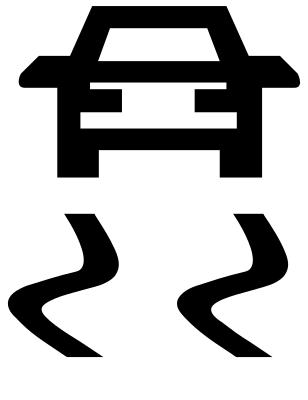
Electronic Stability Control (ESC) and Anti-Slip Regulation (ASR) must be active. The
 or
or  indicator light in the instrument cluster must not be on.
 -
The trailer must be connected to the electrical system in the towing vehicle using the trailer socket.
-
The driving speed must be less than 37 mph (60 km/h).
-
The maximum tongue weight must be used.
-
The trailer must have a fixed drawbar.
-
Braked trailers must have a mechanical overrun protection device.
WARNING
Do not allow the increased convenience provided by the trailer stabilization to tempt you into taking risks.
-
Always adapt your speed and driving style to the visibility, weather, road and traffic conditions.
-
Accelerate carefully on slippery roads.
-
Take your foot off the accelerator pedal when a system is actively regulating.
WARNING
The trailer stabilization may not be able to detect all driving situations correctly.
-
The trailer stabilization switches off when ESC is deactivated.
-
Trailer stabilization may not always detect if a light trailer is swaying and stabilize it.
-
When driving on slippery roads with poor traction, the trailer can still jackknife despite the trailer stabilization.
-
Trailers with a high center of gravity can tip before you notice any swaying back and forth.
-
If there is no trailer hitched to the vehicle but there is a connector in the trailer socket, for example from a bike carrier with lights, sudden braking maneuvers may occur automatically in extreme driving situations.
Download Manual