Navigation
 Introduction
The current vehicle position is determined by a global satellite system. In order to enable optimum navigation to your destination, all measured values and possible traffic reports are compared with the available map material.
Audible navigation aids and graphic representations lead you to your destination.Audible navigation aidsAcoustic navigation announcements and graphic displays lead you to your destination.
In some countries, it may not be possible to select some Infotainment system functions on the screen when driving above a certain speed. This is not a malfunction, but rather compliance with legal regulations.
 WARNING
Only adjust settings, enter destinations, or change navigation information when the vehicle is stationary.
 If you missed a turn on your route, the navigation system may recalculate the route.
The quality of the driving directions depends on the available navigation data and any reported traffic incidents.
Traffic reports are only given in the navigation system if the available VW Car-Net service has been activated.
Opening the navigation system main menu
-
Tap HOME

 .
.Or: tap MENU
.
Open set-up
-
Tap HOME
 .
.Or: Tap MENU
.
Voice guidance
Navigation messages are acoustic driving directions for the current route.
The type and frequency of navigation messages depends on the settings and the driving situation, like the start of the route guidance and whether you are driving on a highway or roundabout.
If the destination cannot be reached exactly, for example because it is not in a digitized area, there will be a navigation announcement that the Destination area has been reached. Messages about the direction and distance to your destination will also be displayed on the screen.
During dynamic route guidance, reported traffic incidents on the route are announced. There will be an additional navigation announcement if the route is recalculated due to a traffic incident or a change in driving style .
You can adjust or mute the volume during a traffic announcement. All other navigation announcements will be given at that volume or will be muted.
Navigation messages will not be given if the Infotainment system is muted.
Navigation restrictions
If the Infotainment system cannot receive data from GPS satellites, for example in a tunnel, navigation will still be possible using the vehicle's sensors.
In areas that are not digitized or only partially digitized in the Infotainment system memory, the Infotainment system will still try to provide route guidance.
If navigation data is missing or incomplete, the vehicle position may not be determined accurately. This may result in navigation that is not as accurate as usual.
Routing is subject to ongoing changes, like new streets, construction zones, road closures, or changes to street names or house numbers. Using outdated navigation data can lead to errors or uncertainty when using route guidance.
Control navigation map
To ensure an optimum view, you can also operate the navigation map using enhanced finger movements.
Moving the navigation map
Recommendation: Use index finger.
-
Move the navigation map with your finger.
Zooming in and out on the map view
Recommendation: Use index finger.
-
Tap and hold the map twice in a row.
-
To zoom out of the map view, move your finger upwards. To zoom in on the map view, move your finger downwards.
Zooming in and out on the map view
Recommendation: Use thumb and index finger.
-
Tap and hold the map with two fingers at the same time.
-
To zoom out of the map view, slide your fingers towards each other. To zoom in on the map view, slide your fingers away from each other.
Tilting the map view
Recommendation: Use index and middle finger.
-
Tap and hold the map with two fingers at the same time, held horizontally next to each other.
-
To tilt the map view to the front, move your fingers upwards. To tilt the map view to the back, move your fingers downwards.
Rotating the map view
Recommendation: Use thumb and index finger.
-
Tap and hold the map with two fingers at the same time.
-
Turn your fingers clockwise or anti-clockwise to turn the map view.
Saved data
In order to enable you to enter destinations quickly and to optimize route guidance, the Infotainment system saves certain data, such as frequently driven routes and positioning data.
Delete saved data
-
Tap
Basic functions Delete usage pattern. -
Tap confirm to delete the data.
Equipment and symbols of the navigation system
Please read the introductory information and heed the Warnings and Notice and .
.
Navigation
The equipment, symbols and functions of the navigation system may differ depending on the vehicle equipment and are not available in all countries.
Equipment
-
Entering a destination and route calculation.
-
Simultaneous display of two navigation maps (screen and instrument cluster).
-
Personal destinations.
-
3D City Maps.
-
Online Map Update.
-
Online Traffic Information.
Symbols on the map
The function keys and displays shown depend on the settings and the current driving situation.
Symbols for traffic reports and POIs, e.g. gas stations, are displayed on the map if the data is available to the navigation system.
 Display current position.
 Destination search.
 Destinations and stopovers along the current route.
 Personal destination suggestions (home address, work address, favorite POIs nearby).
 Display route options.
 Fully automatic map mode (orientation in direction of travel, position, zoom and tilt).
 Determine driving direction and map tilt.
 Map scale.
 Display destination memory.
 Display dialog box with additional options. Map menu with settings for navigation and navigation announcements.
Symbols in the dialog box
-
To open the additional window, tap on
.
 Repeats the last navigation announcement.
 Mute or adjust volume of navigation instructions.
 Navigation settings.
Additional symbols
 Destination search: detailed destination input for an address.
Symbols in the route plan
 Display current position.
 Destination for the current route guidance.
 Ends the current route guidance.
 Close route plan.
Setting preferred POI categories
The system offers different points of interest, e.g. gas stations, using the quick select symbol when entering destinations, in the route plan and on the map. You can prioritize how these symbols are displayed under Basic function settings Preferred POI categories. The system also automatically learns your preferred categories.
Traffic reports
Traffic reports are displayed on the map if the data is available to the navigation system.
Tap a traffic report to open a dialog box with additional details .
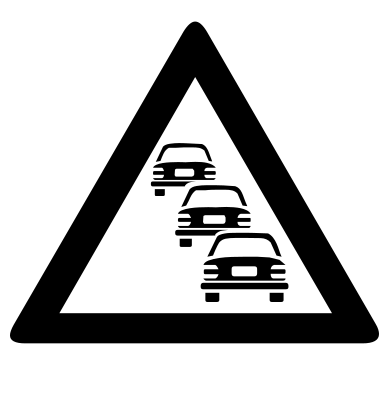 Traffic jam.
 Accident.
 Ice.
Ice. Road closed.
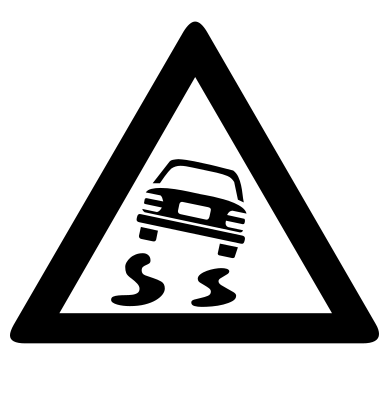 Slip hazard.
 Danger.
 Construction zone.
 Strong wind.
Navigation data
Please read the introductory information and heed the Warnings and Notice and.
The Infotainment system is equipped with an internal navigation data storage medium. Depending on the country, the required navigation data may already be installed.
The Infotainment system always requires up-to-date navigation data to ensure that route guidance can be implemented correctly and that the functions provided are fully available.
 NOTICE
If you use outdated navigation data, there may be adverse effects on the navigation system. It may not be possible to determine up-to-date routes, or route guidance may guide you to an incorrect destination.
-
Always ensure that your navigation data is kept up-to-date.
Updating navigation data online
Navigation data for frequently visited regions is automatically updated in the background when the ignition is switched on and there is an active Internet connection.
-
Switch the ignition on.
-
Check the Internet connection, if necessary.
Navigation data for frequently visited regions is automatically updated in the background.
Automatic updates to navigation data depend on the country.
Updating navigation data manually
Up-to-date navigation data for larger regions, such as Western Europe, can be downloaded online at www.volkswagen.com and stored on a suitable USB data carrier, available to buy in stores. If the Infotainment system is switched off during the process, installation will be interrupted and it will continue automatically once the system is turned on again.
-
Download and save the navigation data onto a USB data storage device.
-
Switch the vehicle ignition on.
-
Link the USB data carrier to the Infotainment system when the vehicle is stationary.
The navigation data for frequently driven regions is automatically updated in the background.
While and after updating the navigation data, no message appears in the Infotainment system.
If you update the navigation data manually, the USB data carrier must remain permanently connected. You will not receive a notification when the update is complete.
Do not disconnect the USB data carrier from the Infotainment system for a few days until the navigation data for visited regions has been fully downloaded and installed. The installation will start automatically in the background during the journey. Doing so will cancel the update process. If you disconnect the data carrier and visit a new region, the navigation data is not updated due to the lack of a USB data carrier.
Displaying the map data version
-
Tap HOME
System information.Or: tap MENU
System information.
Inputting destinations and starting route guidance
Please read the introductory information and heed the Warnings and Notice and.
Depending on country and vehicle equipment, different functions are available for the input of destinations.
For further information about symbols on the Infotainment system screen, see .
You can further restrict your search with specific suggestions in the results list, e.g. “nearby”.
The various functions for inputting destinations are located in the navigation system main menu.
Opening the navigation system main menu
-
Tap MENU
.
Open set-up
-
Tap MENU
.
Enter address
Start route guidance by entering an address. During input, the navigation system suggests already known destinations. You can also enter a new, unknown address for route guidance.
When inputting the address, input the name of the destination, not the postcode of the destination.
Selecting the destination and starting the navigation system
-
Tap
 .
. -
Enter the destination address and select your desired destination.
Or: tap
and enter the address via the input screen. -
Tap Route.
Quick start
-
Tap
. -
Enter the address of the destination, tap the desired destination and hold for a few seconds.
Enter the destination as accurately as possible. If there is an error in the destination entered, route guidance cannot take place or may lead to the wrong destination.
Destination suggestions
Navigation uses saved data such as your last destinations, learned destinations, favorites, home address and work address to provide you with route guidance.
Selecting the destination and starting the navigation system
-
Tap
. -
Tap on the desired destination.
The route guidance starts automatically.
Last destinations
The navigation system saves up to ten of the most recent destinations to make them available for route guidance. A new destination automatically overwrites the oldest destination.
Selecting the destination and starting the navigation system
-
Tap
 .
. -
Tap on the desired destination.
-
Tap Route.
Quick start
-
Tap
. -
Tap and hold the preferred destination for a few seconds.
Favorite destinations
You can save up to 50 journey destinations as favorites.
Saving a journey destination as a favorite
-
While entering a destination, tap on
 in the additional window.
Selecting the destination and starting the navigation system
-
Tap
 .
. -
Tap on the desired destination.
-
Tap Route.
Quick start
-
Tap
. -
Tap and hold the preferred destination for a few seconds.
Selecting on the map
The navigation map contains active areas at many points which are suitable for the input of a destination. To enter a destination, tap on your preferred position or preferred location on the map. If map data is available at this point, you can launch route guidance.
Entering a destination via the navigation map is dependent on data status and not possible for all positions.
Use the Offroad navigation system to enter a destination to a selected destination point with unknown data.
Offroad navigation
The Offroad navigation system calculates routes to selected destinations with unknown data. If the destination is not located on a known road or at a known position, the navigation system will calculate the route up to the next point on the known road and then complete the route to the destination using a straight line.
In order to start an Offroad navigation, tap on a free area without positioning data.
Starting the navigation
-
Tap
 .
. -
Press and slide the map view until you can select your desired position. You can operate the navigation map using extended finger touches .
-
Tap the preferred destination or any destination point on the map without positioning data.
-
Tap Route.
Using a contact's address data
Start route guidance via the saved address data for a contact. You cannot use contacts for whom you have not saved any address data for route guidance.
Starting the navigation
-
Tap
 .
. -
Tap on the preferred contact and address data.
-
Tap Route.
NOTICE
If the address data for your contact is out of date, the route guidance will nevertheless direct you to the stored address. Please ensure the address for your contact is up to date.
Function descriptions
Please read the introductory information and heed the Warnings and Notice and.
Route plan
The route plan contains information about relevant events, such as waypoints and destination suggestions, if the relevant data is available to the navigation system.
Tapping an event will open a dialog box with additional options. The options available depend on the event and the current settings .
Opening and closing the route plan
-
Tap the route plan to open.
-
To stop route guidance, tap
.
Editing route guidance
To edit route guidance, move the stopovers or the destination in the route plan.
-
Tap and hold the desired destination until it is visibly highlighted.
-
Move the destination to the desired position and release it.
The route will be recalculated.
Avoiding traffic disruptions
The route plan displays messages about current traffic disruptions if the relevant data is available to the Navigation system. Avoid traffic disruptions by modifying the route plan.
-
Tap the traffic report.
-
Tap Avoid.
The route will be recalculated.
Only one traffic report can be used for each route guidance to avoid traffic disruptions in this manner.
Additional dialog box in the route plan
Tapping the route plan entries may cause a dialog box to open with additional options for these entries. The options available depend on the entry that is tapped.
Functions in the split screen:
- Display on map
- Displays the selection on the map.
- Add waypoint
- Adds a waypoint to the route guidance.
- Direct route
- Starts direct route guidance.
- Delete
- Delete waypoint from route guidance.
- Avoid
- Avoid traffic disruptions. The route will be recalculated.
- Stop route guidance
- Ends the current route guidance.
Closing an additional dialog box in the route plan
-
Tap a free area outside of the additional window.
Learning usage patterns
While driving, the Navigation system saves routes traveled and destinations reached in order to create automatic destination suggestions. Destinations are learned with reference to the time of day and the day of the week.
The navigation system can suggest pre-learned routes.
-
Tap
to show the suggested routes.
Selecting one of the suggested routes will cause route guidance to begin.
The route guidance follows the selected route until you deviate from it. The route will then be recalculated and will lead back to the selected route via the most direct path.
Serious traffic disruptions are taken into consideration in route guidance. If an alternative route and the navigation data are available, serious disruptions will be avoided.
If you are driving a pre-learned route without active route guidance, the destination is added to the route plan. Route guidance does not need to be actively started for a journey to a pre-learned destination. You are warned about traffic disruptions if necessary.
A predicted arrival time is displayed.
You can activate or deactivate this function at any time as well as delete the saved data for this function.
Activating and deactivating “learn usage pattern”
-
To open this function's settings, tap
Basic function settings. -
To activate or deactivate the function, tap Learn usage pattern.
-
To delete saved data, tap Delete usage pattern.
Download Manual