Operating the lights and wipers
U.S.A.
|
|
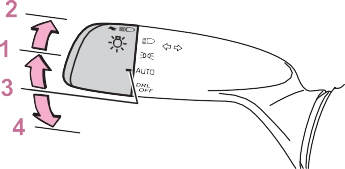
2  The headlights and all lights listed above (except daytime running lights) turn on.
3 The headlights, daytime running lights, LED acces- sory lights (if equipped) (P.295) and all the lights
listed above turn on and off automatically.
4  Off
Off
Canada
|
|
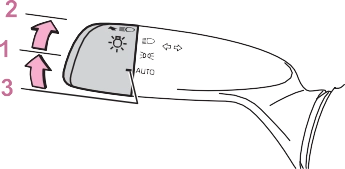
2  The headlights and all lights listed above turn on.
3 The headlights, daytime running lights, LED acces- sory lights (if equipped) (P.295) and all the lights listed above turn on and off automatically.
The power switch is in ON.
to other drivers during daytime driving, the daytime running lights turn on automatically when all of the following conditions are met. (The daytime running lights are not designed for use at night.)
switch is in the  or
or  position
is in the  position
The daytime running lights remain on after they illuminate, even if the parking brake is set again.
To make your vehicle more visible to other drivers during daytime driv- ing, the LED accessory lights turn on automatically when the parking brake is released while the hybrid system is operating.
When the parking lights are turned on, the LED accessory lights dim.
The sensor may not function prop- erly if an object is placed on the sen- sor, or anything that blocks the sensor is affixed to the windshield. Doing so interferes with the sensor detecting the level of ambient light and may cause the automatic head- light system to malfunction.
diately if on the key is pressed after all the doors are closed.)
To turn the lights on again, turn the power switch to ON, or turn the light
switch to the or  position
once and then back to  or
or  position.
A buzzer sounds when the power switch is turned to ACC or OFF and the driver’s door is opened while the lights are turned on.
The level of the headlights is auto- matically adjusted according to the number of passengers and the load- ing condition of the vehicle to ensure that the headlights do not interfere with other road users.
When driving during daytime with
the headlight switch turned to  , if the windshield wipers are used, the headlights will turn on automatically
after several seconds to help enhance the visibility of your vehi- cle.
In order to prevent the 12-volt bat- tery of the vehicle from discharging, if the headlights and/or tail lights are on when the power switch is turned to OFF, the battery saving function will operate and automatically turn off all the lights after approximately 20 minutes.
When any of the following are per- formed, the 12-volt battery-saving function is canceled once and then reactivated. All the lights will turn off automatically 20 minutes after the 12-volt battery-saving function has been reactivated:
The system may be malfunctioning. Have the vehicle inspected by your Toyota dealer.
Settings (e.g. light sensor sensitiv- ity) can be changed. (Customizable features: P.577)
|
|
|
To prevent 12-volt battery dis- charge
Do not leave the lights on longer than necessary when the hybrid system is not operating. |
 NOTICE
|
Turning on the high beam headlights |
Pull the lever toward you to the center position to turn the high beams off.
You can flash the high beams with the headlights on or off.
|
AFS (Adaptive Front-light- ing System) (if equipped) |
AFS operates at speeds of approximately 6 mph (10 km/h) or higher.
2 Turn the headlight switch to the or  position.
The Automatic High Beam indicator will come on when the system is operating.
by another vehicle
fog, mist, ice, dirt, etc.
The system may be malfunctioning.
Have the vehicle inspected by your Toyota dealer.
The sensitivity of the sensor can be temporarily lowered.
 or position.
Automatic High Beam (headlights) may turn on even when the vehicle is stopped.
The Automatic High Beam indicator will turn off and the headlight high beam indicator will turn on.
Pull the lever to its original position to activate the Automatic High Beam system again.
The Automatic High Beam indicator will turn off.
Press the switch to activate the Automatic High Beam system again.
The high beams are on while the lever is pulled toward you, how- ever, after the lever is returned to its original position, the low beams remain on for a certain amount of time. Afterwards, the Automatic High Beam will be activated again.
It is recommended to switch to the low beams when the high beams may cause problems or distress to other drivers or pedestrians nearby.
|
|
|
When the windshield is dry
Do not use the wipers, as they may damage the windshield. |
 NOTICE
|
Operating the wiper lever |
Intermittent windshield wipers
|
|
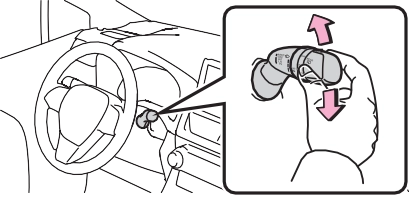
 *1 or *2 Off
 *1 or *2 Intermittent operation
 *1 or *2 Low speed operation
 *1 or *2 High speed operation
 *1 or *2 Temporary operation
*1: For the U.S.A.
*2: For Canada
8  Washer/wiper dual operation
Pulling the lever operates the wip- ers and washer.
The wipers will automatically oper- ate a couple of times after the washer squirts.
|
|
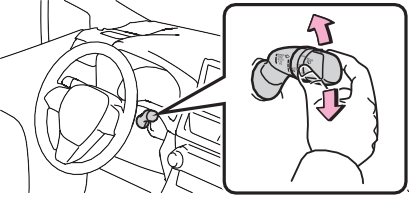
 *1 or *2 Off
 Rain-sensing opera- tion
 *1 or *2 Low speed operation
 *1 or *2 High speed operation
 *1 or *2 Temporary operation
*1: For the U.S.A.
*2: For Canada
When “AUTO” is selected, the wip- ers will operate automatically when the sensor detects falling rain. The system automatically adjusts wiper timing in accordance with rain vol- ume and vehicle speed.
8  Washer/wiper dual operation
Pulling the lever operates the wip- ers and washer.
The wipers will automatically oper- ate a couple of times after the washer squirts.
The power switch is in ON.
Vehicles with intermittent wind- shield wipers
With low speed windshield wiper operation selected, wiper operation will be switched from low speed to intermittent wiper operation when the vehicle is stationary. (However, when the wiper intervals are adjusted to highest level, the mode
will not switch.)
Vehicles with rain-sensing wind- shield wipers
With low speed windshield wiper operation selected, wiper operation will be switched from low speed to intermittent wiper operation when the vehicle is stationary. (However, when the sensor sensitivity is adjusted to the highest level, the mode will not switch.)
Check that the washer nozzles are
not blocked if there is washer fluid in the windshield washer fluid reser- voir.
|
|
|
Caution regarding the use of windshield wipers in “AUTO” mode (vehicles with rain- sensing windshield wipers)
The windshield wipers may oper- ate unexpectedly if the sensor is touched or the windshield is sub- ject to vibration in “AUTO” mode. Take care that your fingers or anything else does not become caught in the windshield wipers. Caution regarding the use of washer fluid
When it is cold, do not use the washer fluid until the windshield becomes warm. The fluid may freeze on the windshield and cause low visibility. This may lead to an accident, resulting in death or serious injury. |
 WARNING
|
|
|
When the rear window is dry
Do not use the wiper, as it may damage the rear window. |
 NOTICE
 *1 or *2 Off
*1 *2
operation
Intermittent
 *1 or *2 Normal oper- ation
*1: For the U.S.A.
*2: For Canada
|
|
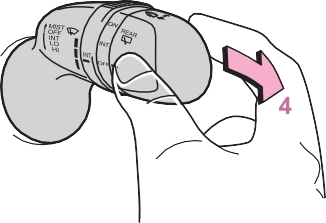
 Washer/wiper dual operation
Pushing the lever operates the wiper and washer.
The wiper will automatically operate a couple of times after the washer squirts.
The power switch is in ON.
Check that the washer nozzle is not blocked if there is washer fluid in the washer fluid reservoir.
When the rear window wiper is operating, if the back door is opened while the vehicle is stopped, opera- tion of the rear window wiper will be stopped to prevent anyone near the vehicle from being sprayed by water from the wiper. When the back door is closed, wiper operation will resume.*
*: The setting must be customized at your Toyota dealer.
When the shift lever is shifted to R when the front wipers are operating, the rear window wiper will operate once.
Setting of the reverse-linked func- tion can be changed. (Customizable features: P.577)
|
|
|
When the washer fluid tank is empty
Do not operate the switch continu- ally as the washer fluid pump may overheat. When a nozzle becomes blocked
In this case, contact your Toyota dealer. Do not try to clear it with a pin or other object. The nozzle will be damaged. To prevent 12-volt battery dis- charge
Do not leave the wiper on longer than necessary when the hybrid system is off. |
 NOTICE
Download Manual