Towing your vehicle
When towing your vehicle, all jurisdictional and local regulations for towing must be followed.
Incorrect towing equipment could damage your vehicle. Towing instructions are available from a NISSAN dealer. Local service operators are generally familiar with the applicable laws and procedures for towing. To assure proper towing and to prevent accidental damage to your vehicle, NISSAN recommends having a service operator tow your vehicle. It is advisable to have the service operator carefully read the following precautions:
WARNING
|
CAUTION
|
For additional information about towing your vehicle behind a recreational vehicle (RV), refer to “Flat towing” in the “Technical and Consumer Information” section of this manual.
Towing recommended by NISSAN
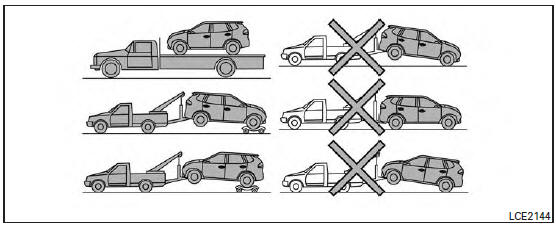
All-Wheel Drive (AWD) models
NISSAN recommends that towing dollies be used when towing your vehicle or the vehicle be placed on a flatbed truck as illustrated.
| CAUTION
DO NOT tow AWD models with any of the wheels on the ground as this may cause serious and expensive damage to the powertrain. |
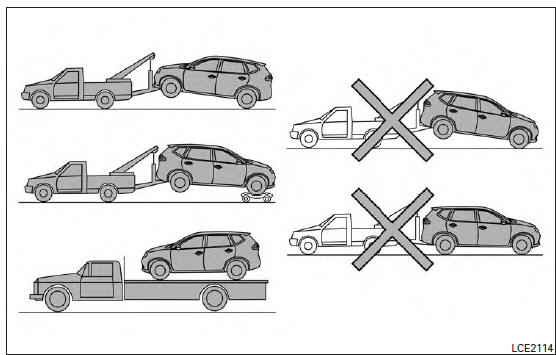
Front-Wheel Drive models
NISSAN recommends that your vehicle be towed with the driving wheels (front) off the ground or place the vehicle on a flatbed truck as illustrated.
WARNING
|
Vehicle recovery (freeing a stuck vehicle)
Pulling a stuck vehicle
| WARNING
To avoid vehicle damage, serious personal injury or death when recovering a stuck vehicle:
|
If your vehicle is stuck in sand, snow, mud, etc., use a tow strap or other device designed specifically for vehicle recovery. Always follow the manufacturer’s instructions for the recovery device.
Do not use the tie-down hooks for towing or vehicle recovery.
Rocking a stuck vehicle
WARNING
|
If your vehicle is stuck in sand, snow, mud, etc., use the following procedure:
- Turn off the Vehicle Dynamic Control (VDC) system.
- Make sure the area in front and behind the vehicle is clear of obstructions.
- Turn the steering wheel right and left to clear an area around the front tires.
- Slowly rock the vehicle forward and backward.
- Shift back and forth between R (Reverse) and D (Drive).
- Apply the accelerator as little as possible to maintain the rocking motion.
- Release the accelerator pedal before shifting between R and D.
- Do not spin the tires above 35 mph (55 km/h).
- If the vehicle cannot be freed after a few tries, contact a professional towing service to remove the vehicle.
Download Manual