When Driving
Starting the Engine
-
- Make sure the parking brake is applied.
- The parking brake and brake system indicator (red) comes on for 30 seconds when you pull up the electric parking brake switch.
- Make sure the parking brake is applied.

-
Continuously variable transmission models
- Check that the transmission is in P, then depress the brake pedal.
- Although it is possible to start the vehicle in N, it is safer to start it in P.
- Check that the transmission is in P, then depress the brake pedal.

-
Manual transmission models
- Check that the shift lever is in N. Then, depress the brake pedal with your right foot, and the clutch pedal with your left foot.
- The clutch pedal must be fully depressed to start the engine.
- Check that the shift lever is in N. Then, depress the brake pedal with your right foot, and the clutch pedal with your left foot.

-
All models
- Press the ENGINE START/STOP button without depressing the accelerator pedal.

- Detail
If the engine does not start, wait at least 30 seconds before starting the engine again.
You can remotely start the engine using the keyless remote.
- WARNING Carbon monoxide gas is toxic and can rapidly accumulate in closed or even partly enclosed areas.
Breathing it can cause unconsciousness and even kill you.
Never use the remote engine starter with the vehicle parked in a garage or other areas with limited ventilation.
- Detail
- You have disabled a remote engine start setting.
- The power mode is not in VEHICLE OFF.
- The transmission is in a position other than P.
- The hood is open, or any door or the trunk is unlocked.
- You have already used the remote twice to start the engine.
- Another registered keyless remote is in the vehicle.
- There is any antenna failure.
- The door is unlocked with the built-in key.
- The engine oil pressure is low.
- The engine coolant temperature is extremely high.
- The security system alarm is not set.
- You do not start the vehicle within 10 minutes of starting the engine with the keyless remote.
- The engine is stopped by using the keyless remote.
- The security system alarm is not set.
- The door is unlocked with the built-in key.
- The hood is open, or any door, or the trunk is unlocked.
- You press the shift lever release button.
- The engine coolant temperature is extremely high.
- The battery is low.
- The engine oil pressure is low.
- The malfunction indicator lamp comes on if there is a problem with the emissions control systems.
- The climate control system is activated in recirculation mode.
- The defroster is activated at a moderately warm temperature.
- The rear defogger, heated door mirrors*, front seat heaters* and heated steering wheel* are activated.
Before using the remote engine start, check your local laws.
This distance may vary by external electrical interference.
When it is warm outside:

To extend the run time for another 10 minutes during the first run, press the
 button, then press and hold the
  button.
- Some exterior lights flash six times if a 10-minute extension request was transmitted successfully.
 button on the keyless remote
- Depress and hold the brake pedal, then press the ENGINE START/STOP button.
- Keeping your right foot on the brake pedal, put the transmission into D. Select R when reversing.
- With the parking brake applied, release the brake pedal and gently depress the accelerator pedal.
- Make sure the parking brake and brake system indicator (red) goes off.
- Detail
button on the keyless remoteWhen facing downhill, you can start your vehicle more smoothly by manually releasing it with the electric parking brake switch than by releasing it with the accelerator pedal.
Hill start assist keeps the brake engaged briefly to help prevent the vehicle from rolling on inclines as you move your foot from the brake pedal to the accelerator.
Put the transmission into D, S*, or L* when facing uphill, or R when facing downhill, then release the brake pedal.
Depress the clutch pedal, and shift to one of the forward gears when facing uphill, or R when facing downhill, then release the brake pedal.
- Detail
You can turn the engine off when the vehicle is completely stopped.
- Put the transmission into P.
- Press the ENGINE START/STOP button.
- If the transmission is in N, press the ENGINE START/STOP button.
- If the transmission is in any gear other than N, depress the clutch pedal, then press the ENGINE START/STOP button.
- Detail
- A door has been opened, such as when leaving the vehicle.
- The driver’s seat belt is not fastened.
- The transmission is in P.
- The vehicle is completely stopped.
* Not available on all models
Precautions While Driving
- Detail
- Parking the vehicle by a parking block
- Parallel parking along the road shoulder
- Driving towards the bottom of a hill
- Driving up or down to a different surface level (such as a road shoulder)
- Driving on a rutted or bumpy road
- Driving on a road with potholes
Continuously variable transmission models
NOTICE
Do not operate the shift lever while pressing the accelerator pedal. You could damage the transmission.
NOTICE
If you repeatedly turn the steering wheel at an extremely low speed, or hold the steering wheel in the full left or right position for a while, the electric power steering (EPS) system heats up. The system goes into a protective mode, and limits its performance. The steering wheel becomes harder and harder to operate. Once the system cools down, the EPS system is restored.
Repeated operation under these conditions can eventually damage the system.
NOTICE
The following can damage the under spoiler:
Avoid driving in deep water and on flooded roads. This can damage the engine or driveline, or cause electrical component failure.
If there is a strong impact with something under the vehicle, stop in a safe location. Check the underside of the vehicle for damage or any fluid leaks.
Continuously Variable Transmission*
Quickly depressing the accelerator pedal while driving uphill may cause the transmission to drop to a lower ratio, unexpectedly increasing vehicle speed.
Depress the accelerator pedal carefully, especially on slippery roads and curves.
* Not available on all models
Shifting (Continuously variable transmission models without paddle shifters)
Change the shift position in accordance with your driving needs.
- Detail
Depress the brake pedal firmly and, when necessary, apply the parking brake.


- Detail NOTICE
When you change the shift position from D to R and vice versa, come to a complete stop and keep the brake pedal depressed.
Operating the shift lever before the vehicle has come to a complete standstill can damage the transmission.
Avoid sudden acceleration and have the transmission checked by a dealer as soon as possible.
Depress the brake pedal first.
Shifting (Continuously variable transmission models with paddle shifters)
Change the shift position in accordance with your driving needs.
- Detail
Depress the brake pedal firmly and, when necessary, apply the parking brake.


- Detail NOTICE
When you change the shift position from D to R and vice versa, come to a complete stop and keep the brake pedal depressed.
Operating the shift lever before the vehicle has come to a complete standstill can damage the transmission.
Avoid sudden acceleration and have the transmission checked by a dealer as soon as possible.
Depress the brake pedal first.
Use the paddle shifters to change between 1st and 7th speeds without releasing your hands from the steering wheel. The transmission switches to the 7-speed manual shift mode when you pull a paddle shifter while driving. This mode is useful when engine braking is needed.
- Detail
Shift Up: The engine speed reaches the lowest threshold of the higher speed position.
Shift Down: The engine speed reaches the highest threshold of the lower speed position.
When the engine speed reaches the lowest threshold of the selected speed position, the transmission shifts down automatically.
The shift mode goes into the 7-speed manual shift mode temporarily, and the number is displayed in the shift indicator.
The 7-speed manual shift mode is canceled automatically if you drive at constant speed or accelerate, and the number in the shift indicator goes off.
You can cancel this mode by pulling the + paddle shifter for a few seconds.
The 7-speed manual shift mode is especially useful when reducing the vehicle speed temporarily before making a turn.
The shift mode goes into the 7-speed manual shift mode. The M indicator and the speed number are displayed in the shift indicator. As the vehicle speed slows down, the transmission automatically shifts down accordingly. When the vehicle comes to a stop, it automatically shifts down into 1st.
If the vehicle speed increases and the engine speed reaches near the tachometer red zone, the transmission automatically shifts up.
You can only pull away in 1st speed.
When canceling the 7-speed manual shift mode, use the drive mode switch to select other than SPORT mode or pull the + paddle shifter for a few seconds. When the 7-speed manual shift mode is canceled, the M indicator and shift indicator will turn off.

- Detail
To change continuously, release the paddle shifter before pulling it again for the next speed.
Slightly accelerate to shift up and decelerate to shift down while the indicator is blinking.
Shifting (Manual transmission models)
- Detail NOTICE
Do not shift to R before the vehicle comes to a complete stop.
Shifting to R before stopping can damage the transmission. NOTICE
Before downshifting, make sure the engine will not go into the tachometer red zone. Should this occur, it can severely damage your engine.
Fully depress the clutch pedal to operate the shift lever and change gears, then slowly release the pedal.
Depress the clutch pedal, and pause for a few seconds before shifting into R, or shift into one of the forward gears for a moment. This stops the gears so they do not “grind.”
- When you are not shifting, do not rest your foot on the clutch pedal. This can cause your clutch to wear out faster.

Adjusts the engine’s RPM to match the optimal speed of the gear that is about to be engaged.
- Detail
Have the system checked by a dealer.

The rev match system will not activate under the following conditions:
- You are shifting into a lower gear, but the system has determined that the engine will over rev.
- You are shifting into 1st gear from a higher gear.
- Engine RPM is low and you are shifting into a lower gear in sequential order.
- The system has determined that the engine will be at idling speed after you have shifted into a higher gear.
- The clutch pedal is not fully depressed.
The rev match system may deactivate if the clutch pedal is fully depressed for a extended period of time.
Come on to inform you that upshifting or downshifting is necessary to prevent the engine from over revving or stalling.
The shift up indicator: Comes on when upshifting is recommended.
The shift down indicator: Comes on when downshifting is recommended.

- Models with A-type meter
- Models with B-type meter
- Detail
The manual transmission has a lockout mechanism that stops you from accidentally shifting into R from a forward gear while the vehicle is moving above a certain speed.
If you cannot shift to R when the vehicle is stopped, do the following:
-
- Depress the clutch pedal, move the shift lever all the way to the left, and shift to R.
- If you still cannot shift into R, apply the parking brake, and set the power mode to ACCESSORY or VEHICLE OFF.
- Depress the clutch pedal and shift into R.
- Keep depressing the clutch pedal and start the engine.
Have your vehicle checked by a dealer if you have to go through this procedure repeatedly.

ECON Button*

The ECON button turns ECON mode on and off.
ECON mode helps you improve your fuel economy by adjusting the performance of the engine, transmission and climate control system.
- Detail
* Not available on all models
Auto Idle Stop (Continuously variable transmission models)
To help maximize fuel economy, the engine automatically stops when the vehicle comes to a stop, depending on environmental and vehicle operating conditions. The indicator (green) comes on at this time.
The environmental and vehicle conditions that impact Auto Idle Stop system operation are varied.
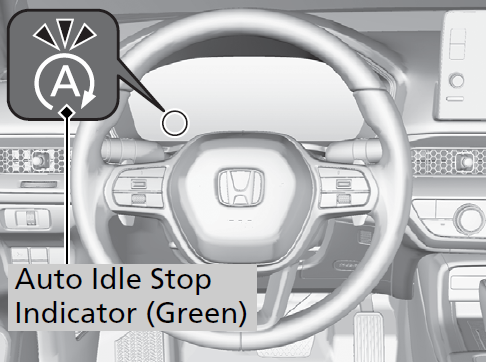
The Auto Idle Stop suspend indicator comes on and a message appears on the gauge when the Auto Idle Stop system cannot be activated.

- Detail
- Increase in ECON mode, compared to when ECON mode is off, with climate control in use.
To turn the Auto Idle Stop system off, press this button. The Auto Idle Stop system stops.
- Auto Idle Stop system will stop, the indicator will come on and a message appears on the gauge.
The Auto Idle Stop system is turned on every time you start the engine, even if you turned it off the last time you drove the vehicle.

- Detail
- Detail
In this case, restart the engine with the ENGINE START/STOP button.
- The Auto Idle Stop OFF button is pressed.
- The driver’s seat belt is not fastened.
- The engine is not adequately warmed up or coolant temperature is high.
- The transmission fluid temperature is low or high.
- The vehicle comes to a stop again before the vehicle speed reaches 3 mph (5 km/h) after the engine starts.
- The vehicle is stopped on a steep incline.
- The transmission is in a position other than D.
- The engine is started with the hood open.
- Turn off the engine. Close the hood before you restart the engine to activate Auto Idle Stop.
- The battery charge is low.
- The internal temperature of the battery is 41°F (5°C) or less.
- The climate control system is in use, and the outside temperature is below −4°F (−20°C) or over 104°F (40°C).
- The climate control system is in use, and the temperature is set to Hi or Lo.
 is ON (indicator on).
- The drive mode is in the SPORT mode.
- The vehicle is stopped by braking suddenly.
- The steering wheel is operated.
- The vehicle is repeatedly accelerated and decelerated at a low speed.
- The fan speed is high.
- The climate control system is in use, and there is a significant difference between the set temperature and the actual interior temperature.
- The climate control system is in use, and humidity in the interior is high.
- Altitude is high.
- The brake pedal is released (without the automatic brake hold system activated).
- The accelerator pedal is depressed (with the automatic brake hold system activated).
- When the transmission is put into P from D or N on a slope.
- Detail
- The Auto Idle Stop OFF button is pressed.
- The steering wheel is operated.
- The transmission is put into R, S*, or L*, or when it is set from N to D.
- If you put the transmission into P after the Auto Idle Stop activates, the Auto Idle Stop continues to operate. In this case, the engine restarts when you depress the brake pedal.
- The pressure on the brake pedal is reduced and the vehicle starts moving while stopped on an incline.
- The pressure on the brake pedal is repeatedly applied and released slightly during a stop.
- The battery charge becomes low.
- The accelerator pedal is depressed.
- The driver’s seat belt is unlatched.
- is ON (indicator on).
- The climate control system is in use, and the difference between the set temperature and actual interior temperature becomes significant.
- The climate control system is being used to dehumidify the interior.
- The vehicle ahead of you starts again when your vehicle stops automatically with Adaptive Cruise Control (ACC) with Low Speed Follow.
- The SPORT mode is selected by using the drive mode switch.
- Detail
Briefly keeps the brake applied after releasing the brake pedal to restart the engine. This can keep your vehicle from unexpectedly moving while on an incline.
* Not available on all models
Auto Idle Stop (Manual transmission models)
To help maximize fuel economy, the engine automatically stops when the vehicle comes to a stop, depending on environmental and vehicle operating conditions. The indicator (green) comes on at this time.
- The environmental and vehicle conditions that impact Auto Idle Stop system operation are varied.

- The Auto Idle Stop suspend indicator comes on and a message appears on the gauge when the Auto Idle Stop system cannot be activated.

- Detail
- To turn the Auto Idle Stop system off, press this button. The Auto Idle Stop system stops.
- Auto Idle Stop system will stop, the indicator will come on and a message appears on the gauge.

- Detail
In this case, restart the engine with the ENGINE START/STOP button.
- The Auto Idle Stop OFF button is pressed.
- The driver’s seat belt is not fastened.
- The engine is not adequately warmed up or coolant temperature is high.
- The vehicle comes to a stop again before the vehicle speed reaches 2 mph (3 km/h) after the engine starts.
- The engine is started with the hood open.
- Turn off the engine. Close the hood before you restart the engine to activate Auto Idle Stop.
- The battery charge is low.
- The internal temperature of the battery is 41°F (5°C) or less.
- The shift lever is in any position except N.
- The climate control system is in use, and the outside temperature is below −4°F (−20°C) or over 104°F (40°C).
- The climate control system is in use, and the temperature is set to Hi or Lo.
- is ON (indicator on).
- The drive mode is in the SPORT mode.
- The steering wheel is operated.
- The fan speed is high.
- The climate control system is in use, and there is a significant difference between the set temperature and the actual interior temperature.
- The climate control system is in use, and humidity in the interior is high.
- Altitude is high.
The clutch pedal is depressed.
- Detail
- The driver’s seat belt is unlatched.
- The transmission is put into a position other than N. Put the transmission into N to restart the engine.
NOTICE
Auto Idle Stop system also comes with stall recovery. If you fully depress the clutch pedal after stalling the engine, the engine automatically restarts.
- The Auto Idle Stop OFF button is pressed.
- The steering wheel is operated.
- The pressure on the brake pedal is reduced and the vehicle starts moving while stopped on an incline.
- The pressure on the brake pedal is repeatedly applied and released slightly during a stop.
- The battery charge becomes low.
- is ON (indicator on).
- The climate control system is in use, and the difference between the set temperature and actual interior temperature becomes significant.
- The climate control system is being used to dehumidify the interior.
- The SPORT mode is selected by using the drive mode switch.
Drive Mode Switch* (Continuously variable transmission models)
You can choose between three modes, SPORT mode, NORMAL mode and ECON mode by using the drive mode switch.
The current mode is displayed on the driver information interface, and each mode will appear differently.
If you were driving in SPORT or NORMAL mode last time, NORMAL mode is selected when you set the power mode to ON.
If you were driving in ECON mode last time, ECON mode is selected when you set the power mode to ON.

- Detail
- The vehicle is turning.
- The VSA® system is activating.
- There is a problem with the engine, the transmission, the VSA®, and the EPS.
- Enhances heightened throttle response.

- Balances handling and riding in all environments.

- Helps you improve your fuel economy by adjusting the performance of the engine, transmission and climate control system.

* Not available on all models
Drive Mode Switch* (Manual transmission models)
You can choose between three modes, SPORT mode, NORMAL mode and INDIVIDUAL mode by using the drive mode switch.
The current mode is displayed on the driver information interface, and each mode will appear differently.
NORMAL mode is selected every time you set the power mode to ON.
- Detail
- The vehicle is turning.
- The VSA® system is activating.
- There is a problem with the engine, the VSA®, and the EPS.

- Enhances heightened throttle response.

- Balances handling and riding in all environments.

- Each category can be customized separately to suit the audio/information screen.

- Press the drive mode switch up and hold or select Customize to enter INDIVIDUAL mode and open the INDIVIDUAL settings.
- You can also select from Customized Features on the 9-in. Color Touchscreen.
- Select the setting category.
- Select the desired setting.

|
Category
|
Description
|
|---|---|
|
Engine
|
Select NORMAL or SPORT for the engine throttle response
|
|
Steering
|
Select NORMAL or SPORT for the steering effort
|
|
Models with B-type meter
Gauge
|
Select NORMAL or SPORT to set the gauges to be displayed
|
|
All models
Default
|
Engine, Steering, and Gauge* are set to NORMAL
|
* Not available on all models
Vehicle Stability AssistTM (VSA®), aka Electronic Stability Control (ESC), System
VSA® helps stabilize the vehicle during cornering if the vehicle turns more or less than what was intended. It also assists in maintaining traction on slippery surfaces. It does so by regulating engine output and selectively applying the brakes.
- Detail
Drive a short distance at more than 12 mph (20 km/h).
Each indicator should go off. If any do not, have your vehicle checked by a dealer.
 button is pressed, the traction control function becomes less effective. This allows for the wheels to spin more freely at low speed. You should only attempt to free your vehicle with the VSA® off if you are not able to free it when the VSA® is on.
- When VSA® activates, you may notice that the engine does not respond to the accelerator. You may also notice some noise from the hydraulic brake system. You will also see the indicator blink.

- Models with A-type meter
- Models with B-type meter
This button is on the driver side control panel. To partially disable VSA® functionality/features, press and hold it until you hear a beep.
Your vehicle will have normal braking and cornering ability, but traction control function will be less effective.
To restore VSA® functionality/features, press the
(VSA®OFF) button until you hear a beep.VSA® is turned on every time you start the engine, even if you turned it off the last time you drove the vehicle.

- Models with A-type meter
- Models with B-type meter
* Not available on all models
Agile Handling Assist
Lightly brakes the front wheels, as needed, when you turn the steering wheel, and helps support the vehicle’s stability and performance during cornering.
- Detail
Limited Slip Differential (LSD)*
LSD (limited slip differential) is a type of differential that delivers extra torque to the wheel or the wheels with the most traction to minimize wheel slip and maintain control of the vehicle.
- Detail
NOTICE
Make sure both front tires of your vehicle are of the same brand and specified size, and have equal wear. Otherwise, the LSD may not function properly.
* Not available on all models
Tire Pressure Monitoring System (TPMS)
Instead of directly measuring the pressure in each tire, the TPMS on this vehicle monitors and compares the rolling radius and rotational characteristics of each wheel and tire while you are driving to determine if one or more tires are significantly under-inflated.
- This will cause the low tire pressure/TPMS indicator to come on and a message to appear on the gauge.


- Detail
- Warm weather can become under-inflated in colder weather.
- Cold weather can become overinflated in warmer weather.
- You rapidly accelerate, decelerate, or turn the steering wheel.
- You drive on snowy or slippery roads.
- Tire chains* are used.
- A compact spare tire* is used.
- There is a heavier and uneven load on the tires than the condition at calibration.
- Tire chains* are used.
Drive a short distance at more than 12 mph (20 km/h).
Each indicator should go off. If any do not, have your vehicle checked by a dealer.
You must start TPMS calibration every time you:
- Adjust the pressure in one or more tires.
- Rotate the tires.
- Replace one or more tires.
Before calibrating the TPMS:
- Set the cold tire pressure in all four tires.
Make sure:
- The vehicle is at a complete stop.
- The power mode is in ON.
- The transmission is in P.
- The shift lever is in N.
-
Models with 7-in. Color TouchscreenYou can calibrate the system from the settings on the driver information interface.
- Press the
 (home) button, to select Settings, then press the left selector wheel.
- Vehicle settings appears on the display.
- Press the

-
- Roll the left selector wheel.
- TPMS calibration appears on the display.
- Roll the left selector wheel.


-
- Press the left selector wheel.
- The display switches to the customization setup screen, where you can select Cancel or Calibrate.
- Roll the left selector wheel and select Calibrate, then press the left selector wheel.
- Calibration started screen appears, then the display returns to the customization menu screen.
- If the Calibration failed to start message appears, repeat step 4.
- The calibration process finishes automatically.
- Press the left selector wheel.

-
Models with 9-in. Color TouchscreenYou can calibrate the system from the customized feature on the audio/information screen.
- Set the power mode to ON.
- Press the
 button.
 - Select Vehicle Settings.
- Select TPMS Calibration.
- Select Calibrate or Cancel.
- If the Calibration Failed To Start. message appears, repeat step 5.
- The calibration process finishes automatically.

- Detail
The calibration process requires approximately 30 minutes of cumulative driving at speeds between 31-62 mph (50-100 km/h).
During this period, if power mode is set to ON and the vehicle is not moved within 45 seconds, you may notice the low tire pressure indicator comes on briefly. This is normal and indicates that the calibration process is not yet complete.
* Not available on all models
Tire Pressure Monitoring System (TPMS) - Required Federal Explanation
Each tire, including the spare (if provided), should be checked monthly when cold and inflated to the inflation pressure recommended by the vehicle manufacturer on the vehicle placard or tire inflation pressure label.
(If your vehicle has tires of a different size than the size indicated on the vehicle placard or tire inflation pressure label, you should determine the proper tire inflation pressure for those tires.)
As an added safety feature, your vehicle has been equipped with a tire pressure monitoring system (TPMS) that illuminates a low tire pressure telltale

when one or more of your tires is significantly under-inflated.
Accordingly, when the low tire pressure telltale illuminates, you should stop and check your tires as soon as possible, and inflate them to the proper pressure.
Driving on a significantly under-inflated tire causes the tire to overheat and can lead to tire failure. Under-inflation also reduces fuel efficiency and tire tread life, and may affect the vehicle's handling and stopping ability.
Please note that the TPMS is not a substitute for proper tire maintenance, and it is the driver's responsibility to maintain correct tire pressure, even if under-inflation has not reached the level to trigger illumination of the TPMS low tire pressure telltale.
Your vehicle has also been equipped with a TPMS malfunction indicator to indicate when the system is not operating properly. The TPMS malfunction indicator is combined with the low tire pressure telltale. When the system detects a malfunction, the telltale will flash for approximately one minute and then remain continuously illuminated. This sequence will continue upon subsequent vehicle start-ups as long as the malfunction exists.
When the malfunction indicator is illuminated, the system may not be able to detect or signal low tire pressure as intended.
TPMS malfunctions may occur for a variety of reasons, including the installation of replacement or alternate tires or wheels on the vehicle that prevent the TPMS from functioning properly.
Always check the TPMS malfunction telltale after replacing one or more tires or wheels on your vehicle to ensure that the replacement or alternate tires and wheels allow the TPMS to continue to function properly.
Blind Spot Information System*
When the system detects vehicles approaching from behind in adjacent lanes, the appropriate indicator comes on, providing assistance when you change lanes.
- Detail
- The rear bumper or area around the radar sensors is strongly impacted.
- The indicator does not come on even if a vehicle in the alert zone should have been detected.
- The rear bumper or any system components need to be repaired.
- Always keep the rear bumper and area around the radar sensors clean.
- Do not cover the rear bumper corner area with labels or stickers of any kind.
- The blind spot information system alert indicator does not come on and the message Blind spot information system not available appears on the driver information interface.
- The blind spot information system alert indicator may come on even with the message displayed.
The system activates when your vehicle is moving forward at about 20 mph (32 km/h) or above.

A: Approx. 1.6 ~ 10 feet (0.5 ~ 3 meters) from vehicle side.
B: Approx. 10 feet (3 meters) from rear bumper.
C: Approx. 10 ~ 82 feet (3 ~ 25 meters) behind from rear bumper. (The faster the approaching vehicle, the further away it will be detected.)
The initially set alert zone is alert zone 1. Over time, after the vehicle has been driven on straight roads with traffic and roadside objects, the system will adapt and expand the alert zone (alert zone 1 and 2).
-
Blind spot information system alert indicator: Located on the outside rearview mirror on both sides.
Comes on when:- A vehicle approaches you from behind to overtake you at a speed difference of no more than about 31 mph (50 km/h).
- You pass a vehicle at a speed difference of no more than about 12 mph (20 km/h).
Blinks and a beeper sounds when:You use the turn signal lever to signal a turn in the direction of the detected vehicle while the blind spot information system alert indicator is on.
- The beeper sounds three times.

- When you turn the blind spot information system on and off, do the following.
- Press the safety support switch.
Models with A-type meter- Roll the left selector wheel to the
 symbol and push it.
Models with B-type meter- Roll the right selector wheel to the symbol and push it.
- A message appears on the driver information interface when the system turns on or off.
- A check mark appears in the box and the color of the symbol changes to green when the system is on. The check mark disappears and the color of the symbol changes to gray when the system is off.
The blind spot information system will stay on the previously selected on (checked) or off (unchecked) setting each time you start the engine.


The blind spot information system alert indicator may not come on under the following conditions:
- There is a large speed difference between your vehicle and the vehicle in the adjacent lane.
- A vehicle is parked in a side lane.
- An object not detected by the radar sensors approaches or passes your vehicle.
- The vehicle driving in the adjacent lane is a motorcycle or other small vehicle.
The blind spot information system may not operate correctly under the following conditions:
- Making a turn at an intersection.
- Objects (guard rails, poles, trees, etc.) are detected.
- An object that does not reflect radio waves well or a motorcycle, is in the alert zone.
- Driving on a curved road.
- A vehicle is moving from a far lane to the adjacent lane.
- The system picks up signal interference such as other radar sensors from another vehicle or strong radio wave transmitted from a facility nearby.
- The rear bumper or the area around the radar sensors is covered by dirt, mud, snow, ice, etc.
- The rear bumper or the area around the radar sensors has been damaged or deformed.
- In bad weather (heavy rain, snow, and fog).
- Making a short turn or driving on a bumpy road that slightly tilts the vehicle.
* Not available on all models
Download Manual