Automatic Transmission
Automatic Transmission Precautions
|
|
Park (P)
 WARNING: Shift into park (P) only when your vehicle is stationary. WARNING: Shift into park (P) only when your vehicle is stationary. |
In park (P) power is not transmitted to the driven wheels.
Note: A tone sounds if you attempt to exit your vehicle without the vehicle in park (P).
Note: Your vehicle may not shift out of park (P) if the 12V battery has run out of charge.
Note: Your vehicle may not shift out of park (P) if a fuse is blown.
Note: Your vehicle may not shift out of park (P) unless the key or remote control is inside your vehicle.
Note: The electronic parking brake could apply when you power your vehicle on with the selector in park (P).
Note: The electronic parking brake could apply if you shift to park (P) without fully pressing the brake pedal.
Note: The electronic parking brake could apply if you shift to park (P) on a slope.
Note: Do not manually release the parking brake when the selector is in park (P). See Automatically Releasing the Electric Parking Brake.
Note: Your vehicle could shift into park (P) if you attempt to exit your vehicle without the transmission in park (P). See How Does Automatic Return to Park (P) Work.
Note: A tone could sound when you select park (P).
Reverse (R)
| WARNING: Shift into reverse (R) only when your vehicle is stationary. |
In reverse (R) power is transmitted to the driven wheels.
Neutral (N)
| WARNING: In neutral (N) your vehicle is free to roll. |
In neutral (N) power is not transmitted to the driven wheels.
Drive (D)
In drive (D) power is transmitted to the driven wheels.
Sport (S)
In sport (S) your vehicle holds gears longer.
Note: We recommend using this mode for a sportier feel or when driving on hilly or mountainous roads.
Shifting Your Vehicle Into Gear
Rotary Gear Shift Dial
The transmission selector is on the center console.
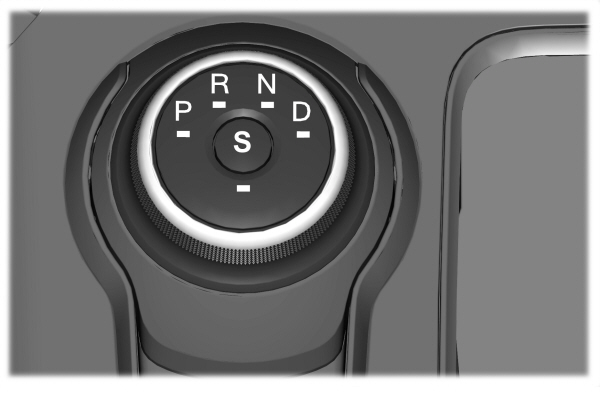
- Press and hold the brake pedal.
- Rotate the outer ring to select a position.
Note: The position illuminates on the transmission selector.
Note: Your vehicle cannot shift from drive (D) to park (P) with a clockwise rotation. Your vehicle cannot shift from park (P) to drive (D) with a counterclockwise rotation.
- Press the low (L) or manual (M) or sport (S) button when your vehicle is in drive (D) to enter or exit mode.
Automatic Transmission Position Indicators
The instrument cluster displays the current position.

Note: The position could illuminate on the transmission selector.
Automatic Transmission Audible Warnings
Transmission Not In Park (P) Audible Warning
Sounds if you open the driver door before shifting into park (P).
Shifting Using the Paddle Shifters
The instrument cluster displays the current gear. The current gear flashes when your vehicle cannot shift into the requested gear. Your vehicle will not shift if the requested gear raises or lowers the engine speed beyond the limit.
Your vehicle could shift when you fully press the accelerator or brake pedal.
Note: Prolonged driving with high engine speed could cause vehicle damage not covered by vehicle warranty.
Note: Drive modes could affect when the vehicle shifts into the requested gear.
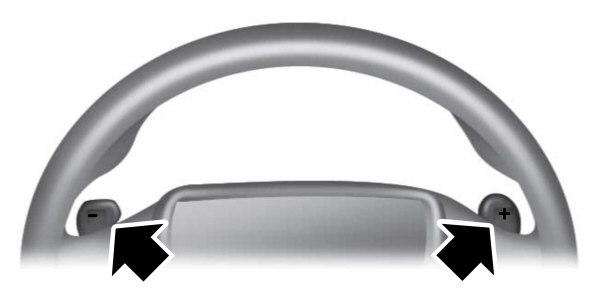
Manually Shifting in Drive (D)
Use this feature to temporarily change gear.
Note: We recommend using this feature for engine braking or driving on hilly or mountainous roads.
- Pull any paddle to switch the feature on.
- Pull the right (+) paddle to upshift.
- Pull the left (-) paddle to downshift.
- Hold the (+) paddle for a few seconds to switch the feature off.
Note: The feature switches off after a short period of time if neither paddle is pulled.
Manually Shifting in Sport (S)
Use this feature to select a specific gear.
Note: We recommend using this feature for engine braking, driving on hilly or mountainous roads, or when towing a trailer. See Towing a Trailer.
- Pull any paddle to switch the feature on.
- Pull the right (+) paddle to upshift.
- Pull the left (-) paddle to downshift.
- Hold the (+) paddle for a few seconds to switch the feature off.
What Is Temporary Neutral Mode
This mode keeps your vehicle in neutral (N), for a limited time, when you exit your vehicle or switch your vehicle off.
Note: Do not tow your vehicle in this mode.
How Does Temporary Neutral Mode Work
Use this mode to keep your vehicle in neutral (N), for a limited time, when you exit your vehicle or switch your vehicle off. For example, if you exit your vehicle before an automatic car wash.
Note: You do not need to use this mode at an automatic car wash if you shift into neutral (N) and stay in your vehicle with power on.
Note: Do not tow your vehicle in this mode.
Note: Automatic return to park (P) is delayed when your vehicle is in this mode.
Temporary Neutral Mode Limitations
This mode could be unavailable if your 12 V battery charge level is low. Connect an external power source and attempt the procedure again.
Your vehicle could shift to park (P) after 30 minutes, or when the vehicle battery charge level is low. Prolonged use of this mode can cause the 12 V battery to run out of charge.
This mode could be unavailable if your vehicle is below operating temperature. Warm up your vehicle and attempt the procedure again.
Do not tow your vehicle in this mode. Failure to follow these instructions could result in vehicle damage not covered by the vehicle warranty.
Entering Temporary Neutral Mode
- Bring your vehicle to a complete stop.
- Press and hold the brake pedal.
- Power your vehicle on.
- Shift into neutral (N).
Note: An instructional message appears.
- Press the sport (S) button.
Note: A confirmation message appears when your vehicle enters the mode.
- Release the brake pedal.
Note: Your vehicle is free to roll.
- Switch your vehicle off.
Note: Do not tow your vehicle in this mode.
Note: The neutral (N) indicator on the transmission selector may flash in this mode.
Exiting Temporary Neutral Mode
- Press the brake pedal.
- Shift into park (P), or power your vehicle on and shift into drive (D) or reverse (R).
What Is Automatic Return to Park (P)
Your vehicle shifts into park (P) if you attempt to exit your vehicle without the vehicle in park (P).
How Does Automatic Return to Park (P) Work
Your vehicle shifts into park (P) when your vehicle is stationary and any of the following occur:
- You switch the vehicle off.
- You open the driver door with your seatbelt unfastened.
- You unfasten the driver seatbelt when the driver door is open.
Note: Do not use automatic return to park (P) when your vehicle is moving, except in an emergency.
Automatic Return to Park (P) Limitations
Automatic return to park (P) may not work if any of the following occur:
- The driver door ajar sensor is malfunctioning.
- The driver seatbelt sensor is malfunctioning.
See an authorized dealer if any of the following occur:
- Seatbelt indicator illuminates or tone sounds with the driver seatbelt fastened.
- Door ajar indicator does not illuminate with the driver door open.
- Door ajar indicator illuminates with the driver door closed.
- Transmission not in park message appears, with the driver door closed, after you shift out of park (P).
What Is Manual Park Release
Manual park release allows you to shift your vehicle out of park (P) in the event of an electrical malfunction or emergency.
Manual Park Release Precautions
|
|
Using Manual Park Release
Activating the Manual Park Release Cable
- Apply the parking brake.
Note: If the 12V battery has run out of charge, use an external power source to apply the parking brake.
- Remove the access cover located under the steering wheel.
Note: Do not pull the tether.
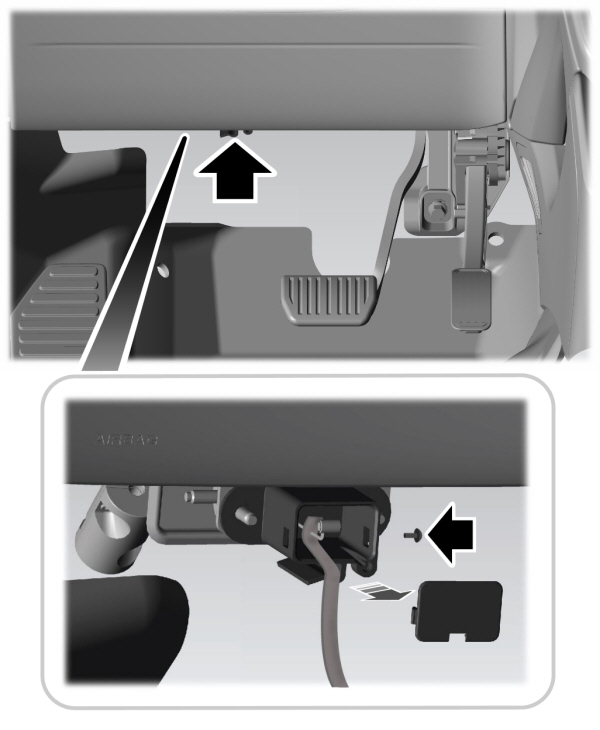
- Sit in the driver seat.
- Power your vehicle on without your foot on the brake pedal.
Note: Do not attempt this procedure when the engine is running. Failure to follow this instruction could result in vehicle damage not covered by the vehicle warranty.
- Press and hold the brake pedal.
- Pull the tether towards you. Move tether to the lower righthand corner of housing until bead engages in the pocket.
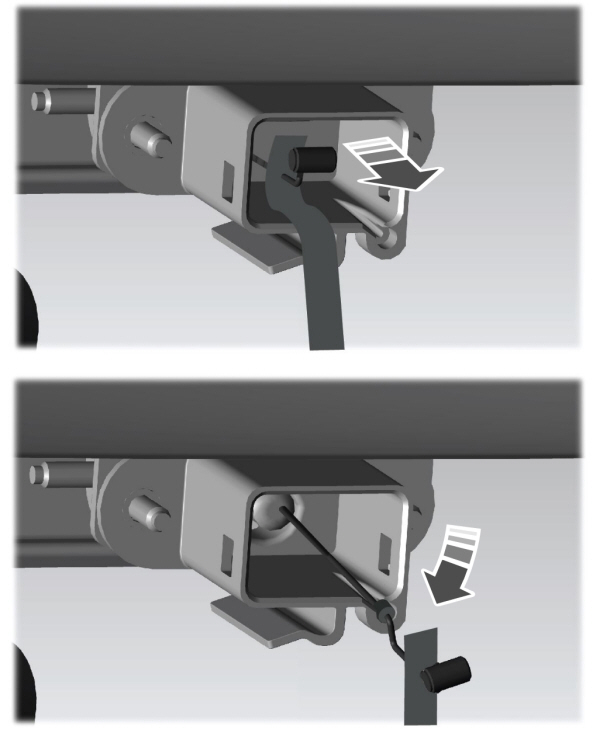
Note: Do not use excessive force. Failure to follow this instruction could result in vehicle damage not covered by the vehicle warranty.
Note: A message appears when your vehicle is out of park (P). If you do not receive a message attempt the procedure again.
Note: A warning lamp could illuminate.
- Release the parking brake.
- Switch your vehicle off.
- Release the brake pedal.
Note: Your vehicle is free to roll.
- Disconnect the negative battery cable from the 12V battery as soon as it is safe to do so.
Note: If your vehicle detects wheel speed when the 12V battery is connected, the electronic parking brake could apply.
Returning Your Vehicle to Normal Mode
- Connect the negative battery cable to the 12V battery as soon as it is safe to do so.
Note: If your vehicle detects wheel speed when the 12V battery is connected, the electronic parking brake could apply.
- Apply the parking brake.
Note: If the 12V battery has run out of charge, use an external power source to apply the parking brake.
- Sit in the driver seat.
- Press and hold the brake pedal.
Note: Do not start your vehicle.
- Pull the tether towards you to release the bead. Maintain tension. Center the tether within housing. Release tension and return tether to the stowed position.
- Start your vehicle.
- Confirm the instrument cluster displays park (P).
Note: If the instrument cluster does not display park (P), the warning lamp remains illuminated, or a message persists contact an authorized dealer for service.
- Switch your vehicle off.
- Release the brake pedal.
- Install the access cover.
Download Manual