Driving Hints
The functional operation of some components and systems can be affected at temperatures below approximately -13 °F (-25 °C).
Breaking-In
Tires
You need to break in new tires for approximately 300 mi (480 km). During this time, your vehicle may exhibit some unusual driving characteristics.
Brakes and Clutch
Avoid heavy use of the brakes and clutch if possible for the first 100 mi (160 km) in town and for the first 1,000 mi (1,600 km) on freeways.
Driving Economically
The following helps to improve fuel consumption:
- Drive smoothly, accelerate gently and anticipate the road ahead to avoid heavy braking.
- Regularly check your tire pressures and make sure that they are inflated to the correct pressure.
- Follow the recommended maintenance schedule and carry out the recommended checks.
- Plan your journey and check the traffic before you set off. It is more efficient to combine errands into a single trip whenever possible.
- Avoid idling the engine in cold weather or for extended periods. Start the engine only when you are ready to set off.
- Do not carry unnecessary weight in your vehicle as extra weight wastes fuel.
- Do not add unnecessary accessories to the exterior of your vehicle, for example running boards. If you use a roof rack, remember to fold it down or remove it when not in use.
- Do not shift into neutral when you are braking or when your vehicle is slowing down.
- Shut all windows when driving at high speeds.
- Switch off all electric systems when not in use, for example air conditioning. Make sure that you unplug any accessories from the auxiliary power points when not in use.
Driving Through Mud and Water
Mud
Be cautious of sudden changes in vehicle speed or direction when you are driving in mud. Even all-wheel drive and four-wheel drive vehicles can lose traction in mud. If your vehicle slides, steer in the direction of the slide until you regain control of your vehicle. After driving through mud, clean off residue stuck to rotating driveshafts and tires. Excess residue can cause an imbalance that could damage drive components.
Note: If your vehicle gets stuck in mud, it could be rocked out by shifting between forward and reverse gears, stopping between shifts in a steady pattern. Press lightly on the accelerator in each gear.
Note: Do not rock your vehicle if the engine is not at normal operating temperature, as damage to the transmission could occur.
Note: Do not rock your vehicle for more than a minute, as damage to the transmission and tires could occur or the engine could overheat.
Water
If you must drive though deep water, drive slowly. The water could limit traction or brake capability. See Driving Through Shallow Water.
When driving though water, determine the depth and avoid water higher than the center of the wheel.
Once through water, always try the brakes. Wet brakes do not stop your vehicle as quickly as dry brakes. Apply light pressure to the brake pedal while slowly moving the vehicle to dry the brakes.
Note: Driving through deep water could cause damage to the transmission. If the front or rear axle is submerged in water, have the axle lubricant and power transfer unit lubricant checked and changed if necessary.
Driving on Hilly or Sloping Terrain
 WARNING: Extreme care should be used when steering the vehicle in reverse down a slope so as not to cause the vehicle to swerve out of control. WARNING: Extreme care should be used when steering the vehicle in reverse down a slope so as not to cause the vehicle to swerve out of control. |
Although natural obstacles could make it necessary to travel diagonally up or down a hill or steep incline, you should try to drive straight up or straight down.
Note: Avoid turning on steep slopes or hills. A danger lies in losing traction, slipping sideways and possible vehicle roll over. Whenever driving on a hill, determine beforehand the route you can use. Do not drive over the crest of a hill without seeing what conditions are on the other side. Do not drive in reverse over a hill without the aid of an observer.
Apply just enough power to the wheels to climb the hill. Too much power causes the tires to slip, spin or lose traction, and you could lose control of your vehicle. When descending a steep hill, do not descend the hill in neutral. Avoid sudden hard braking to keep the front wheels rolling and to maintain your vehicle's steering.
Note: Your vehicle has anti-lock brakes, apply the brakes steadily. Do not pump the brakes.
Note: If your vehicle gets stuck driving on hilly or sloping terrain, it could be rocked out by shifting between forward and reverse gears, stopping between shifts in a steady pattern. Press lightly on the accelerator in each gear.
Note: Do not rock your vehicle if the engine is not at normal operating temperature, as damage to the transmission could occur.
Note: Do not rock your vehicle for more than a minute, as damage to the transmission and tires could occur or the engine could overheat.
Driving In Sand
When driving over sand, try to keep all four wheels on the most solid area of the trail.Steadily drive through the terrain.Apply the accelerator slowly and avoid excessive wheel slip. Do not drive your vehicle in deep sand for an extended period of time.This could overheat the system.A message appears in the instrument cluster display.
Note: If your vehicle gets stuck driving on hilly or sloping terrain, it could be rocked out by shifting between forward and reverse gears, stopping between shifts in a steady pattern. Press lightly on the accelerator in each gear.
Note: Do not rock your vehicle if the engine is not at normal operating temperature, as damage to the transmission could occur.
Note: Do not rock your vehicle for more than a minute, as damage to the transmission and tires could occur or the engine could overheat.
Driving Through Shallow Water
| WARNING: Do not attempt to cross a deep or flowing body of water. Failure to follow this instruction could result in the loss of control of your vehicle, personal injury or death. |
Note: Driving through standing water can cause vehicle damage.
Note: Engine damage can occur if water enters the air filter.
Before driving through standing water, check the depth. Never drive through water that is higher than the bottom of the front rocker area of your vehicle.
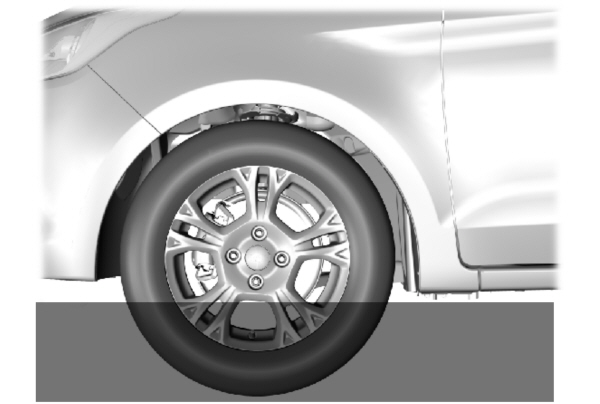
When driving through standing water, drive very slowly and do not stop your vehicle. Your brake performance and traction could be limited.After driving through water and as soon as it is safe to do so:
- Lightly press the brake pedal to dry the brakes and to check that they work.
- Turn the steering wheel to check that the steering power assist works.
Check the function of the following:
- Horn
- Exterior lights
Floor Mats
| WARNING: Use a floor mat designed to fit the footwell of your vehicle that does not obstruct the pedal area. Failure to follow this instruction could result in the loss of control of your vehicle, personal injury or death. WARNING: Pedals that cannot move freely can cause loss of vehicle control and increase the risk of serious personal injury. WARNING: Secure the floor mat to both retention devices so that it cannot slip out of position and interfere with the pedals. Failure to follow this instruction could result in the loss of control of your vehicle, personal injury or death. WARNING: Do not place additional floor mats or any other covering on top of the original floor mats. This could result in the floor mat interfering with the operation of the pedals. Failure to follow this instruction could result in the loss of control of your vehicle, personal injury or death. WARNING: Always make sure that objects cannot fall into the driver foot well while your vehicle is moving. Objects that are loose can become trapped under the pedals causing a loss of vehicle control. |
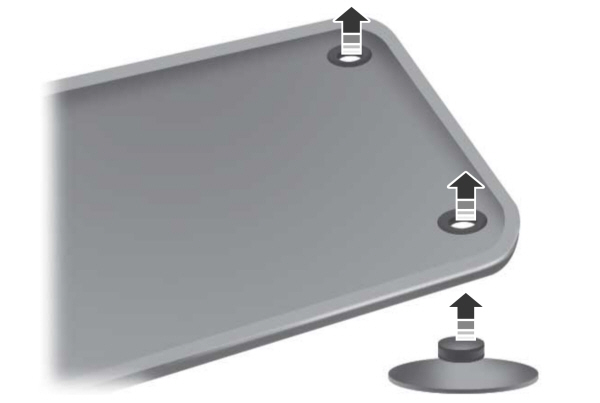
To install floor mats that have eyelets, position the floor mat eyelet over the retention post and press down to lock in position. Repeat for all eyelets on the floor mat.
To remove the floor mats, reverse the installation procedure.
Note: Regularly check the floor mats to make sure they are secure.
Download Manual