Weights and axle weights
The actual gross weight of any vehicle depends on the engine, basic equipment, any factory-installed optional equipment for the given model, and any accessories that have been installed. The Gross Vehicle Weight Rating (GVWR) and the Gross front and Rear Axle Weight Ratings (GAWR) for a given vehicle are printed on the vehicle's Safety Compliance Certification Label on the driver door jamb .
The Gross Vehicle Weight Rating includes the weight of the vehicle itself with all of its factory-installed equipment, plus a full tank of gasoline, the engine oil and coolant, all vehicle occupants (150 lbs/68 kg per seating position) and cargo.
The Gross Axle Weight Ratings specify the maximum allowable load for each axle.
The cargo payload may not be increased by using a roof rack without subtracting the weight of the roof rack and the cargo being carried on it . See .
Vehicle payload consists of the combined weight of the following:
- Passengers.
- Total luggage and other cargo.
- Roof load, including the roof rack system, if permitted .
- Factory-installed or retrofitted accessories.
Please refer to the Gross Vehicle Weight Rating (GVWR) and the Gross front and rear Axle Weight Ratings (GAWR) for your vehicle, which are printed on the vehicle's Safety Compliance Certification Label on the driver door jamb .
 WARNING
Exceeding maximum permissible weight ratings can result in vehicle damage, accidents, and serious personal injury.
- Never let the actual weights at the front and rear axles exceed the permissible Gross Axle Weight Rating. Also, never let the total of these actual weights exceed the Gross Vehicle Weight Rating.
- Always remember that the vehicle's handling and braking will be affected by extra load and the distribution of this load. Adjust your speed accordingly.
 NOTE
NOTE
- Always distribute the load evenly and as low as possible in the vehicle. The vehicle capacity weight figures apply when the load is distributed evenly in the vehicle (passengers and luggage).
- When transporting a heavy load in the luggage compartment, carry the load as close to the rear axle (as far forward) as possible so that the vehicle's handling and braking are affected as little as possible.
Vehicle identification label
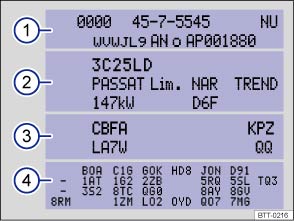
Fig. 180 Vehicle identification label: Shown in the example with engine identification code CBFA ③.
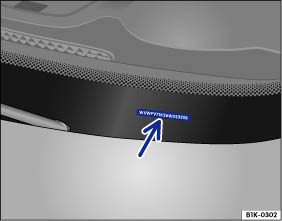
Fig. 181 Vehicle identification number (VIN).
Vehicle identification number (VIN)
The vehicle identification number is on a plate on top of the instrument panel on the driver side, and is visible from the outside through the windshield (arrow). The view window is on the side at the bottom of the windshield. The vehicle identification number is also stamped into the bulkhead in the engine compartment. Open the engine hood to read the vehicle identification number .
Vehicle identification label
The vehicle identification label is affixed to the area of the spare wheel well underneath the luggage compartment floor panel and contains the following information:
 Vehicle identification number (VIN)
 Vehicle type, engine output, and transmission
 Engine and transmission identification codes, paint number, and interior type. In the example, the engine identification code is CBFA .
 Optional equipment and part numbers
Dimensions
| Length | 168.4–168.8 inches (4278–4288 mm) |
| Width | 71.2 inches (1808 mm) |
| Height (unloaded)a) | 58.0–58.5 inches (1473–1486 mm) |
| Wheelbase | 99.9 inches (2537 mm) |
| Minimum turning circle diameter (wall to wall)b) | 35.4 feet (10.8 m) |
| Trackb), front | 61.8–62.2 inches (1570–1580 mm) |
| Trackb), rear | 60.5–61.2 inches (1536–1556 mm) |
| Ground clearance (unloaded)b) | 5.3–5.7 inches (136–144 mm) |
NOTE
- Please be careful when parking your vehicle in areas with parking barriers or curbs. These vary in height and could damage your bumper and related parts if the front of your vehicle hits a barrier or curb that is too high while you are getting into or out of a parking spot.
- Always be careful when you enter a driveway or drive up or down steep ramps or over curbs or other obstacles. Parts of the vehicle close to the ground may be damaged (such as bumper covers, spoilers, and parts of the engine, suspension, and exhaust systems).
a) With convertible top closed (Beetle Convertible models only).
b) Slight differences to these figures are possible, depending on wheel and tire size fitted, tire inflation pressure, equipment level, driving situation, and other factors.
Fuel capacities
| Engine | Fuel tank capacity |
|---|---|
| All engines | About 14.5 gallons (55.0 liters), of which about 1.8 gallons (7.0 liters) are reserve. |
Download Manual