Information on driving safely and efficiently
 Introduction to the subject
In this chapter you will find information on the following subjects:
Pedals
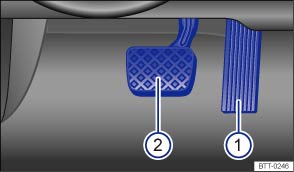
Fig. 97 In the driver footwell: Pedals in vehicles with automatic transmission.
Read and follow the introductory information and safety information first
Key to :
 Accelerator pedal
 Brake pedal
All pedals must always be able to move freely in and out without interference from floor mats or other things.
Only use floor mats that leave the pedal area free and are held securely in place with floor mat fasteners to help prevent sliding.
If a brake circuit malfunctions, more brake pedal travel is needed to bring the vehicle to a full stop, and it is important that nothing is in the way when you have to depress the brake pedal harder and farther than normal.
 WARNING
Objects in the driver footwell can prevent the pedals from moving freely. This can cause loss of vehicle control and increase the risk of serious personal injuries.
- Always make sure that nothing can interfere with the pedals.
- Always fasten floor mats securely to the floor.
- Never put floor mats or other floor coverings on top of already installed floor mats.
- Always make sure that nothing can fall into the driver footwell while the vehicle is moving.
 NOTE
NOTE
Always make sure that the pedals are able to move freely and that nothing can interfere with them. If a brake circuit fails, more brake pedal travel will be needed to bring the vehicle to a stop. The brake pedal must be pressed farther and harder than normal.
Efficient driving style
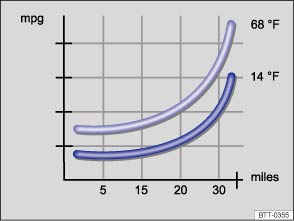
Fig. 98 Fuel consumption in miles per gallon (mpg) at 2 different outside air temperatures.
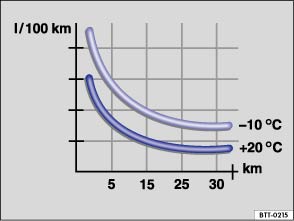
Fig. 99 Fuel consumption in l/100 km at 2 different outside air temperatures.
Read and follow the introductory information and safety information first
Drive defensively
Frequent braking and acceleration increase fuel consumption significantly. By watching the traffic, you can help avoid unnecessary braking and accelerating. If you keep enough distance from the car in front of you, you can maintain a more constant speed. Active braking and accelerating is then not necessarily required.
Use the cruise control when possible to maintain a uniform driving style .
If possible, coast the vehicle to a stop, for example, when you can see that the next traffic light is red or about to turn red.
Avoid full throttle acceleration
Driving at higher speeds uses more fuel. The air resistance and the power needed to move the vehicle increases at high speeds, for example over about 80 mph (130 km/h).
Reduce idling
In situations where the vehicle will be stopped for a longer period of time, such as at a railroad crossing, switch off the engine.
Refuel in moderation
A completely full tank raises the weight of the vehicle. A partially-filled tank is plenty, especially in city traffic.
Avoid traveling short distances
A cold engine uses a lot more fuel right after starting. It takes a few miles (km) before the engine is warmed up and fuel consumption is stabilized.
Under the same conditions, the vehicle consumes more fuel in winter than in summer. Therefore, avoid driving short distances unnecessarily and consolidate routes.
Letting the engine run to warm up is not only illegal in some places, but also technically not necessary and wastes fuel.
Perform regular maintenance
Regular maintenance is necessary for fuel-efficient driving and helps extend the life of the vehicle.
Adjust the tire pressure
The proper tire pressure helps reduce rolling resistance as well as fuel consumption. When purchasing new tires, always make sure that the tires are optimized for lower rolling resistance.
Adjust the tire pressure according to the figures on the tire pressure label .
Use low viscosity engine oil
Fully synthetic, low viscosity engine oils that expressly comply with Volkswagen oil quality standards reduce fuel consumption. Low viscosity engine oils reduce the frictional resistance on the engine and are distributed more evenly and quickly, particularly when cold-starting the engine. The effect is particularly apparent in vehicles that frequently travel short distances.
Always ensure the right engine oil level is maintained and keep to the scheduled service intervals (engine oil changes).
Make sure the engine oil that you purchase expressly complies with Volkswagen oil quality standards and is the oil approved by Volkswagen for your vehicle.
Avoid unnecessary weight
The lighter the vehicle, the more economical and eco-friendly it will be. For example, an extra 220 lbs (100 kg) of weight increases fuel consumption by up to 1 pint per 60 miles (0.3 l/100 km). Remove unnecessary dead weight from the vehicle.
The more aerodynamic the vehicle, the less fuel it will consume. Remove unnecessary items, such as roof racks, from the vehicle.
Use extra electrical loads in moderation
Comfort inside the vehicle is important, but it is also important to use extra electrical loads, such as the air conditioner and seat heating, in an environmentally conscious manner.
Saving energy can be easy, for example:
- In hot outside temperatures, it may be helpful to ventilate the vehicle before driving and then to drive a short distance with the windows open. After that, switch on the air conditioner with the windows closed. Keep the windows closed when driving at high speeds. Open windows increase wind resistance and fuel consumption.
- Switch off electrical loads once they have served their purpose.
WARNING
Always adjust your speed and driving style to visibility, road, traffic, and weather conditions.
NOTE
Never let the vehicle coast or roll down a hill in Neutral (N), especially when the engine is not running. The transmission will not be lubricated and will be damaged.

Find out about other ways to protect the environment. Think Blue.® is the international Volkswagen brand for sustainability and environmental compatibility.
Your Volkswagen dealer or authorized Volkswagen Service Facility can provide you with additional information about correct maintenance and replacement parts that are particularly fuel efficient, for example new tires.

Under the same conditions, the vehicle consumes more fuel in winter than in summer.
About the brakes
Read and follow the introductory information and safety information first
New brake pads do not provide full performance during the first 100 to 200 miles (200 to 300 km) and must first be broken in . To some extent, you can make up for the somewhat reduced performance by applying more pressure to the brake pedal. But, during the break-in period, the stopping distance for hard braking and emergency braking will be longer until the brakes are fully broken in. Avoid hard braking and situations that might require hard braking (such as following other vehicles too closely) – especially during the break-in period.
Brake pad wear depends mostly on operating conditions and the way the vehicle is driven. If you do a lot of city and short-distance driving and/or have a sporty driving style, you should have the brake pads checked by an authorized Volkswagen dealer or authorized Volkswagen Service Facility more often than the regular service intervals .
Wet brakes (for example, after driving through water or washing the vehicle or after heavy rainfall) will not brake as well. Stopping distances will be longer when brake discs are wet or, in winter, even icy. Wet or icy brakes must be dried as soon as possible by carefully applying the brakes a couple of times while traveling at a relatively high speed. Make sure nobody is behind you and that you do not endanger yourself or others .
Brakes coated with road salt also react slower and need longer stopping distances. If there is salt on the roads and you are not braking regularly, brake carefully and gently from time to time to remove any salt coating from the brake discs and pads .
Brake disc corrosion (rust) and dirt buildup on the brake pads are more likely to occur if the vehicle is not driven much or is driven only for short distances with little braking. If the brakes have not been used and there is some rust on the discs, clean the brake discs and pads once in a while by carefully braking a couple of times while driving at relatively high speed to help clean the brake discs and pads. Make sure nobody is behind you and that you do not endanger yourself or others .
Brake system malfunction
If you brake and find that the vehicle doesn't brake nearly as well as it used to (sudden increase in stopping distance), a brake circuit may have failed. The brake warning light or
will light up and a message may appear in the instrument cluster display. If you believe the vehicle is safe to drive, immediately take it to the nearest authorized Volkswagen dealer or authorized Volkswagen Service Facility for repair. Drive slowly and very carefully, allow for the longer stopping distance, and be ready to push longer and harder on the brake pedal to slow the vehicle down.
Brake booster
The brake booster works only when the engine is running. It increases the force on the brakes above and beyond the pressure put on the brake pedal by the driver.
If the brake booster is not working, or if the vehicle has to be towed, you will have to push the brake pedal harder to make up for the lack of booster assistance and the resulting longer stopping distance .
WARNING
Driving with bad brakes or worn brake pads can cause a collision and serious personal injury.
- If the brake warning light
or
does not go out, or lights up when driving, either the brake fluid level in the reservoir is too low or there is a fault in the brake system. Stop the vehicle as soon as you can do so safely and get expert assistance .
- If the brake warning light
or
, the ABS may not be working properly. This could cause the rear wheels to lock up relatively quickly during braking. Rear wheel brake lock-up can cause loss of vehicle control.
- If you believe the vehicle is safe to drive, drive slowly and very carefully to the nearest authorized Volkswagen dealer, authorized Volkswagen Service Facility, or other qualified workshop and have the brake system inspected. Avoid sudden hard braking and steering.
- If the ABS indicator light
- If the brake pads are worn or you notice changes in the way the vehicle brakes, immediately contact an authorized Volkswagen dealer or authorized Volkswagen Service Facility to have the brake pads checked and, if necessary, replaced.
WARNING
New brake pads do not provide maximum braking performance.
- New brake pads do not have the best stopping power for the first 200 miles (320 km) and must be broken in. You can compensate for the slightly reduced braking force by putting more pressure on the brake pedal.
- Drive with extra care while the new brake pads are being broken in. This reduces the risk of collisions and serious personal injuries due to a loss of control over the vehicle.
- Never follow other vehicles too closely or put yourself into other situations that might require sudden, hard braking, especially when the brake pads have not been broken in.
WARNING
Constant braking causes the brakes to overheat and even to fail leading to collisions and serious personal injury.
- Never ride the brakes or apply the brake pedal too often or too long.
- Riding the brakes will substantially reduce braking performance, increase stopping distance, and can cause complete brake system failure.
WARNING
Overheated brakes will reduce the vehicle's stopping power and increase stopping distances considerably.
- When driving downhill, the brakes have to work especially hard and heat up quickly.
- Before driving downhill, especially on hills that are long or steep, always reduce speed and shift into lower gear (manual, automatic transmission). This will let the vehicle use engine braking and reduce the load on the brakes. Otherwise, the brake system could overheat and possibly fail. Only use the brakes when you need them to slow the vehicle down more or to stop.
- A damaged front bumper or a non-standard spoiler can reduce airflow to the brakes and make them overheat.
WARNING
Wet brakes or brakes coated with ice or road salt react slower and need longer stopping distances.
- Carefully apply the brakes to test them.
- Always dry brakes and clean off ice and salt coatings with a few cautious brake applications when visibility, weather, road and traffic conditions permit.
WARNING
Driving when the brake booster is not working increases stopping distances and can cause accidents and serious personal injuries.
- Never let the vehicle coast when the engine is switched off.
- If the brake booster is not working (such as when the vehicle is being towed), a lot more pedal force is needed to slow down and stop.
NOTE
- Never ride the brakes by keeping your foot on the brake pedal when you do not want to brake. Constant pressure on the brake pedal can make the brakes overheat. Riding the brakes will substantially reduce braking performance, increase stopping distance, and can cause complete brake system failure.
- Before driving downhill, especially on hills that are long or steep, always reduce speed and shift into lower gear (manual or automatic transmission). This will let the vehicle use engine braking and reduce the load on the brakes. Otherwise, the brake system could overheat and possibly fail. Only use the brakes when you need them to slow the vehicle down more or to stop.
When the front brakes are serviced, you should have the rear brake pads inspected at the same time. The wear of all brake pads should be visually checked regularly. The best way to check for brake pad wear is to have your authorized Volkswagen dealer or authorized Volkswagen Service Facility visually inspect the pads through the openings in the wheel rims or from underneath the vehicle. If necessary, the wheels can be taken off for a more thorough inspection.
Driving a loaded vehicle
Read and follow the introductory information and safety information first
For good handling when driving a loaded vehicle, please observe the following:
- Securely stow all luggage .
- Drive especially carefully and accelerate gently.
- Avoid sudden braking and driving maneuvers.
- Brake earlier than you would if you were not driving a loaded vehicle.
- If applicable, observe information about driving with a roof rack .
WARNING
Heavy loads can change the way your vehicle handles and increase stopping distances. Heavy loads that are not properly stowed or secured can shift suddenly, causing loss of control and serious injury.
- Secure the load properly to keep it from shifting.
- Always remember when transporting heavy objects that they change the vehicle's center of gravity and also the way it handles.
- Always distribute the load as evenly as possible.
- Secure heavy objects as far forward in the luggage compartment as possible.
- Securely latch the rear seat backrest in the upright position.
- Never exceed the Gross Axle Weight Rating or the Gross Vehicle Weight Rating on the safety compliance sticker on the left door jamb. Exceeding permissible weight can cause the vehicle to skid and handle differently.
- Always adapt speed and driving to the heavier load and the weight distribution in the vehicle. Take road, weather, traffic, and visibility conditions into account as well.
- Always accelerate gently and avoid sudden braking and driving maneuvers.
- Always brake earlier than you would if you were not driving a loaded vehicle.
Driving with an open trunk lid
Read and follow the introductory information and safety information first
Driving with an open trunk lid can lead to serious personal injury. If you have to drive with an open trunk lid, make sure that all objects and the trunk lid itself are properly secured and take appropriate measures to keep toxic exhaust fumes from entering the vehicle.
WARNING
Driving with an unlatched or open trunk lid can lead to serious personal injury.
- Never transport objects larger than those that fit completely in the luggage compartment, because the trunk lid cannot be fully closed properly.
- After closing the trunk lid, always pull up on it to make sure that it is properly closed and cannot open suddenly when the vehicle is moving.
- Always stow all objects securely in the luggage compartment. Loose objects can fall out of the luggage compartment and injure others on the road behind you.
- Drive carefully; anticipate what other drivers will do.
- Avoid abrupt or sudden acceleration, steering, or braking, because the unlatched trunk lid can move suddenly.
- Always mark objects sticking out from the luggage compartment clearly for others to see. Obey all applicable legal requirements.
- Never use the trunk lid to clamp or hold objects that stick out of the luggage compartment.
- Always remove any luggage rack or other rack mounted on the trunk lid (along with any luggage on the rack) before driving with an open trunk lid.
WARNING
Driving with an open trunk lid can cause poisonous carbon monoxide in the engine exhaust to get into the passenger compartment.
- Carbon monoxide causes drowsiness, inattentiveness, poisoning, and loss of consciousness. It can lead to accidents and severe personal injuries.
- Always keep the trunk lid closed while driving to help keep poisonous exhaust fumes from being drawn into the vehicle.
- Never transport objects that are too large to fit completely into the luggage area, because then the trunk lid cannot be fully closed.
- If you absolutely must drive with an open trunk lid (for vehicles with a convertible top, when the convertible top is closed), do the following to reduce the risk of carbon monoxide poisoning:
- Close all windows and the power sunroof (if equipped).
- Switch off the climate control system's air recirculation feature.
- Open all air vents in the instrument panel.
- Set the fresh air fan to the highest speed.
NOTE
The open trunk lid changes the vehicle length and height.
Driving through water on roads
Read and follow the introductory information and safety information first
Note the following to help prevent vehicle damage when driving through water, for example on flooded roads:
- Check the depth of the water before driving through it. The water must not be any higher than the bottom of the vehicle body .
- Do not drive faster than walking speed.
- Never stop the vehicle, and do not drive in reverse or switch the engine off when driving through water.
- Oncoming vehicles may create waves that raise the water level and make it too deep for your vehicle to drive through safely.
WARNING
After driving through water, mud, sludge, etc., the brakes react slower and need longer stopping distances.
- Always dry the brakes and clean off any ice coatings with a few careful applications of the brake. Make sure not to endanger other motorists or cyclists or disobey legal requirements.
- Avoid abrupt or sudden braking maneuvers immediately after driving through water.
NOTE
- Vehicle components such as the engine, transmission, suspension or electrical system can be severely damaged by driving through water.
- Never drive through salt water. Salt causes vehicle corrosion. Thoroughly rinse with fresh water all vehicle parts that were exposed to salt water.
Break-in period
Read and follow the introductory information and safety information first
engine must be carefully broken in during the first 1000 miles (1600 kilometers). During the first few hours of driving, the engine's internal friction is higher than later when all moving parts have been broken in.
Breaking in a new engine
- Do not use full throttle.
- Don't let the engine speed get above 2/3 of the maximum speed.
- Do not tow a trailer.
- Speed may gradually be increased to maximum permissible road and engine speed.
Engine life is influenced by how you drive the vehicle for the first 1000 miles (1600 km). Even afterwards, driving at moderate engine speeds, especially when the engine is cold, will tend to reduce engine wear and help the engine to last longer and go farther. But do not drive at an excessively low engine speed, either. Always downshift if the engine is not running smoothly.
New tires and brake pads
Note applicable requirements for breaking in new parts.
- New tires and replacement tires
- Brakes
Breaking in a new engine gently will increase service life and reduce oil consumption.
Download Manual