Important information on tires and wheels
 Introduction to the subject
In this chapter you will find information on the following subjects:
Volkswagen recommends that all work on tires and wheels be done by an authorized Volkswagen dealer or authorized Volkswagen Service Facility. They are familiar with the technical requirements and recommended procedures, have the necessary special tools and spare parts, and can properly dispose of old tires.
 WARNING
New tires or tires that are old, worn or damaged cannot provide maximum control and braking performance.
- Improper care and handling of tires and wheels can reduce driving safety and cause accidents and severe injuries.
- Install only radial tires of the same make, the same dimensions (tread circumference), and similar tread profile on all 4 wheels.
- New tires tend to be slippery and must be broken in. Always drive with special care for the first 350 miles (560 km) to help reduce the risk of losing control, a collision, and serious personal injuries.
- Check tire inflation pressure regularly when the tires are cold and always maintain the prescribed tire pressure. Low tire pressure can cause tires to get too hot, resulting in tread separation, sudden loss of pressure, and blowouts. Tires with excessively low pressure flex (bend) more, which can cause the tire to overheat and fail suddenly without warning.
- Check tires regularly for wear and damage.
- Never drive with worn or damaged tires (for example, tires with punctures, cuts, cracks, blisters, or bumps). Driving with worn or damaged tires can lead to loss of vehicle control, sudden tire failure including blowouts and sudden deflation, crashes, and serious personal injuries.
- Have worn or damaged tires replaced immediately.
- Never exceed the maximum speed rating or the maximum load rating of the tires on your vehicle.
- The effectiveness of the driver assistance systems and the braking support systems depends on the tire traction.
- If you notice unusual vibration or if the vehicle pulls to one side when driving, always stop as soon as it is safe to do so and check the wheels and tires for damage.
- To reduce the risk of losing control, crashes, and serious personal injuries, never loosen the bolts on wheels with bolted rim rings.
- Never mount used tires on your vehicle if you are not sure of their past use. Old, used tires and wheels may have damage that cannot be seen that can lead to sudden tire failure and loss of vehicle control.
- Tires age even if they are not being used and can fail suddenly, especially at high speeds, causing loss of vehicle control, accidents, and severe personal injuries. Tires that are more than 6 years old can be used only in an emergency and even then only with special care and at low speed.
WARNING
Improperly tightened or missing wheel bolts can come loose while driving, causing loss of vehicle control, collisions, and serious personal injuries.
- Never drive with missing or loose wheel bolts.
- Only use wheel bolts that are designed for your vehicle and for the wheel being installed.
- Always tighten the wheel bolts to the correct tightening torque. If you do not have a torque wrench, tighten the wheel bolts with a lug wrench and have the torque checked as soon as possible by an authorized Volkswagen dealer or authorized Volkswagen Service Facility.

For technical reasons it is usually not possible to use wheel rims from other vehicles. Even wheel rims from the same model may not fit properly. Check with an authorized Volkswagen dealer or authorized Volkswagen Service Facility if necessary.
Tire and wheel handling
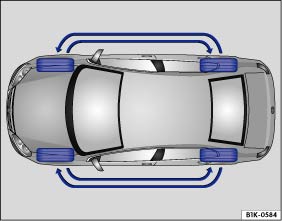
Fig. 164 Tire rotation diagram.
Read and follow the introductory information and safety information first
Tires may be the least appreciated and most abused parts of a motor vehicle. Tires are very important, since their small patches of rubber are the only contact between your vehicle and the road.
Maintaining correct tire pressure, making sure that your vehicle and its tires do not have to carry more weight than they can safely handle, and regularly inspecting tires for damage (such as cuts, slashes, irregular wear, and overall condition) are the most important things that you can do to help avoid sudden tire failure, including tread separation and blowout.
The tires and wheels are essential parts of the vehicle's design. The tires and wheels approved by Volkswagen are specially matched to the characteristics of the vehicle for good road holding and safe handling when in good condition and properly inflated.
Avoiding tire damage
- If you must drive over a curb or other obstacle, drive very slowly and as much as possible at a right angle to the curb with the tire tread of both front wheels contacting the curb at the same time.
- Regularly check tires for damage, such as punctures, cuts, tears and blisters.
- Remove embedded material in the tread profile that has not yet penetrated the inside of the tire .
- Heed all warning messages from the Tire Pressure Monitoring System (TPMS) .
- Replace worn or damaged tires immediately .
- Damage to tires and wheels is often not readily visible. If you notice unusual vibration or the vehicle pulls to one side, this may indicate that one of the tires is damaged. The tires must be checked immediately for hidden damage by an authorized Volkswagen dealer or an authorized Volkswagen Service Facility. See also .
- Never exceed the load and permissible maximum speed rating of the tires .
- Always keep aggressive chemicals including grease, oil, gasoline and brake fluid off the tires, including the compact spare wheel .
- Replace missing valve caps immediately.
Unidirectional tires
Unidirectional tires are designed to rotate only in one direction. Unidirectional tires have arrows on the sidewalls that show the direction of rotation . Unidirectional tires must always be mounted according to the specified direction of rotation in order to deliver their best grip, braking performance, low road noise, and good wear as well as good hydroplaning resistance.
If you have to mount a tire opposite to its proper direction of rotation, you must drive more carefully, since the tire is no longer being used as designed. This is particularly important on wet roads. You must replace or remount the tire as soon as possible in order to restore the correct direction of rotation.
Rotating tires
To help ensure even wear on all tires, regular tire rotation according to the diagram is recommended. In this way all tires can have about the same service life.
Volkswagen recommends that you have your tires rotated by an authorized Volkswagen dealer or authorized Volkswagen Service Facility.
Tires more than 6 years old
Tires age even if they are not being used. Physical and chemical processes reduce tire strength and performance and cause them to harden and become brittle. Old tires can fail suddenly and without warning.
Volkswagen recommends replacing tires that are 6 years and older. This also applies to tires that look new (including the tire on the compact spare wheel) or that seem to still be usable with tread depth that has not yet reached the legal minimum depth .
The age of each tire can be determined with the manufacturing date that is part of the U.S. DOT tire identification number (TIN) .
Tire storage
Mark tires before removing them to help make sure that the previous location (left, right, front, rear) and rolling direction can be maintained when remounting them. Store tires in a cool, dry and preferably dark place. Do not store tires mounted on wheels standing up.
Tires not mounted on wheels should be covered to help protect them from dirt and stored vertically (sitting on the tread).
Lower profile tires (low aspect ratio tires)
Lower profile tires have a wider tread surface, larger rim diameter, and lower sidewalls than conventional wheel/tire combinations . Lower profile tires can improve the vehicle’s handling and precision. They may, however, result in a less comfortable ride, for example, on uneven road surfaces.
WARNING
Aggressive fluids and materials can cause visible and invisible tire damage that can cause tire blowouts.
- Always keep chemicals, oils, grease, fuels, braking fluids and other aggressive substances away from tires.
WARNING
Tires age even if they are not being used and can fail suddenly, especially at high speeds, causing loss of vehicle control, accidents, and severe personal injuries.
- Tires that are more than 6 years old can be used only in an emergency and even then only with special care and at low speed.
 NOTE
NOTE
Tires and rims, especially lower profile tires and their rims, can be severely damaged and even destroyed by driving through potholes or over curbs and other obstacles.

Always dispose of old tires in accordance with legal requirements.
Wheel rims
Read and follow the introductory information and safety information first
The design of the wheel bolts is matched to the factory-installed wheels. If different wheels are installed, wheel bolts with the right length and bolt head shape must be used. This helps to ensure that wheels can be mounted securely and that the brakes will work correctly .
In most cases, you cannot use wheel bolts from a different vehicle. Even wheel rims from the same model may not fit properly.
Tires and wheel rims approved by Volkswagen have been matched precisely to your vehicle model and contribute considerably to good handling and safe vehicle performance.
The wheel bolt tightening torque must be checked regularly with an accurate torque wrench.
Tightening torque
Wheel bolts must always be installed with the correct tightening torque . The required tightening torque for your vehicle's wheel bolts is 103 ft-lbs (140 Nm). After changing a wheel, the bolt torque must be checked as soon as possible with an accurate torque wrench. See an authorized Volkswagen dealer or an authorized Volkswagen Service Facility.
Wheel rims with bolted rim rings
Wheel rims with bolted rim rings have several parts. The parts are bolted together with special screws in a special process. This helps to ensure that they will work properly, prevent leaks, run true and safely. Damaged wheel rims must be replaced, and you must never take them apart or try to repair them yourself. Have an authorized Volkswagen dealer or an authorized Volkswagen Service Facility repair them for you .
Wheel rims with bolted decorative covers
Light-alloy wheels may have interchangeable decorative covers attached to the rim with self-locking screws. If you want to replace damaged wheel covers, contact your authorized Volkswagen dealer or authorized Volkswagen Service Facility .
WARNING
Using improper or damaged wheel rims can affect driving safety, cause accidents and severe personal injury.
- Use only wheel rims approved for the vehicle.
- Regularly check wheel rims for damage and replace them if necessary.
WARNING
Improper loosening and tightening of the bolts on wheel rims with bolted rim rings can cause accidents and severe personal injury.
- Never loosen bolted connections on wheel rims with bolted rim rings.
- Have all work on wheel rims with bolted rim rings performed by an authorized Volkswagen dealer or authorized Volkswagen Service Facility.
New and replacement tires
Read and follow the introductory information and safety information first
New tires
- Drive a vehicle with new tires especially carefully for the first 350 miles (560 km) because the tires must first be broken in. Tires that are not broken in have reduced traction and braking performance .
- Install only radial tires of the same make, the same dimensions (tread circumference), and similar tread profile on all 4 wheels.
- The tread depth of new tires can differ between tire models and manufacturers because of different design features and tread design.
Replacing tires
- Tires should be replaced in pairs and not individually (both front tires or both rear tires at the same time) .
- Replace tires only with tires that have the same specifications, including width and diameter, load and top speed rating as the tires approved by Volkswagen for your vehicle and model.
- Never use tires that are larger or wider than the dimensions of the tires approved by Volkswagen for your vehicle and model. Larger tires could scrape and rub on the vehicle body or other parts of the vehicle.
Tire Pressure Monitoring System (TPMS) considerations: The Tire Pressure Monitoring System (TPMS) must be recalibrated whenever you remove and remount or change any wheel or tire on the vehicle, even if the reinstalled or replacement wheels and tires are identical to those that were removed and even if the tire pressure does not change .
WARNING
New tires tend to be slippery and must be broken in.
- Always drive with special care for the first 350 miles (560 km) to help reduce the risk of losing control, a collision, and serious personal injuries.
WARNING
Tires must have the required clearance. Tires that do not have enough clearance can rub against parts of the vehicle body, suspension, and brake system, causing brake system failure, tread delamination, and sudden blowouts.
- Always make sure that new tires are not larger than the tires approved for your vehicle and that the new tires do not rub against parts of the vehicle.
NOTE
- When switching to different tires, make certain the valves are not damaged.
- Never drive without valve stem caps. The valves could be damaged.
Always dispose of old tires in accordance with legal requirements.
If the replacement wheel is different from the tires that you have mounted on your vehicle — for example, winter tires, wider, low-profile tires, or a compact spare — only use the replacement wheel for a short time and drive cautiously.
- Replace it with a tire matching the others on your vehicle as soon as possible.
Although tire size specifications can be the same, the actual dimensions may differ from those nominal values for different tire makes, or the tire contours may be significantly different.
Tire inflation pressure
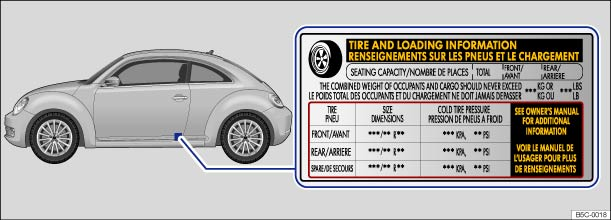
Fig. 165 On the driver door jamb: Location of the tire inflation pressure label.
Read and follow the introductory information and safety information first
The correct tire inflation pressure for the factory-installed tires is listed on a label. The factory-installed tires may be summer, winter, or all-season tires. The label is on the driver door jamb.
Under- or over-inflation significantly shortens the service life of your tires and affects the handling of the vehicle . The correct tire pressure is very important, particularly when the vehicle is driven at higher speeds. Incorrect tire pressure causes increased wear and even sudden tire failure and blowouts.
Therefore, tire pressure should be checked at least once a month and always before long trips.
The specified tire inflation pressure applies to a cold tire. When tires are warm, the pressure will be higher than when the tires are cold.
Do not reduce the tire pressure on warm tires to match the required cold tire inflation pressure. The tire inflation pressure would then be too low and could cause sudden tire failure and blowout.
Checking tire inflation pressure
Always check the tire pressure only on cold tires when the vehicle has not been driven more than a couple of miles (kilometers) at low speed within the last 3 hours.
- Check tire inflation pressure regularly and on cold tires. Check all the tires, including the compact spare, if any. In colder climates tire pressure should be checked more often, but only when the tires are cold. Always use an accurate tire pressure gauge.
- After adjusting the tire inflation pressures, make sure to screw the valve caps back on; replace missing valve caps immediately. Please read and heed the information on resetting the Tire Pressure Monitoring System .
- Remember that the vehicle manufacturer, not the tire manufacturer, determines the correct tire pressure for the tires on your vehicle. Never exceed the maximum inflation pressure listed on the tire sidewall for any reason.
Inflate the compact spare wheel to the pressure specified for the compact spare on the tire pressure label or on a separate label for the compact spare, if there is one.
WARNING
Incorrect tire pressure can cause a sudden tire failure or blowout, loss of control, collision, serious personal injury, and even death.
- Always inflate tires to the recommended and correct cold tire pressure before driving off.
- Low tire pressure can cause tires to get too hot, resulting in tread separation, sudden loss of pressure, and blowouts. Tires with excessively low pressure flex (bend) more, which can cause the tire to overheat and fail suddenly without warning.
- Excessive speed and/or overloading can cause heat buildup, sudden tire failure including a blowout and sudden deflation and loss of control.
- If the tire pressure is too low or too high, the tires will wear prematurely and the vehicle will not handle well.
- Regularly check tire inflation pressure, at least once a month, and also especially before a long trip.
- Check the pressure in all 4 tires when the tires are still cold. Never reduce air pressure in warm tires to match cold tire inflation pressure.
NOTE
- Make sure not to jam the tire pressure gauge into the valve stem. Otherwise, you can damage the tire valves.
- Driving without valve caps, with the wrong valve caps, or with valve caps that are not properly screwed on can damage the tire valves. To help prevent damage, always use valve stem caps like those originally installed at the factory. The caps must be screwed on tightly. Do not use metal valve caps or comfort valve stem caps.
Underinflation increases fuel consumption.
When the TPMS warns that the pressure in at least one tire is too low, check the tire pressure in all 4 tires with an accurate tire pressure gauge. Low tire pressure usually cannot be spotted by looking at the tire. This is especially true for low-profile tires. When checking the tire pressures, refer to .
Tire inflation pressure in cold tires
Read and follow the introductory information and safety information first
| Model and engine | Tire size | Standard tire pressure (full load) |
||
|---|---|---|---|---|
| psi | kPa | bar | ||
| Beetle or Beetle Dune 2.0L (174 hp/130 kW) |
215/60 R16 95T | 32 | 220 | 2.2 |
| 215/55 R17 94H | 32 | 220 | 2.2 | |
| 235/45 R18 94H | 32 | 220 | 2.2 | |
| 235/45 R18 94V | 32 | 220 | 2.2 | |
| 235/40 R19 92H | 32 | 220 | 2.2 | |
| 235/35 R20 92Y XL | 35 | 240 | 2.4 | |
| Beetle Convertible 2.0L (174 hp/130 kW) |
215/60 R16 95T | 32 | 220 | 2.2 |
| 215/55 R17 94H | 32 | 220 | 2.2 | |
| 235/45 R18 94H | 32 | 220 | 2.2 | |
| 235/45 R18 94V | 32 | 220 | 2.2 | |
| 235/40 R19 92H | 32 | 220 | 2.2 | |
| 235/35 R20 92Y XL | 36 | 250 | 2.5 | |
The Tire Pressure Monitoring System (TPMS) is configured at the factory with the correct tire inflation pressure applicable for the vehicle model, engine and factory-installed tires. The tire inflation pressure is listed on the tire inflation pressure label on the driver door jamb . The tire inflation pressures for the road tires are listed on this label. The inflation pressure for the compact spare is as specified on the tire pressure label or on a separate label for the compact spare, if there is one. In the event of a discrepancy between the above figures and the tire pressures listed on the tire inflation pressure label, the pressures listed on the label are the ones you should use. The listed pressure applies to all road tires. The Tire Pressure Monitoring System (TPMS) must be recalibrated using the SET button whenever you change or adjust the cold tire inflation pressures or remove and remount or change any wheel or tire on the vehicle, even if the reinstalled or replacement wheels and tires are identical to those that were removed and even if the tire pressure does not change .
Tread depth and tread wear indicators
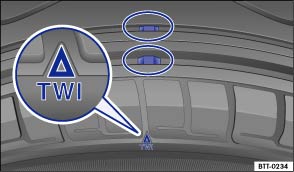
Fig. 166 Tread pattern: Wear indicator.
Read and follow the introductory information and safety information first
Tread depth
Most driving situations require as much tread depth as possible and similar tread depth for the tires on the front and rear wheels. This is especially true when driving in winter weather, at low temperatures and under wet conditions .
In most countries the legally permissible minimum tread depth is 1/16 in. (1.6 mm), as measured in tread grooves next to the wear indicators. Please be sure to obey country-specific legal requirements.
Winter tires are no longer suitable for winter operation once the tread pattern is worn down to a depth of 3/16 in. (4.8 mm).
The tread depth of new tires can differ between tire models and manufacturers because of the different design features and tread patterns.
Make sure to use snow chains when required and to install them only on the approved tire and rim combinations .
Tread wear indicator (TWI) in the tire
The 1/16 in. (1.6 mm) high wear indicators are molded into the bottom of the tread grooves of the original tires running across the treads . Several wear indicators are evenly spaced around the tire. Markings on the sides of the tires (for example TWI or symbols) show the position of the wear indicators.
Wear indicators show when the tires are worn down. The tires must be replaced no later than when the tread pattern is worn down to the wear indicators.
WARNING
Worn tires are dangerous and can cause loss of vehicle control including serious personal injuries.
- Never drive a vehicle when the tread on any tire is worn down to the wear indicators, replace them sooner.
- Worn tires do not grip the road properly, especially on wet roads, increasing your risk of hydroplaning and loss of control.
- Worn tires reduce the ability of your vehicle to handle well in normal and difficult driving situations and increase braking distances and the risk of skidding.
Tire wear and damage
Read and follow the introductory information and safety information first
Wheel rim and tire damage is often difficult to see. Unusual vibrations or pulling to one-side can be an indication of tire damage .
- If you suspect tire damage, immediately reduce speed!
- Check tires and wheel rims for damage.
- If a tire is damaged, do not drive any farther. Change the damaged wheel . If necessary, get expert assistance.
- If no external damage is visible, slowly and carefully drive to the nearest authorized Volkswagen dealer, authorized Volkswagen Service Facility, or other qualified workshop and have the vehicle checked.
Objects embedded in the tire
- If embedded objects have penetrated to the inside of the tire, do not remove them! If objects are stuck in the tread grooves of the tire, they can be removed.
- If necessary, change the damaged wheel . If necessary, get professional assistance to change the wheel.
- Check tire pressure and adjust if necessary.
Tire wear
Tire wear depends on several factors, including:
- Driving style.
- Unbalanced wheels.
- Wheel alignment.
Driving style – Fast cornering, hard acceleration and braking increase tire wear. If you experience increased tire wear under normal driving conditions, have the vehicle suspension checked by an authorized Volkswagen dealer or an authorized Volkswagen Service Facility.
Unbalanced wheels – The wheels on a new vehicle are balanced. When driving, however, various conditions can cause a wheel to become unbalanced. Unbalanced wheels can cause wear to the steering and suspension systems. Have all wheels rebalanced. A wheel must always be rebalanced if a new tire has been mounted.
Wheel alignment – Incorrect wheel alignment causes excessive and uneven tire wear, impairing vehicle safety. If you notice excessive or uneven tire wear, have the wheel alignment checked by an authorized Volkswagen dealer or an authorized Volkswagen Service Facility.
WARNING
Unusual vibrations or pulling to one side can indicate tire damage.
- Reduce speed immediately and stop when it is safe to do so.
- Check tires and wheel rims for damage.
- Never drive with a damaged tire or rim. Get expert assistance instead.
- If no external damage is visible, slowly and carefully drive to the nearest authorized Volkswagen dealer, authorized Volkswagen Service Facility, or other qualified workshop and have the vehicle checked.
Compact spare wheel
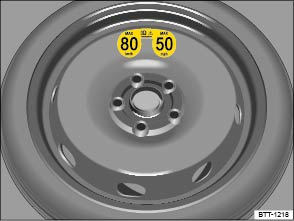
Fig. 167 In the luggage compartment: Compact spare wheel (label design may vary).
Read and follow the introductory information and safety information first
Removing the compact spare wheel (Beetle Coupe models only)
- Open the trunk lid, lift up the floor covering, and hang it on the hook beneath the luggage compartment cover.
- If necessary, remove the vehicle tool kit from the center of the spare wheel .
- Completely unscrew the handwheel in the center of the compact spare wheel counterclockwise and remove the compact spare wheel.
Removing the compact spare wheel (Beetle Convertible models only)
- Open the trunk lid and remove the floor covering.
- If necessary, remove the vehicle tool kit from the center of the spare wheel .
- Completely unscrew the handwheel in the center of the compact spare wheel counterclockwise and remove the compact spare wheel.
Stowing the replaced wheel (Beetle Coupe models only)
- Lift up the floor covering and hang it on the hook beneath the luggage compartment cover.
- If the wheel you took off the vehicle fits in the spare wheel well, position it so that the center hole of the rim is aligned with the threaded pin in the center of the well.
- Turn the handwheel clockwise until the wheel is securely in place.
- If necessary, return the vehicle tool kit to its location in the luggage compartment.
- Unhook the floor covering and fold it back down onto the floor of the luggage compartment.
- Close the trunk lid.
If the replaced wheel does not fit in the spare wheel well, stow it securely in the luggage compartment on top of the floor covering.
Stowing the replaced wheel (Beetle Convertible models only)
- Open the trunk lid, lift up the floor covering, and remove it from the luggage compartment.
- If the wheel you took off the vehicle fits in the spare wheel well, position it so that the center hole of the rim is aligned with the threaded pin in the center of the well.
- Turn the handwheel clockwise until the wheel is securely in place.
- If necessary, return the vehicle tool kit to its location in the luggage compartment.
- Return the floor covering to the luggage compartment floor.
- Close the trunk lid.
If the replaced wheel does not fit in the spare wheel well, stow it securely in the luggage compartment on top of the floor covering.
Differences between the road tires and the compact spare
The compact spare is different in design from the road tires and must be used only in the event of a flat tire, only for a brief time, and only when driving with extra caution .
Replace it with a tire matching the others on your vehicle as soon as possible.
Please heed the following:
- Do not drive faster than 50 mph (80 km/h)!
- Avoid full-throttle acceleration, hard braking, and fast cornering!
- Do not use snow chains on the compact spare wheel .
- After installing the compact spare wheel, check the tire pressure as soon as possible .
Check the tire inflation pressure of the compact spare whenever you check the tire pressure of the road wheels, at least once a month. Inflate the compact spare wheel to the cold tire pressure specified for the compact spare on the tire pressure label or on a separate label for the compact spare, if there is one.
WARNING
Improper use of a compact spare wheel can cause loss of vehicle control, a crash or other accident, and serious personal injury.
- Never use a compact spare wheel if it is damaged or worn down to the wear indicators.
- In some vehicles, the compact spare wheel is smaller than the original tire. A smaller compact spare wheel is identified with a sticker and the words 50 mph or 80 km/h. This is the maximum permissible speed when driving with this tire.
- Never drive faster than 50 mph (80 km/h) with a compact spare wheel. Avoid full-throttle acceleration, heavy braking, and fast cornering!
- Never drive more than 125 miles (200 km) if a compact spare wheel is installed on the front axle (drive axle).
- Replace the compact spare with a normal wheel and tire as soon as possible. Compact spare wheels are designed for brief use only.
- Regularly check the U.S. DOT Tire Identification Number (TIN) to determine the age of the compact spare wheel . Tires age even if they are not being used and can fail suddenly, especially at higher speeds.
- Tires that are more than 6 years old can only be used in an emergency and then with special care and at lower speeds.
- The compact spare wheel must always be secured with the wheel bolts provided by the factory.
- Never drive using more than one compact spare wheel.
- After installing the compact spare wheel, the tire pressure must be checked as soon as possible .
- Snow chains cannot be used on the compact spare wheel. If you must use snow chains and have a compact spare wheel mounted, move the compact spare wheel to the rear axle if a front tire has to be replaced. The tire taken off the rear axle can then be used to replace the flat front tire. Be sure you do not change the tire's direction of rotation. Install the snow chains on the full-sized road tire.
NOTE
When the compact spare wheel is being used, the TPMS indicator light can come on after a couple of minutes .
If possible, attach the compact spare wheel or the wheel you took off the vehicle securely in the luggage compartment.
Tire labeling
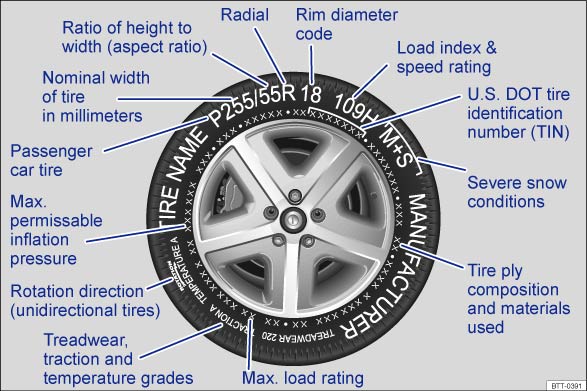
Fig. 168 International tire labeling.
Read and follow the introductory information and safety information first
Knowing about tire specifications makes it easier to choose the correct replacement tires. Radial tires have specifications marked on the sidewall.
| Tire labeling (example) | Meaning | |
|---|---|---|
| Brand, Logo | Manufacturer | |
| Tire name | Individual tire designation of the manufacturer. | |
| P255 / 55 R 18 | Dimensions: | |
| P | Tire application: Passenger car | |
| 255 | Nominal sidewall-to-sidewall width of tire in millimeters. | |
| 55 | Ratio of height to width (aspect ratio) | |
| R | Tire belt design letter code for radial. | |
| 18 | Rim diameter (in inches) | |
| 109 H | Load rating code and speed rating code . | |
| XL | Indicates reinforced tire (heavy-duty) | |
| M+S or M/S | Indicates Mud and Snow capability (also M/S) . | |
| RADIAL TUBELESS | Tubeless radial tire. | |
| E4 ... | Labeling according to international regulations (E) including number of the approving country. The multi-digit approval number is listed next. | |
| DOT BT RA TY5 1709 | Tire identification number (TIN)a) – In some cases the manufacturing date is only on one side of the tire: | |
| DOT | The tire complies with the requirements of the United States Department of Transportation, responsible for issuing safety standards. | |
| BT | Identification letter of the manufacturing site. | |
| RA | Manufacturer information regarding tire dimensions. | |
| TY5 | Tire characteristics provided by the manufacturer. | |
| 1709 | Manufacturing date: 17th week in 2009. | |
| TWI | Marks the position of the treadwear indicator . | |
| Made in Germany | Country of manufacture. | |
| MAX LOAD 615 KG (1356 LBS) | United States maximum load rating per wheel. | |
| MAX INFLATION 350 KPA (51 PSI) | United States maximum permissible inflation pressure. | |
| ROTATION | Rotation direction (unidirectional tires) | |
| SIDEWALL 1 PLY RAYON | Tire ply composition and materials used: 1 layer of rayon. |
|
| TREAD 4 PLIES 1 RAYON + 2 STEEL + 1 NYLON |
Tire tread composition and materials used: In this example there are 4 layers under the tread: 1 layer of rayon, 2 layers of steel belt and 1 layer of nylon. |
|
| Consumer information regarding comparison to specified base tires (standardized test procedure) : | ||
| TREADWEAR 220 | Relative service life expectancy of the tire referenced to a U.S.-specific standard test. | |
| TRACTION A | Traction rating under wet conditions (AA, A, B or C). | |
| TEMPERATURE A | Temperature stability of the tire at increased test bench speeds (A, B or C). | |
| Additional numbers found on the tire could either be tire manufacturer internal labels or country-specific labels (such as for Brazil and China). | ||
Unidirectional tires
Unidirectional tires are designed to rotate only in one direction. Unidirectional tires have arrows on the sidewalls that show the direction of rotation. Make sure you mount the tire so that it rotates in the proper direction. The tire's performance with regard to hydroplaning, traction, noise, and wear is worse if it is not mounted in the proper direction of rotation.
If you have to mount a tire opposite to its proper direction of rotation, you must drive more carefully, since the tire is no longer being used as designed. This is particularly important on wet roads. You must replace or remount the tire as soon as possible in order to restore the correct direction of rotation.
Load rating code
The load index indicates the maximum permissible load per individual tire in pounds (kilograms).
- 91
- 1356 lbs (615 kg)
- 92
- 1388 lbs (630 kg)
- 93
- 1433 lbs (650 kg)
- 95
- 1521 lbs (690 kg)
- 97
- 1609 lbs (730 kg)
- 98
- 1653 lbs (750 kg)
- 99
- 1709 lbs (775 kg)
- 100
- 1763 lbs (800 kg)
- 101
- 1819 lbs (825 kg)
- 102
- 1874 lbs (850 kg)
- 103
- 1929 lbs (875 kg)
- 104
- 1984 lbs (900 kg)
- 110
- 2337 lbs (1060 kg)
Speed rating code letter
The speed rating code letter indicates the maximum permissible road speed of the tires.
- P
- up to 93 mph (150 km/h)
- Q
- up to 99 mph (160 km/h)
- R
- up to 106 mph (170 km/h)
- S
- up to 112 mph (180 km/h)
- T
- up to 118 mph (190 km/h)
- U
- up to 124 mph (200 km/h)
- H
- up to 130 mph (210 km/h)
- V
- up to 149 mph (240 km/h)
- Z
- over 149 mph (240 km/h)
- W
- up to 168 mph (270 km/h)
- Y
- up to 186 mph (300 km/h)
Some tire manufacturers label tires with a maximum permissible road speed above 149 mph (240 km/h) with the letter combination ZR.
WARNING
Using incorrect or unmatched tires and/or wheels or improper tire and wheel combinations can lead to loss of control, collision and serious personal injury.
- Always use tires, wheels and wheel bolts that meet the specifications of the original factory-installed tires or other combinations that have been specifically approved by the vehicle manufacturer.
- All 4 wheels must be fitted with radial tires of the same type, the same size (tread circumference), and the same tread pattern. Driving with different tires reduces vehicle handling and can lead to a loss of control.
- Never drive faster than the maximum speed for which the tires installed on your vehicle are rated because tires that are driven faster than their rated speed can fail suddenly.
- Overloading tires can cause heat build-up, sudden tire failure, including a blowout and sudden deflation and loss of control.
- Temperature grades apply to tires that are properly inflated and not over- or underinflated.
a) TIN represents the serial number of the tire.
Winter tires
Read and follow the introductory information and safety information first
Winter tires improve the handling characteristics of your vehicle significantly when driving under wintry road conditions. Summer tires have less traction on snow and ice because of their design (width, rubber composition, tread design). Volkswagen strongly recommends that you always have winter tires or all-season tires installed on all 4 wheels on your vehicle, especially when winter road conditions are expected. Winter tires also improve the vehicle's braking performance and help reduce stopping distances during winter weather. Volkswagen recommends installing winter tires once temperatures are below +45 °F (+7 °C).
Winter tires are no longer suitable for winter driving once the tread pattern is worn down to a depth of 3/16 in (4.8 mm). In addition, winter tire performance decreases with age – independent of the tread profile depth.
When using winter tires:
- Obey state and country-specific legal requirements.
- Install winter tires on all 4 wheels.
- Use winter tires only under wintry road conditions.
- Only use winter tires with dimensions approved for the vehicle.
- Use only winter tires of the same tire belt design, the same dimensions (tread circumference), and the same tread design.
- Follow speed restrictions according to the winter tire's speed rating code letter .
Speed restrictions
Winter tires are certified up to a top speed identified by speed rating code letters on the sidewall .
In some vehicle models it is possible to set a speed warning in the menu in the instrument cluster display .
Top speed rating and tire inflation pressure for V winter tires depend on the engine installed in your vehicle. Be sure to ask your authorized Volkswagen dealer or authorized Volkswagen Service Facility about the maximum permissible speed and the required tire inflation pressure for the winter tires that you plan to use.
WARNING
Driving faster than the maximum speed for which the winter tires on your vehicle were designed can cause sudden tire failure including a blowout and sudden deflation, loss of control, crashes and serious personal injuries.
- Winter tires have a maximum speed rating that may be lower than your vehicle's maximum speed.
- Never drive faster than the maximum speed for which the winter tires installed on your vehicle are rated because tires that are driven faster than their rated speed can fail suddenly.
- Never exceed the maximum load rating for the winter tires installed on your vehicle.
Install summer tires promptly in the spring. Summer tires offer better handling characteristics for temperatures above +45 °F (+7 °C). They are quieter, do not wear as quickly, and reduce fuel consumption.
The Tire Pressure Monitoring System must be recalibrated using the SET button whenever you remove and remount or change any wheel or tire on the vehicle, even if the reinstalled or replacement wheels and tires are identical to those that were removed and even if the tire pressure does not change .
If necessary, ask your authorized Volkswagen dealer or authorized Volkswagen Service Facility about permissible winter tire dimensions.
Snow chains
Read and follow the introductory information and safety information first
Obey local regulations as well as the applicable speed limits when driving with snow chains.
Snow chains improve forward motion, traction and braking characteristics under wintry conditions.
Snow chains may be used only on the front wheels and only in tire and wheel combinations that have been approved by Volkswagen.
Please contact your authorized Volkswagen dealer or authorized Volkswagen Service Facility about appropriate wheel, tire and snow chain dimensions.
If possible, use only chains with low profile links that are not thicker than 37/64 in. (15 mm) including the tensioner.
Remove center hubcaps and decorative rim rings before installing snow chains . However, for safety reasons, caps must be installed on the wheel bolts. These are available from authorized Volkswagen dealers and authorized Volkswagen Service Facilities.
Compact spare wheel
For technical reasons, snow chains cannot be used on the compact spare .
If you must use snow chains and have a compact spare wheel mounted, move the compact spare wheel to the rear axle if a front tire has to be replaced. The tire taken off the rear axle can then be used to replace the flat front tire. Be sure to install the unidirectional tires so that they will run in the proper direction. Volkswagen recommends installing the snow chains before mounting the wheel to the vehicle.
WARNING
Using the wrong snow chains or installing snow chains improperly can cause accidents and severe personal injuries.
- Always use the proper snow chains.
- Follow the installation instructions provided by the snow chain manufacturer.
- Never exceed the permissible speed limit when driving with snow chains.
NOTE
- Remove snow chains when roads are free of snow. Otherwise, the chains can damage the tires, impair vehicle handling and can be quickly worn down.
- Snow chains can scratch or damage wheel rims if they have direct contact with the rims. Volkswagen recommends using coated snow chains.
Glossary of tire and loading terminology
Read and follow the introductory information and safety information first
Accessory weight
The combined weight (in excess of those standard items which may be replaced) of automatic transmission, electro-mechanical power steering, power brakes, power windows, power seats, radio, and heater, to the extent that these items are available as factory-installed equipment (whether installed or not).
Aspect ratio
The ratio of sidewall height to tire width, expressed as a percentage. A number of 50 (0.5:1 or 50%) means that the cross-sectional height is 50% of the tread width. A shorter sidewall can improve steering response and provide better overall handling, for example, on dry pavement.
Bead
The part of a tire made of steel wires, wrapped or reinforced by ply cords, with the shape and structure to ensure proper fit to the wheel rim.
Bead separation
A breakdown of the bond between components in the bead.
Carcass
The tire structure, except tread and sidewall rubber which, when inflated, bears the load.
Chunking
The breaking away of pieces of the tread or sidewall.
Cord
The strands of material forming the plies in the tire.
Cord separation
The parting of cords from adjacent rubber compounds.
Cracking
Any parting within the tread, sidewall, or inner liner of the tire extending to cord material.
Cold tire inflation pressure
The tire pressure recommended by the vehicle manufacturer for a tire of a specified size that has not been driven for more than a couple of miles (kilometers) at low speeds in the 3 hour period before the tire pressure is measured or adjusted.
Curb weight
The weight of a motor vehicle with standard equipment including the maximum capacity of fuel, oil, and coolant, air conditioner, and additional weight of optional equipment.
Extra load tire
A tire designed to operate at higher loads and at higher inflation pressures than the corresponding standard tire.
Gross Axle Weight Rating (GAWR)
The load-carrying capacity of a single axle system, measured where the tire contacts the ground.
Gross Vehicle Weight Rating (GVWR)
The maximum loaded weight of the vehicle.
Groove
The space between 2 adjacent tread ribs.
Load rating (code)
The maximum load that a tire is rated to carry for a given inflation pressure. You may not find this information on all tires because it is not required by law.
Maximum load rating
The load rating for a tire at the maximum permissible inflation pressure for that tire.
Maximum loaded vehicle weight
The total of:
- Curb weight.
- Accessory weight.
- Vehicle capacity weight.
- Production options weight.
Maximum (permissible) inflation pressure
The maximum cold inflation pressure to which a tire may be inflated. Also called maximum inflation pressure.
Normal occupant weight
Means 150 lbs (68 kilograms) times the number of occupants seated in the vehicle up to the total seating capacity of your vehicle.
Occupant distribution
The placement of passengers in a vehicle.
Outer diameter
The diameter of a new, properly inflated tire.
Overall width
Total width measured at the exterior sidewalls of an inflated tire, including the additional width of labeling, decorations, or protective bands or ribs.
Passenger car tire
A tire intended for use on passenger cars, multipurpose passenger vehicles, and trucks, that have a gross vehicle weight rating (GVWR) of 10,000 pounds or less.
Ply
A layer of rubber-coated parallel cords.
Ply separation
A parting of rubber compound between adjacent plies.
Pneumatic tire
A mechanical device made of rubber, chemicals, fabric, and steel or other materials, that, when mounted on an automotive wheel, provides the traction and contains the gas or fluid that sustains the load.
Production options weight
The combined weight of installed regular production options weighing over 5 lbs (2.3 kg) more than the standard items they replace, and not previously considered as curb weight or accessory weight. These include, for example, heavy-duty brakes, ride levelers, roof rack, heavy-duty battery, and special trim.
Radial ply tires
A pneumatic tire in which the ply cords that extend to the beads are laid at substantially 90 degrees to the centerline of the tread.
Recommended inflation pressure
The tire pressure recommended by the vehicle manufacturer for a tire of a specified size that has not been driven for more than a couple of miles (kilometers) at low speeds in the 3 hour period before the tire pressure is measured or adjusted.
Reinforced tire
A tire designed to operate at higher loads and at higher inflation pressures than the corresponding standard tire.
Rim
The outer edge of a wheel upon which the tire beads are seated.
Rim diameter
The nominal diameter of the wheel's tire bead seating surface. If you change your wheel size, to wheels of a different diameter, you will have to purchase new tires to match the new wheels.
Rim size
Designation means rim diameter and width.
Rim type designation
The industry or manufacturer's designation for a rim by style or code.
Rim width
The nominal distance between wheel rim flanges.
Section width
The linear distance between the exteriors of the sidewalls of an inflated tire, excluding elevations due to labeling decoration, or protective bands.
Sidewall
The portion of a tire between the bead and the tread.
Sidewall separation
The parting of the rubber compound from the cord material in the sidewall.
Speed rating (letter code)
A standardized letter code indicating the maximum speed at which a tire is designed to be driven for extended periods of time. The ratings range from 93 mph or 150 km/h (P) to 186 mph or (300 km/h) Y.
The speed rating letter code, where applicable, is molded on the tire sidewall . You may not find this information on all tires because it is not required by law.
Tire Pressure Monitoring System
A system that detects when at least one of a vehicle's tires is underinflated and illuminates a low tire-pressure warning light.
Tread
The portion of a tire that normally touches the road.
Tread rib
A tread section running circumferentially around a tire.
Tread separation
Tire failure caused by the tread pulling away from the tire carcass.
Tread wear indicators (TWI)
Raised areas within the main tread grooves that show, visually, when tires are worn and near the end of their useful life .
Uniform Tire Quality Grading (UTQG)
A tire information system developed by the U.S. National Highway Traffic Safety Administration (NHTSA) that is designed to help buyers compare tires. UTQG is not a safety rating, nor is it a guarantee that a tire will last for a certain number of miles or perform a certain way. It gives tire buyers more information to compare with factors such as price, brand loyalty and dealer recommendations. Under UTQG, tires are graded by the tire manufacturers in 3 areas: tread wear, traction and temperature resistance. UTQG information is molded into the tire sidewalls.
U.S. DOT Tire Identification Number (TIN)
A tire's serial number. It begins with the letters DOT (Department of Transportation) and indicates that the tire meets all federal standards. The next 2 numbers or letters indicate the plant where the tire was manufactured. The last 4 numbers represent the week and year of manufacture.
For example, the numbers 1709 mean that the tire was produced in the 17th week of 2009. Any other numbers are marketing codes used by the tire manufacturer. This information is used to help identify affected consumers if a tire defect requires a recall.
Vehicle capacity weight
The total rated cargo, luggage and passenger load. Passenger load is 150 lbs (68 kilograms) times the vehicle's total seating capacity (as listed on the label inside the driver door).
Vehicle maximum load on the tire
The load on an individual tire that is determined by taking each axle's share of the maximum loaded vehicle weight (GAWR) and dividing by 2.
Vehicle normal load on the tire
The load on an individual tire that is determined by taking each axle's share of the curb weight, accessory weight, and normal occupant weight (distributed according to the table below) and dividing by 2.
Wheel size designation
Wheel rim diameter and width.
Occupant loading and distribution for vehicle normal load for various designated seating capacities
| Designated seating capacity, number of occupants | Vehicle normal load, number of occupants | Occupant distribution in a normally loaded vehicle |
|---|---|---|
| 2, 3, or 4 | 2 | 2 in front |
| 5 | 3 | 2 in front, 1 in back |
Tires and vehicle load limits
Read and follow the introductory information and safety information first
There are limits to the load any vehicle or any tire can carry. A vehicle that is overloaded will not handle well and is more difficult to stop. Overloading can damage important parts of the vehicle. Overloading can also lead to blowout, sudden loss of pressure or other tire failure that can cause loss of control.
Your safety and the safety of your passengers depends on making sure that load limits are not exceeded. Vehicle load includes everybody and everything in and on the vehicle. These load limits are technically referred to as the vehicle's Gross Vehicle Weight Rating (GVWR).
The GVWR includes the weight of the basic vehicle, all factory-installed and other accessories, a full tank of fuel, oil, coolant and other fluids plus maximum load. The maximum load includes the number of passengers that the vehicle is intended to carry (seating capacity) with an assumed weight of 150 lbs (68 kg) for each passenger at a designated seating position and the total weight of any luggage in the vehicle.
The Gross Axle Weight Rating (GAWR) is the maximum load that can be carried at each of the vehicle's 2 axles (by the front or rear tires). GVWR and GAWR are listed on the safety compliance label on the driver door jamb. Because there is an upper limit to your vehicle's total weight (GVWR), the weight of whatever is being carried is also limited. More passengers, or passengers who are heavier than the assumed 150 lbs (68 kg), mean that less weight can be carried as luggage or other cargo. The tire pressure label on your Volkswagen also lists the maximum combined weight of all of the occupants and luggage or other cargo that the vehicle can carry.
WARNING
Overloading a vehicle can cause loss of vehicle control, a crash or other accident, serious personal injury, and even death.
- Carrying more weight than your vehicle was designed to carry will prevent the vehicle from handling properly and increase the risk of the loss of vehicle control.
- The brakes on a vehicle that has been overloaded may not be able to stop the vehicle in a safe distance.
- Tires on a vehicle that has been overloaded can fail suddenly, including a blowout and sudden deflation, causing loss of control and a crash.
- Always make sure that the total load being transported does not make the vehicle heavier than the vehicle's Gross Vehicle Weight Rating.
Determining the correct load limit
Read and follow the introductory information and safety information first
Never overload tires. The following example illustrates how to determine the combined weight of all vehicle occupants and luggage or other vehicle payloads. Never overload the vehicle!
| Steps for Determining Correct Load Limit: | |
|---|---|
| 1. | Locate the statement THE COMBINED WEIGHT OF OCCUPANTS AND CARGO SHOULD NEVER EXCEED XXX KG OR XXX LBS on your vehicle's placard (tire inflation pressure label) . |
| 2. | Determine the combined weight of the driver and passengers that will be riding in your vehicle. |
| 3. | Subtract the combined weight of the driver and passengers from XXX kg or XXX lbs. |
| 4. | The resulting figure equals the available amount of cargo and luggage load capacity. For example, if the XXX amount equals 1400 lbs. and there will be five 150 lb. passengers in your vehicle, the amount of available cargo and luggage load capacity is 650 lbs. (1400-750 (5 x 150) = 650 lbs.) |
| 5. | Determine the combined weight of luggage and cargo being loaded on the vehicle. That weight may not safely exceed the available cargo and luggage load capacity calculated in Step 4. |
| 6. | If your vehicle is capable of towing a trailer: The load from your trailer will be transferred to your vehicle. Consult this manual to determine how this reduces the available cargo and luggage load capacity of your vehicle. |
| Check the tire sidewall to determine the load index specified for the tire. | |
UTQG classification
Read and follow the introductory information and safety information first
Uniform Tire Quality Grading (UTQG): Quality grades can be found where applicable on the tire sidewall between the tread shoulder and maximum section width. Example:
- Treadwear (number)
- Traction: AA, A, B or C
- Temperature: A, B or C
For example: Treadwear 200, Traction AA, Temperature A.
All passenger car tires must conform to Federal Safety Requirements in addition to these grades.
Treadwear
The treadwear grade is a comparative rating based on the wear rate of the tire when tested under controlled conditions on a specified government test course.
For example, a tire graded 150 (Treadwear-value 150) would wear one-and-one-half (1 1/2) times as well on the government course as a tire graded 100.
The relative performance of tires depends upon the actual conditions of their use, however, and may depart significantly from the norm due to variations in driving habits, service practices and differences in road characteristics and climate.
Traction
The traction grades, from highest to lowest, are AA, A, B, and C. Those grades represent the tire's ability to stop on wet pavement as measured under controlled conditions on specified government test surfaces of asphalt and concrete. A tire marked C may have poor traction performance .
Temperature
The temperature grades are A (the highest), B, and C representing the tire's resistance to the generation of heat, and its ability to dissipate heat when tested under controlled conditions on a specified indoor laboratory test wheel.
Sustained high temperature can cause the material of the tire to degenerate and reduce tire life, and excessive temperature can lead to sudden tire failure.
The grade C corresponds to a level of performance which all passenger car tires must meet under the Federal Motor Vehicle Safety Standard No. 109. Grades B and A represent higher levels of performance on the laboratory test wheel than the minimum required by law .
WARNING
The traction grade assigned to this tire is based on straight-ahead braking traction tests, and does not include acceleration, cornering, hydroplaning or peak traction characteristics.
WARNING
The temperature grade for this tire is established for a tire that is properly inflated and not overloaded. Excessive speed, underinflation or excessive loading, either separately or in combination, can cause heat buildup and possible tire failure.
Download Manual