Park Distance Control (PDC)
 Introduction to the subject
In this chapter you will find information on the following subjects:
Depending on equipment, the vehicle may be equipped with the Park Distance Control system (PDC).
The Park Distance Control (PDC) system can help the driver when backing up and parking. PDC uses ultrasonic sensors in the bumpers to measure the distance between the vehicle and objects. The system uses the time it takes for the ultrasonic waves to bounce back from the object to calculate the distance between the vehicle and an object. PDC works only at speeds up to about 5–10 mph (10–15 km/h).
If the vehicle gets too close to an obstacle behind it, a beeping signal sounds. The closer the vehicle gets to the obstacle, the faster the beep. When the obstacle is very close, the sound is continuous.
If you move even closer to the obstacle despite the continuous warning sound, the system cannot measure the distance remaining until collision.
A Declaration of Compliance with United States FCC and Industry Canada regulations is found in the Consumer information section of this Manual .
 WARNING
Park Distance Control is no substitute for careful and attentive driving. Never rely completely on these systems for information about people and objects that might be in the way of the vehicle and could be struck resulting in serious personal injuries.
- Always be careful and look around you when parking. The sensors have blind spots and cannot always detect people, animals, and objects. Watch out for small children and animals in particular.
- Certain types of clothing and the surfaces of certain objects do not reflect the ultrasonic waves that the sensors send and receive. Such objects and persons wearing such clothing will not be detected by PDC or will not be detected accurately.
- Noise in the area can interfere with the signals of the Park Distance Control sensors. Under certain circumstances, the system will not detect people and objects for this reason.
 NOTE
NOTE
- Things like trailer draw bars, thin rods, fences, trees, narrow painted vertical poles, posts, or a trunk lid that is opening may not be detected by the Park Distance Control sensors and could damage the vehicle.
- If you keep driving closer to an object that the Park Distance Control has already detected and reported, the object may disappear from the sensor range and may no longer be detected. This is especially true for low or high objects. The system will no longer sound warnings about these objects. Ignoring signals from the Park Distance Control system could result in serious damage to the vehicle.
- The sensors in the bumpers can be damaged or become misaligned in low speed impacts and parking maneuvers. Damaged or misaligned sensors cannot accurately detect or report objects that might be within range of the PDC system.
- To help make sure that the system works properly, always keep the sensors in the bumpers clean and free of snow and ice; do not cover the sensors with stickers or other objects.
- Repainting the sensors in the bumpers can impair the function of the PDC system.
- When cleaning the sensors with power washers or steam cleaners, only spray the sensors directly for a very short time, and always keep the washer nozzle at least 4 inches (10 cm) from the sensors.
- Noise from rough roads, cobblestones, other vehicles and the surrounding area, for example, can prevent the Park Distance Control system from accurately detecting and reporting people and objects that may be within range of the sensors.
- Aftermarket components such as bicycle racks can impair the function of the Park Distance Control system.

Volkswagen recommends practicing with the Park Distance Control system in a location or parking space with no traffic in order to become familiar with the system and how it works.
If an ultrasonic sensor malfunctions, the corresponding sensor area is switched off and cannot be reactivated until the malfunction is corrected (depending on vehicle equipment). Have the system checked by an authorized Volkswagen dealer or an authorized Volkswagen Service Facility.
If you hear a long beep of about 3 seconds when you first turn PDC on or the indicator light in the button starts blinking, there is a malfunction in the Park Distance Control system. Switch off the Park Distance Control system with the button and have it checked by an authorized Volkswagen dealer or an authorized Volkswagen Service Facility.
Using PDC
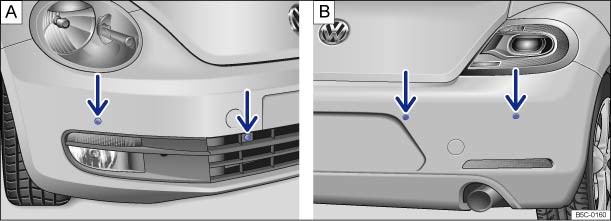
Fig. 113 In the front and rear bumpers: Park Distance Control system sensors.
Fig. 114 In the lower center console: Button to switch the Park Distance Control system on or off.
Read and follow the introductory information and safety information first
The Park Distance Control (PDC) uses ultrasonic sensors to determine the distance from the front or rear bumpers to an obstacle. The PDC sensors are located in front bumper and the rear bumper
(arrows).
The intermittent and continuous signal chimes triggered by the front PDC sensors have a higher pitch than those given by the rear PDC sensors. This is a standard feature.
Switching the Park Distance Control (PDC) system on and off
| Function | Operation (when the ignition is switched on) |
|---|---|
| Manually activate or deactivate PDC: | Press the |
| Manually deactivate the display (sound stays active): | Press a function selection button on the factory-installed Infotainment system ⇒BookletInfotainment System,. |
| OR: Move your hand toward the screen and tap the |
|
| Automatically activate PDC: | Shift into Reverse (R). To switch on the mini-PDC display, tap the MENU or the |
| Automatically deactivate PDC: | Drive forward faster than about 5–10 mph (10–15 km/h). |
| Mute the PDC volume temporarily (depending on equipment): | Move your hand toward the screen and tap the |
| Switch to the Rear View Camera system display (depending on equipment): | Shift into Reverse (R). |
| OR: Move your hand toward the screen and tap the |
Special considerations for PDC
- In some cases, the Park Distance Control system interprets water and ice on the sensors as an obstacle.
- If the distance remains the same, the warning chime volume decreases after a few seconds. If a continuous tone sounds, its volume remains the same.
- If the vehicle moves away from the obstacle, the beeping sound stops automatically. The beep turns on again automatically if the vehicle approaches the obstacle again.
- There is no beeping when the selector lever is in Park (P).
- The volume of the audible signals can be adjusted by an authorized Volkswagen dealer or an authorized Volkswagen Service Facility.
WARNING
Never rely completely on the PDC for information about people and objects that might be in the way of the vehicle and could be struck by the vehicle causing serious personal injury.
- Always watch for people, especially small children and animals, because the sensors have blind spots and may not always be able to detect them.
WARNING
The automatic activation of PDC only functions at very low speeds. Improper driving behavior can lead to an accident and can cause serious personal injury.
- Always heed the warning signals.
NOTE
Failure to observe the illuminated text messages can lead to the vehicle being damaged.
PDC signal chimes and displays
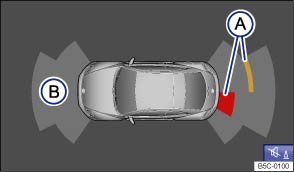
Fig. 115 PDC display of the area around the vehicle (display may vary depending on vehicle equipment).
Read and follow the introductory information and safety information first
Key to :
- A
- Scanned area behind the vehicle.
- B
- Scanned area in front of the vehicle.
- A yellow segment represents an obstacle in the vehicle’s path.
- A red segment depicts an obstacle located close to the vehicle.
- A white or gray segment represents an obstacle outside of the vehicle's path.
- Mute the PDC signal chimes.
Display
When the factory-installed Infotainment system is switched on, the areas to the front and rear of the vehicle that are scanned by ultrasonic sensors are shown on the screen . The positions of potential obstacles are displayed relative to the vehicle .
The display shows the scanned areas in several segments. The closer the vehicle gets to an obstacle, the closer the segment will move to the vehicle in the display. The collision area has been reached at the latest when the second to last segment appears. Stop! Do not keep driving!
PDC signal chimes
When the vehicle gets near an obstacle in range of the ultrasonic sensors, a chime sounds. An intermittent chime means that a nearby obstacle is detected. The shorter the distance, the shorter the intervals between the chimes. The PDC signal sounds continuously if the obstacle is very close.
The intermittent chime volume decreases after a few seconds if the distance stays the same. The volume also stays the same if the PDC signal is continuous. As soon as the vehicle moves away from an obstacle again, the intermittent chime stops automatically. If the vehicle moves towards an obstruction again, the intermittent chime starts automatically.
If you keep driving closer to the obstacle despite a continuous PDC signal, the system will no longer be able to measure the distance.
When there is an imminent risk of collision at the front area of the vehicle, the chime sounds at the front of the vehicle. When there is a risk of imminent collision at the rear area of the vehicle, the chime sounds at the rear of the vehicle.
Muting the Park Distance Control volume
Tap the function key in the Infotainment system to mute the PDC signals. Tap the function key again to turn the signals back on.
Switching Park Distance Control back on after it was switched off reactivates the volume. System malfunction warning signals cannot be switched off.
If you manually deactivate the display, PDC remains on and the sound is reactivated.
WARNING
Never pay so much attention to the images on the screen that you fail to notice what is going on around you.
NOTE
Failure to observe the illuminated text messages can lead to the vehicle being damaged.
It can take a few seconds before the area scanned by the sensors is displayed on the Infotainment system screen.
Rear Traffic Alert
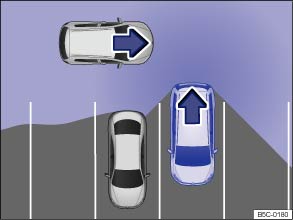
Fig. 116 Rear Traffic Alert: Monitored area around the vehicle that is backing out of a parking space.
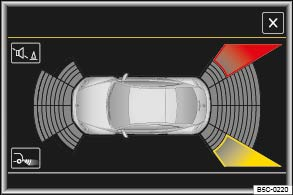
Fig. 117 Rear Traffic Alert display: Colored display shown (may vary depending on vehicle equipment).
Key to :
- The red area indicates that the system has detected traffic behind the vehicle.
- The yellow area indicates that the system has possibly detected traffic behind the vehicle.
- There is a system malfunction in the scanned area (not pictured).
The Rear Traffic Alert system uses the radar sensors in the rear bumper to monitor the traffic crossing behind your vehicle when you are backing out of a parking space or maneuvering, for example, in traffic situations with poor visibility.
A warning sounds if the system detects approaching traffic behind your vehicle when backing up (red area).
- Vehicles without Park Distance Control (PDC): There is a warning tone and a text message in the instrument cluster display.
- Vehicles with Park Distance Control (PDC): There is a continuous warning tone from the PDC. If PDC is deactivated, a warning for the driver may not be possible, and therefore the Rear Traffic Alert is also deactivated.
Automatic braking intervention
If the Rear Traffic Alert detects an approaching vehicle and the driver does not press the brake pedal, the system can intervene with automatic braking.
The Rear Traffic Alert assists the driver with harsh automatic braking that could help prevent or reduce damage that may result from a collision. The automatic braking occurs while backing up at speeds between 1–7 mph (1–12 km/h). Once the system detects that your vehicle is stationary, it keeps the vehicle from moving for up to 2 seconds.
After an automatic braking intervention, about 10 seconds must pass before the system can brake automatically again.
The driver can interrupt the automatic braking and take control of the vehicle by pressing firmly on the gas or brake pedal.
WARNING
The Blind Spot Monitor with Rear Traffic Alert technology cannot overcome the laws of physics and limits of the system. Careless or unintentional use of the Blind Spot Monitor and Rear Traffic Alert may result in accidents and serious injuries.
- The Rear Traffic Alert is not a substitute for careful and attentive driving.
- Never use the system when visibility is limited or in confusing traffic situations, for example, on heavily traveled roads or when there are multiple lanes.
- Always watch for people, especially small children, bicycles, animals, and objects, because the Rear Traffic Alert may not always be able to detect them. Rear Traffic Alert cannot detect people, animals, and things that are moving slowly or not at all.
- The Rear Traffic Alert does not always brake the vehicle to a complete stop.
- The harsh automatic braking will be uncomfortable for many people, and if you or your passengers have special conditions or sensitivities, particularly in the neck, you may want to switch off Rear Traffic Alert.
Download Manual