Controls
 Introduction to the subject
In this chapter you will find information on the following subjects:
Always obey local vehicle lighting laws.
The driver is always responsible for the correct headlight settings.
 WARNING
Crashes and other accidents can happen when you cannot see the road ahead and when you cannot be seen by other motorists.
- Always switch on the low beam headlights at dusk or when it is dark and whenever the weather is bad or visibility is poor.
WARNING
Headlights that are aimed too high and improper use of the headlight flasher or high beams can blind and distract other drivers. This can lead to a crash and serious personal injuries.
- Always make sure that headlights are properly adjusted.
- Never use the headlight flasher or high beams when they can blind or distract other drivers.

In cool or humid weather, the insides of the headlights, the rear lights, and turn signals can temporarily fog up. This is normal and does not affect the service life of the vehicle's lighting system.
Indicator lights
Read and follow the introductory information and safety information first
Indicator lights in the instrument cluster
| Lights up | Possible cause | Proper response |
|---|---|---|
| One or more driving lights not working. | Replace the burned out bulb . | |
| Cornering light malfunction. | If all light bulbs are OK, see an authorized Volkswagen dealer or authorized Volkswagen Service Facility. | |
| Left or right turn signal. The indicator light blinks twice as fast if a turn signal is not working on the vehicle. |
Check the turn signals on the vehicle. | |
| High beams switched on or headlight flashers in use (appears in solid blue). | . |
When the ignition is switched on, several warning and indicator lights come on briefly for a function check. They go out after a few seconds.
Indicator lights in the light switch
| Lights up | Possible cause |
|---|---|
| The fog lights are switched on | |
| The automatic headlights and, if applicable, the daytime headlights or daytime running lights are switched on . |
WARNING
Failure to heed warning lights and instrument cluster text messages can cause the vehicle to break down in traffic and result in a collision and serious personal injury.
- Never ignore warning lights or text WARNINGS.
- Always stop the vehicle as soon as it is safe to do so.
- Whenever stalled or stopped for repair, move the vehicle a safe distance off the road, stop the engine, turn on the emergency flashers, and use other warning devices to warn approaching traffic.
- Never park the vehicle in areas where the hot catalytic converter and exhaust system can come into contact with dry grass, brush, spilled fuel, oil, or other material that can catch fire.
- A broken down vehicle presents a high accident risk for itself and others. Switch on emergency flashers and set up a warning triangle to warn oncoming traffic.
 NOTE
NOTE
Failure to heed warning lights or text WARNINGS can result in vehicle damage.
High Intensity Discharge (HID) headlights provide bright, uniform lighting to help you see and be seen. The light comes from an electric arc between two electrodes in the gas-filled bulb. Over time, the electrodes can wear down and the gap between them will get wider. The HID lamp’s control unit then increases the voltage to keep the arc’s brightness constant. However, the commonly called “Xenon” bulbs will also ultimately burn out. Before they burn out, HID lamps can flicker. A message will then appear in the MFI. This is your reminder to see an authorized Volkswagen dealer or an authorized Volkswagen Service facility to check the headlights.
Switching lights on and off
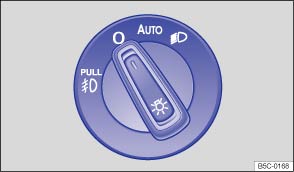
Fig. 83 Headlight switch next to the steering wheel (with fog lights and automatic headlights, if equipped).
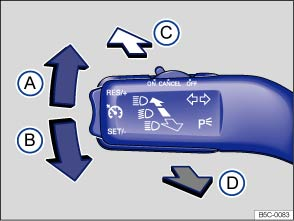
Fig. 84 On the left side of the steering column: Turn signal lever and high beam switch.
Read and follow the introductory information and safety information first
| Adjust the light switch to the desired position or : | ||
|---|---|---|
| Symbol | When the ignition is switched off | When the ignition is switched on |
| Fog lights and low beams switched off. | Headlights off, daytime running lights (DRL) on. | |
| Orientation lighting may be switched on. | Automatic headlights active; DRL on. | |
| Low beams switched off. The DRL, side marker lights, and rear lights may stay on. The length of time they stay on depends on the vehicle battery charge. | Headlights and rear lights switched on. | |
| Fog lights switched off. The DRL may stay on for some time. | Headlights, rear lights, and fog lights switched on. | |
Move the lever to the desired position
 Right turn signal
 .
 Left turn signal
 .
 Switching high beams on . An indicator light
 lights up in the instrument cluster when the high beams are switched on.
 Switching the high beams off and operating the headlight flasher. The headlight flasher turns on the high beams as long as the lever is pulled and manually held in the pulled position. The indicator light
Move the lever back to the home position to turn the selected feature off.
Fog lights (if equipped)
The indicator light in the headlight switch shows that the fog lights are switched on.
- To switch on the fog lights
: first turn the light switch to position
, then pull the light switch out to the detent.
- To switch off the fog lights, push the switch back in. To then turn off the headlights, turn the switch to position
.
WARNING
Daytime running lights are not bright enough to let you see ahead or be seen by others when it is dark.
- Always switch on the low-beam headlights at dusk or when it is dark and whenever the weather is bad or visibility is poor.
- Never use the daytime running lights to see where you are going. They are not bright enough and will not let you see far enough ahead for safety, especially at dusk or when it is dark. Always switch on the low-beam headlights at dusk or when it is dark.
- The taillights do not come on with the daytime running lights. Unless the taillights are on, a vehicle cannot be seen by others in bad weather, at dusk, or when it is dark.
- Even if automatic headlights (
WARNING
Improper use of high beams can distract and blind others, causing accidents and serious injuries.
The turn signal light works only when the ignition is switched on. The emergency flasher works even when the ignition is switched off .
The indicator light flashes twice as fast if a turn signal bulb is burned out.
High beams can only be switched on when the low beams are on.
In cool or humid weather, the insides of the headlights, the rear lights, and turn signals can temporarily fog up. This is normal and does not affect the service life of the vehicle's lighting system.
Instrument panel lighting and headlight range adjustment
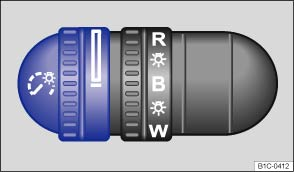
Fig. 85 To the left of the steering wheel: Thumbwheel to adjust instrument panel lighting (vehicles without manual headlight range adjustment).
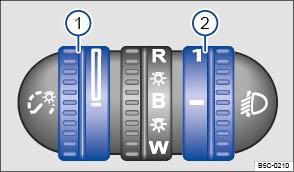
Fig. 86 To the left of the steering wheel: Thumbwheel to adjust instrument panel lighting ① and headlight range adjustment ② (if equipped).
Read and follow the introductory information and safety information first
Instrument cluster and switch brightness
You can adjust the brightness of the instrument cluster and switch lighting when the lights are on by turning the thumbwheel , .
In some vehicles with daytime running lights (DRL), the instrument cluster lighting switches off automatically when it is dark outside or when driving through tunnels, for example. You will need to switch the headlights on manually when this happens, so that the vehicle's taillights will turn on .
Headlight range adjustment for vehicles with High Intensity Discharge (HID) headlights
For vehicles with HID headlights, the headlight range can be manually adjusted to the vehicle loading condition once the low beams are switched on. This feature helps ensure good visibility for the driver and helps prevent oncoming traffic from being blinded .
| Turn the thumbwheel to the desired position ②: | |
|---|---|
| Position | Vehicle loading conditiona) |
| – | Front seats occupied and an empty luggage compartment. |
| 1 | All seats occupied and an empty luggage compartment. |
| 1.5 | All seats occupied and a fully loaded luggage compartment |
| 2 | Only the driver seat occupied and a fully loaded luggage compartment. |
| 3 | – |
WARNING
Headlights that are aimed too high because of the way the vehicle is loaded can blind and distract other drivers. This can lead to a crash and serious personal injuries.
- Always make sure the headlights are adjusted to loading conditions so that they do not blind others.
a) You can also select intermediate positions on the thumbwheel depending on the loading condition.
Interior and reading lights
Read and follow the introductory information and safety information first
- Interior lights off.
- Interior lights on.
OR: Switch in the center position
- Door contact switch on. When the feature is switched on, the interior lights come on automatically when the vehicle is unlocked or a door is opened. The lights go out about 20 seconds after you close the doors; they also go out when you lock the vehicle or switch on the ignition.
- Reading lights on or off.
Glove and luggage compartment lights
The glove and luggage compartments may have lights that come on automatically when they are opened and go off when they are closed.
The interior and reading lights go out when you lock the vehicle or a few minutes after you remove the vehicle key from the ignition. This helps to prevent unnecessary drain on the vehicle battery.
Download Manual