Exterior care and cleaning
Maintaining and cleaning the convertible top (Beetle Convertible)
The attractive appearance of the convertible top and the length of its life depend to a large extent on correct use and care . Volkswagen recommends using only Volkswagen-approved convertible top cleaning and care products according to the manufacturer's instructions.
The longer that insects, bird droppings, tree sap, road and industrial dust, tar, soot particles, road salt, and other aggressive deposits remain on the convertible top, the more destructive they will be. High temperatures such as those caused by intense sunlight increase the corrosive effect.
- Keep the convertible top completely closed when cleaning it .
- Only wash the convertible top in an automatic car wash or by hand.
- Remove bird droppings immediately .
- Bird droppings and normal dirt can be removed by hand using clean water and a soft brush. Always move the brush from front to back with the grain of the fabric.
- For heavy dirt and spots, clean the convertible top using a suitable convertible top cleaning product and a clean, soft brush. Always move the brush from front to back with the grain of the fabric and rinse with plenty of clean water. Let the convertible top air-dry.
- If the convertible top is excessively soiled, see an authorized Volkswagen dealer or authorized Volkswagen Service Facility for assistance.
- Do not dry the convertible top with a chamois cloth.
- The convertible top seals must be cared for regularly .
- The cloth convertible top should be treated with protectant after frequent and intense cleaning with special convertible top cleaning products.
 WARNING
The convertible top may move by itself due to gravity. This can lead to injuries.
- Always close the convertible top completely when cleaning. Never leave the convertible top partly open to clean the roof pillar shafts on the side or the roof rods.
- Never reach into the shafts or grab the rods when the convertible top is opening, closing or stopped.
 NOTE
NOTE
- Never clean with a pressure washer, even briefly. The convertible top cloth and seals could be damaged and could leak.
- Never clean the convertible top with gasoline, stain remover, benzene, paint thinner, detergent solutions, or other aggressive substances. Do not use any abrasive cleaning materials or stiff brushes.
- Avoid parking under trees that drop a lot of sap or pollen.
- Bird droppings must be removed immediately because they damage the convertible top.
Cleaning windows and outside mirrors
Cleaning windows and outside mirrors
Spray windows and outside mirrors with a commercially available alcohol-based window cleaner.
Dry windows and mirrors with a clean chamois or a lint-free cloth. Do not use a chamois that has been used to wipe painted surfaces because it will have absorbed an oily residue that will smear the glass surfaces.
Use window cleaner or a silicone remover to remove rubber, oil, grease and silicone deposits .
Removing wax residue
Automatic car washes and vehicle care products can leave a wax residue on all glass surfaces. These wax residues can only be removed with special cleaners or cleaning cloths. Wax residue left on the windshield can cause the windshield wipers to grab and squeak instead of gliding smoothly. We recommend that after every car wash you remove any wax residue left on the windshield with a window cleaning cloth/chamois - G 052 522 A1 - or equivalent.
Windshield wiper squeak and grab can be reduced by filling the windshield washer fluid tank with a wiper fluid containing wax-removing agents. Make sure to maintain the proper mixing ratio when refilling the washer fluid tank. Grease-removing cleaning agents cannot remove wax residue .
Windshield cleaners, special cleaners, and cleaning cloths are available from your authorized Volkswagen dealer and authorized Volkswagen Service Facility.
Removing snow
Remove snow from all windows and outside mirrors with an appropriate brush.
Removing ice
The best way to remove ice is with a deicer spray. When using an ice scraper always scrape in one direction, never back and forth. Dirt can scratch the glass when moving the scraper backward.
WARNING
Dirty or fogged up windows reduce visibility and increase the risk of accidents and severe injuries.
- Don't drive until you have clear visibility through all windows.
- Remove ice, snow and condensation from all inside and outside window surfaces.
NOTE
- Never mix recommended cleaning agents with other cleaning agents in the windshield washer reservoir. If you do, this could cause sediments or other by-products that can clog the windshield washer nozzles.
- Never use warm or hot water to remove snow and ice from windows and mirrors. This could cause the glass to crack!
- The heating elements for the rear defroster are on the inside of the rear window. Do not put stickers over the heating elements on the inside of the rear window and never clean the inside of the windows with corrosive or acidic cleaning agents or other chemicals that could damage the heating elements.
- Antennas installed on the insides of windows can be damaged by abrasive objects or by corrosive, acidic, or abrasive cleaning agents, materials, or chemicals. Do not place any stickers on the windshield-integrated antenna and never clean the antenna with corrosive or acidic cleaning agents or other chemicals.
Caring for and cleaning chrome and aluminum parts
- Clean the surface using a clean, soft, lint-free cloth dampened with water.
- If the surface is especially dirty, use a special solvent-free cleaning material.
- Then polish chrome and aluminum parts with a soft, dry cloth.
NOTE
To help prevent damage to chrome and aluminum parts:
- Do not clean or polish in direct sunlight.
- Do not clean or polish in sandy or dusty places.
- Do not use abrasive cleaners or abrasive sponges.
- Do not polish dirty surfaces.
- Do not use cleaning materials that contain solvents.
- Do not use hard wax.
NOTE
Chrome wheel covers and hubcaps can have an extra coating. Do not treat them with chrome care or polishing products. Use regular paint care and polishing products.
Caring for and cleaning “Second Skin” vehicle graphics
Vehicle graphics are design elements that can be applied to the vehicle body that are made of soft polyvinyl chloride (PVC).
In areas where the vehicle is covered by vehicle graphics, the paint finish below the PVC covering is protected from the weather and other environmental factors.
If vehicle graphics stay on the vehicle for a long time, you may notice a difference in appearance between areas protected by vehicle graphics and areas where no vehicle graphics cover the paint finish. These differences can normally be reduced by polishing the vehicle.
Volkswagen recommends contacting an authorized Volkswagen dealer or authorized Volkswagen Service Facility for information on suitable care products.
Durability of vehicle graphics
Environmental factors such as exposure to sunlight, moisture, atmospheric pollutants, and stone impact affect the durability and color of vehicle graphics. Signs of use and aging are normal and are not a defect in the material.
After applying vehicle graphics, high summer temperatures or other factors may cause the material to blister for a period of time. Blistering normally goes away on its own and does not have a lasting effect on the material.
Vehicle graphics may show signs of use and begin fading, especially if exposed to direct sunlight, after about 1 to 3 years.
In very hot climates, heat exposure from direct sunlight can cause vehicle graphics to show signs of aging, including fading, within one year.
Cleaning vehicle graphics
Vehicle graphics can be washed in an automatic car wash, provided that hot wax is not applied.
Please heed the information and instructions on .
When using a pre-spray cleaner, power washer, or steam cleaner, always keep the nozzle at least 16 inches (40 cm) from vehicle graphics. Never spray the vehicle graphics with water pressure above 1450 psi (100 bar) .
Insect splatter, bird droppings, tree sap, road dirt, industrial deposits, tar, soot, road salt, and other aggressive materials can damage vehicle graphics.
The longer these aggressive deposits stay on the vehicle graphics, the more damage they do. High temperatures (including strong sunlight) increase their corrosive effects. Wash the vehicle immediately and thoroughly with warm water or with a mild soap solution .
Remove stubborn deposits carefully with mild alcohol-based cleaners and then rinse with warm water. Do not clean vehicle graphics with aggressive cleaning agents such as gasoline, paint thinner, or solvents.
Caring for vehicle graphics
In general, follow the same care instructions for vehicle graphics as you do for the vehicle’s paint finish .
Apply a coat of liquid hard wax to vehicle graphics regularly, at least once every three months. Hard wax smoothes out the surface and repels dirt.
To apply hard wax, use a microfiber cloth only.
Volkswagen recommends contacting an authorized Volkswagen dealer or authorized Volkswagen Service Facility for information on suitable care products.
NOTE
- Always keep the spray nozzle perpendicular to the edges and surface of vehicle graphics.
- When cleaning vehicle graphics with a power washer or steam cleaner, only spray the graphics briefly and always keep the nozzle at least 16 inches (40 cm) from the vehicle. Never spray the vehicle graphics with water pressure above 1450 psi (100 bar).
- Depending on the type of brush used in the car wash, brushes can cause fine scratches on vehicle graphics.
- To help prevent lasting damage to vehicle graphics, remove contaminants as soon as possible using suitable cleaning agents.

Damage to vehicle graphics caused by stone impact, for example, can only be corrected by replacing the entire damaged vehicle graphics element. Volkswagen recommends having the work performed by an authorized Volkswagen dealer, an authorized Volkswagen Service Facility, or another qualified workshop.
Cleaning wheel rims
Cleaning steel wheels
Stubborn brake dust can be removed with an industrial cleaner. Clean steel wheels regularly with a separate sponge.
Repair any paint damage on steel wheels before rust begins to form.
Cleaning alloy wheels
Every 2 weeks: Wash road salt and brake dust off alloy wheels, and clean the wheels with an acid-free detergent. Every 3 months: Volkswagen recommends applying a hard wax compound to the wheels.
If road salt and brake dust are not removed regularly, they can corrode the metal.
Use an acid-free detergent specifically designed for light alloy wheels. Do not use car polish or other abrasive products.
If the protective coating is damaged, for example by stone impact, repair the damaged area right away.
Caring for rubber door and window seals (Beetle Coupe)
The rubber seals around the doors and windows will stay soft and flexible, seal better and last longer if the seals are treated regularly with a suitable rubber care product.
Before applying the treatment, use a soft cloth to remove dust and dirt from the rubber seals.
Do not apply any rubber care products to the rubber seals on the body in the areas around the windows in the driver and front passenger doors. The product could run down onto the windows and smudge them.
Caring for rubber door and window seals (Beetle Convertible)
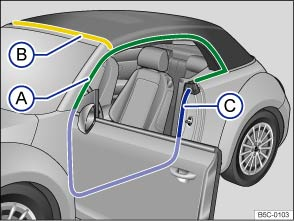
Fig. 139 Caring for rubber seals: Seals on the side windows Ⓐ, the roof seal Ⓑ, and door seals Ⓒ.
The rubber seals around the doors and windows will stay soft and flexible, seal better and last longer if the seals are treated regularly with a suitable rubber care product.
Before applying the treatment, use a soft cloth to remove dust and dirt from the rubber seals.
Caring for rubber seals on the side windows Ⓐ and the roof seal Ⓑ
- Remove dust and dirt from the rubber seals using a soft, lint-free cloth and plenty of water. The roof seal Ⓑ is located between the vehicle body and the convertible top frame.
- Do not use any conditioning materials on seals Ⓐ and Ⓑ . The windows could be smudged by the product running down onto the glass.
Caring for rubber seals on the luggage compartment and the doors Ⓒ
- Remove dust and dirt from the rubber seals on the luggage compartment using a soft, lint-free cloth and plenty of water.
- Remove the dust and dirt from the paint where the seals were in contact with it, if necessary.
- Allow the rubber seals to dry completely.
- Volkswagen recommends treating the rubber seals sparingly when dry with a suitable conditioning product .
Overview of recommended rubber conditioning products
| Seal | Recommended product |
|---|---|
| Ⓐ and Ⓑ | Clean only. Do not use any conditioning products. |
| Ⓒ | Rubber conditioning product without silicone or special lubricant- G 052 172 A1 -. |
NOTE
Using incorrect conditioning products can damage the seals. For information on suitable conditioning products, see your authorized Volkswagen dealer or authorized Volkswagen Service Facility.
Deicing door lock cylinders
Volkswagen recommends using only genuine Volkswagen deicer spray with lubricating and anti-corrosive properties to deice door lock cylinders.
NOTE
Lock deicers that contain grease solvents can cause the lock cylinder to rust.
Undercoating
The vehicle underbody is coated to help protect it from corrosion and damage. The undercoating could be damaged during normal use. We therefore recommend that you have the protective coatings on the underbody and suspension inspected regularly, and repaired if necessary.
WARNING
Undercoating and rustproofing products can catch fire on the hot exhaust system or any other hot engine component.
- Never apply additional undercoating or rustproofing on or near the exhaust manifold, the exhaust pipes, the catalytic converter, the heat shields, or any other hot vehicle component.
Cleaning the engine compartment
The engine compartment of a vehicle is a dangerous area .
If necessary, the engine compartment should be cleaned by an authorized Volkswagen dealer or authorized Volkswagen Service Facility. Incorrect cleaning procedures could remove corrosion protection and damage electrical components, among other things. In addition, water could enter directly into the vehicle interior through the plenum chamber .
Never use a power washer to clean the engine compartment .
If the engine compartment is extremely dirty, have it cleaned professionally by your authorized Volkswagen dealer or authorized Volkswagen Service Facility.
Plenum chamber
The plenum chamber is located in the engine compartment between windshield and engine, under a perforated cover. Outside air is taken into the vehicle interior from the plenum chamber via the climate control system.
Regularly remove leaves and other loose objects from the plenum chamber cover by hand or with a vacuum cleaner.
Have the area under the perforated cover cleaned by an authorized Volkswagen dealer or authorized Volkswagen Service Facility.
WARNING
Injuries, scalding, electric shock, accidents, and fire hazards can occur while working on the engine or in the engine compartment!
- Before working in the engine compartment, be sure to familiarize yourself with the necessary procedures and generally accepted safety precautions .
- Volkswagen recommends having the work performed by an authorized Volkswagen dealer or authorized Volkswagen Service Facility.
NOTE
Spraying or pouring water (for example, with a power washer) into the plenum chamber can cause severe damage to the vehicle.

Wash the engine compartment only in special wash bays so that the oily dirt and fuel residue that are washed off the vehicle will not enter the sewage system. In some areas it illegal to wash the engine compartment anywhere other than at such specified locations.
Download Manual