Essential information
Emergency flashers
Press the switch.
All the turn signal lights will flash.
To turn them off, press the switch once again.
The emergency flashers will turn off automatically after operating for approximately 20 minutes. To manually turn the emergency flashers off, press the switch twice. (The emergency flashers may not turn on automatically depending on the force of the impact and conditions of the colli- sion.)
Do not pump the brake pedal repeatedly as this will increase the effort required to slow the vehicle.
If the shift lever is shifted to N
If the shift lever cannot be shifted to N
Vehicles without smart key system
Turn the engine switch to ACC.
619
Press and hold the engine switch for 2 consecutive seconds or more, or press it briefly 3 times or more in succession.
and exit the vehicle. 8
|
|
|
Using an emergency hammer* for emergency escape
The front side windows and rear side windows, as well as the rear window can be shattered with an emergency hammer* used for emergency escape. However, an emergency hammer can not shat- ter the windshield as it is lami- nated glass. *: Contact your Toyota dealer, or aftermarket accessory manu- facturer for further information about an emergency hammer. Escaping the vehicle from the window
There are cases where escaping the vehicle from the window is not possible due to seating position, passenger body type, etc. When using an emergency ham- mer, consider your seat location and the size of the window open- ing to ensure that the opening is accessible and large enough to escape. |
 WARNING
621
8
|
|
|
Observe the following precau- tions. Failure to do so may result in death or serious injury. |
 WARNING
before towing.
623
From the front (2WD models) Release the parking brake.
Turn automatic mode off. (P.204)
From the front (AWD models)
Use a towing dolly under the rear wheels.
From the rear
Use a towing dolly under the front wheels.
When using a flat-bed truck to transport the vehicle, use tire strapping belts. Refer to the owner’s manual of the flat-bed truck for the tire strapping method.
In order to suppress vehicle movement during transporta- tion, set the parking brake and turn the engine switch off.
If a tow truck is not available in an emergency, your vehicle may be temporarily towed using
cables or chains secured to the emergency towing eyelets. This should only be attempted on hard surfaced roads for at most 50 miles (80 km) at under 18
mph (30 km/h).
A driver must be in the vehicle to steer and operate the brakes.
The vehicle’s wheels, drive train, axles, steering and brakes must be in good condition.
To have your vehicle towed by another vehicle, the towing eye- let must be installed to your vehicle. Install the towing eyelet by following the specified proce- dure.
Type A
|
|
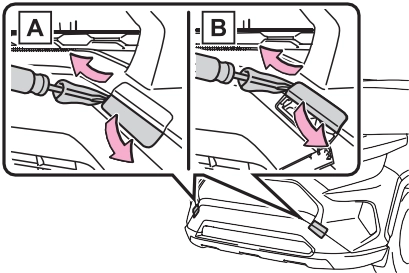
Type B
Type A
cover ( B ).
To protect the bodywork, place a rag between the screwdriver and the vehicle body as shown in the illustration.
Take care not to damage the vehi- cle body.
Turn off the Parking Support Brake
627
8
|
Warning light |
Details/Actions |
|
(U.S.A.) (Canada) (Red) |
Indicates that: The brake fluid level is low; or
The brake system is malfunctioning
Immediately stop the vehicle in a safe place and contact your Toyota dealer. Continuing to drive the vehicle may be dangerous. |
|
Warning light |
Details/Actions |
|
(Yellow) |
Indicates a malfunction in the parking brake sys- tem Have the vehicle inspected by your Toyota dealer immediately. |
|
Warning light |
Details/Actions |
|
Indicates a malfunction in the vehicle’s charging system Immediately stop the vehicle in a safe place and contact your Toyota dealer. |
|
Warning light |
Details/Actions |
|
Indicates that the engine is overheating Immediately stop the vehicle in a safe place. Handling method (P.659) |
|
Warning light |
Details/Actions |
|
Indicates that the engine oil pressure is too low Immediately stop the vehicle in a safe place and contact your Toyota dealer. |
|
Warning light |
Details/Actions |
|
(U.S.A.) (Canada) |
Indicates a malfunction in: The electronic engine control system;
The electronic throttle control system; or
The emission control system (if equipped)
Have the vehicle inspected by your Toyota dealer immediately. |
|
Warning light |
Details/Actions |
|
Indicates a malfunction in: The SRS airbag system;
The front passenger occupant classification system; or
The seat belt pretensioner system
Have the vehicle inspected by your Toyota dealer immediately. |
|
Warning light |
Details/Actions |
|
(U.S.A.) (Canada) |
Indicates a malfunction in: The ABS; or
The brake assist system
Have the vehicle inspected by your Toyota dealer immediately. |
|
Warning light |
Details/Actions |
|
(Red/yellow) |
Indicates a malfunction in the EPS (Electric Power Steering) system Have the vehicle inspected by your Toyota dealer immediately. |
|
Warning light |
Details/Actions |
|
(Flashes or illuminates) |
When a buzzer sounds simultaneously: Indicates a malfunction has occurred in the PCS (Pre-Collision System). Have the vehicle inspected by your Toyota dealer immediately. When a buzzer does not sound: The PCS (Pre-Collision System) has become temporarily unavailable, corrective action may be necessary. Follow the instructions displayed on the multi-information display. (P.227, 641) If the PCS (Pre-Collision System) or VSC (Vehi- cle Stability Control) system is disabled, the PCS warning light will illuminate. P.236 |
|
Warning light |
Details/Actions |
|
(Orange) |
Indicates a malfunction in the LTA (Lane Tracing Assist) Follow the instructions displayed on the multi-information display. (P.246) |
|
Warning light |
Details/Actions |
|
(Flashes) (If equipped) |
Indicates a malfunction in the Stop & Start sys- tem Have the vehicle inspected by your Toyota dealer immediately. |
|
Warning light |
Details/Actions |
|
(Flashes) (If equipped) |
When a buzzer sounds: Indicates a malfunction in the Intuitive parking assist function Have the vehicle inspected by your Toyota dealer immediately. When a buzzer does not sound: Indicates that the system is temporarily unavail- able, possibly due to a sensor being dirty or cov- ered with ice, etc. Follow the instructions displayed on the multi-information display. (P.273, 639) |
|
Warning light |
Details/Actions |
|
(Flashes) (If equipped) |
When a buzzer sounds: Indicates a malfunction in the PKSB (Parking Support Brake) system Have the vehicle inspected by your Toyota dealer immediately. When a buzzer does not sound: Indicates that the system is temporarily unavail- able, possibly due to a sensor being dirty or cov- ered with ice, etc. Follow the instructions displayed on the multi-information display. (P.281, 639) |
|
Warning light |
Details/Actions |
|
(Flashes) (If equipped) |
When a buzzer sounds: Indicates a malfunction in the RCTA (Rear Cross Traffic Alert) function Have the vehicle inspected by your Toyota dealer immediately. When a buzzer does not sound: Indicates that the rear bumper around the radar sensor is covered with dirt, etc. (P.263) Follow the instructions displayed on the multi-information display. (P.262, 639) |
|
Warning light |
Details/Actions |
|
Indicates a malfunction in: Multi-terrain Select brake control (if equipped);
The VSC/Trailer Sway Control system;
The TRAC system;
The hill-start assist control system; or
The downhill assist control system (if equipped)
Have the vehicle inspected by your Toyota dealer immediately. |
|
Warning light |
Details/Actions |
|
Brake Override System Indicates that the accelerator and brake pedals are being depressed simultaneously, and the Brake Override System is operating. Release the accelerator pedal and depress the brake pedal. Indicates a malfunction in the Brake Override System (with warning buzzer) Have the vehicle inspected by your Toyota dealer immediately. |
|
|
Drive-Start Control Indicates that the shift position was changed and Drive-Start Control was operated while depressing the accelerator pedal. (with warning buzzer) Momentarily release the accelerator pedal. Indicates a malfunction in the Drive-Start Con- trol (with warning buzzer) Have the vehicle inspected by your Toyota dealer immediately. |
|
|
PKSB (if equipped) Parking Support Brake function (for static objects) is operating. (P.277) If a warning message is shown on the multi-information display, read the mes- sage and follow the instructions. |
*: This light illuminates on the multi-information display with a message.
|
Warning light |
Details/Actions |
|
(Flashes) |
Indicates a malfunction in the brake hold system Have the vehicle inspected by your Toyota dealer immediately. |
|
Warning light |
Details/Actions |
|
|
It is possible that the parking brake is not fully engaged or released |
|
(U.S.A.) (Flashes) |
Operate the parking brake switch once again. |
|
(Canada) (Flashes) |
This light comes on when the parking brake is not released. If the light turns off after the park- ing brake is fully released, the system is operat- ing normally. |

|
Warning light |
Details/Actions |
|
(If equipped) |
When the light comes on after blinking for 1 min- ute: Malfunction in the tire pressure warning system Have the system checked by your Toyota dealer. When the light comes on: Low tire inflation pressure such as Natural causes
Flat tire
Immediately stop the vehicle in a safe place. Handling method (P.636) |
|
Warning light |
Details/Actions |
|
Indicates that remaining fuel is approximately 2.2 gal. (8.3 L, 1.8 Imp. gal.) or less Refuel the vehicle. |
635
|
Warning light |
Details/Actions |
|
Warns the driver and/or front passenger to fas- ten their seat belts Fasten the seat belt. If the front passenger’s seat is occupied, the front passenger’s seat belt also needs to be fastened to make the warning light (warning buzzer) turn off. |
*: Driver’s seat belt warning buzzer:
The driver’s seat belt warning buzzer sounds to alert the driver that his or her seat belt is not fastened. Once the engine switch is turned to ON, the buzzer sounds. If the seat belt is still unfastened, the buzzer sounds inter- mittently for a certain period of time after the vehicle reaches a certain speed.
Front passenger’s seat belt warning buzzer:
The front passenger’s seat belt warning buzzer sounds to alert the front passenger that his or her seat belt is not fastened. If the seat belt is unfastened, the buzzer sounds intermittently for a certain period of time after the vehicle reaches a certain speed.
|
Warning light |
Details/Actions |
|
(If equipped) |
Warns the rear passengers to fasten their seat belts Fasten the seat belt. |
*: Rear passengers’ seat belt warning buzzer:
The rear passengers’ seat belt warning buzzer sounds to alert the rear passenger that his or her seat belt is not fastened. If the seat belt is unfastened, the buzzer sounds intermittently for a certain period of time, after the seat belt is fastened and unfastened and the vehicle reaches a certain speed.
In some cases, the buzzer may not be heard because of noisy place or an audio sound.
seat.
This warning light system monitors the airbag sensor assembly, front impact sensors, side impact sensors (front door), side impact sensors (front), side impact sensors (rear), driver’s seat position sensor, driver’s seat belt buckle switch, front passenger occupant classification system (ECU and sensors), “AIR BAG ON” indicator light, “AIR BAG OFF” indicator light, front passen- ger’s seat belt buckle switch, seat belt pretensioners and force limiters, airbags, interconnecting wiring and power sources. (P.34)
First check the following:
If it is, fill the fuel tank immediately.
The light will go off after several driving trips.
If the light does not go off even after several trips, contact your Toyota dealer as soon as possible.
When the battery charge becomes insufficient or the voltage temporar- ily drops, the electric power steering system warning light may come on and the warning buzzer may sound.
Inspect the tires to check if a tire is punctured.
If a tire is punctured: P.642
If none of the tires are punctured:
Turn the engine switch to OFF then turn it to ON. Check if the tire pres- sure warning light comes on or blinks.
If the tire pressure warning light blinks for approximately 1 minute then stays on
There may be a malfunction in the tire pressure warning system. Have the vehicle inspected by your Toyota dealer immediately.
If the tire pressure warning light comes on
The tire pressure warning light may come on due to natural causes such as natural air leaks and tire inflation pressure changes caused by tem- perature. In this case, adjusting the tire inflation pressure will turn off the warning light (after a few minutes).
The compact spare tire is not equipped with a tire pressure warn- ing valve and transmitter. If a tire goes flat, the tire pressure warning light will not turn off even though the flat tire has been replaced with the spare tire. Replace the spare tire with the standard tire and adjust the tire inflation pressure. The tire pres-

639
The warning messages explained below may differ from the actual messages according to operation conditions and vehicle specifica- tions.
A warning message about an opera- tion of the brake pedal may be
shown while the driving assist sys- tems such as PCS (Pre-Collision system) or the dynamic radar cruise control with full-speed range is oper- ating. If a warning message is shown, be sure to decelerate the vehicle or follow an instruction shown on the multi-information dis- play.
A warning message is shown when Brake Override System, Drive-Start Control or Parking Support Brake (if equipped) (P.170, 277) operates. Follow the instructions on the multi- information display.
An instruction for operation of the engine switch is shown when the incorrect procedure for starting the engine is performed or the engine switch is operated incorrectly. Fol- low the instructions shown on the multi-information display to operate the engine switch again.
To prevent the shift lever from being operated incorrectly or the vehicle
from moving unexpectedly, a mes- 8
sage that requires shifting the shift lever may be shown on the multi- information display. In that case, fol- low the instruction of the message and shift the shift lever.
Confirm the part indicated by the multi-information display or a warn- ing light, and then perform the cop- ing method such as closing the open door or replenishing a con-
sumable.
The system or part shown on the multi-information display is malfunc- tioning. Have the vehicle inspected by your Toyota dealer immediately.
Immediately stop the vehicle in a safe place and contact your Toy- ota dealer. Continuing to drive the vehicle may be dangerous.
Immediately have the vehicle inspected by your Toyota dealer.
Message is displayed when the driver’s door is opened without turn- ing the engine switch to OFF with the shift lever in any position other than P.
Shift the shift lever to P.
Power was turned off due to the automatic power off function.
Next time when starting the engine, increase the engine speed slightly and maintain that level for approxi- mately 5 minutes to recharge the battery.
The engine oil level may be low. Check the level of the engine oil, and add engine oil if necessary. This message may be displayed if the vehicle is stopped on a slope. Move the vehicle to a level surface and check if the message disappears.
Indicates that all maintenance according to the driven distance on the maintenance schedule* should be performed soon.
Comes on approximately 4500 miles (7200 km) after the message has been reset.
If necessary, perform maintenance. Please reset the message after the maintenance is performed. (P.565)
*: Refer to the separate “Scheduled Maintenance Guide” or “Owner’ Manual Supplement” for the main- tenance interval applicable to your vehicle.
Indicates that all maintenance is required to correspond to the driven distance on the maintenance sched- ule*.
Comes on approximately 5000 miles (8000 km) after the message has been reset. (The indicator will not work properly unless the mes- sage has been reset.)
Perform the necessary mainte- nance. Please reset the message after the maintenance is performed. (P.565)
*: Refer to the separate “Scheduled Maintenance Guide” or “Owner’ Manual Supplement” for the main- tenance interval applicable to your vehicle.
 If “Front Camera Unavailable” or “Front Camera Unavailable See Owner’s Manual” is dis- played
The following systems may be sus- pended until the problem shown in the message is resolved. (P.445, 630)
*: If equipped
The dynamic radar cruise control with full-speed range system is sus- pended temporarily or until the prob- lem shown in the message is resolved. (causes and coping meth- ods: P.445)
The dynamic radar cruise control with full-speed range system cannot be used temporarily. Use the system when it becomes available again.
P.635
641
|
|
|
If a warning light comes on or a warning buzzer sounds when a warning message is shown on the multi-informa- tion display
P.637 |
 WARNING
643
Towing eyelet*2 (if equipped)
*1: Except for models made in Japan*3
*2: For models made in Japan*3
*3: The country of production is written on the Certification Regulation label. (P.665)
|
Use a jack stand if it is neces- sary to get under the vehicle.
Stop the vehicle on firm, flat and level ground, firmly set the park- ing brake and shift the shift lever to P. Block the wheel diagonally opposite to the one being changed if necessary.
When lowering the vehicle, make sure that there is no-one near the vehicle. If there are people nearby, warn them vocally before lowering.
|
(P.532).
Do not touch the threaded portion of the jack as it is greased.
|
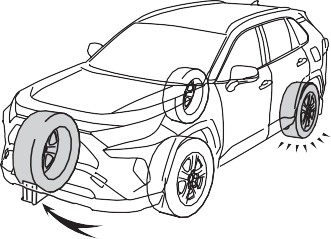
Replacing a flat tire |
|
|
|
Flat tire |
Wheel chock positions |
|
Front left- hand side |
Behind the rear right- hand side tire |
|
Front right- hand side |
Behind the rear left- hand side tire |
|
Rear left- hand side |
In front of the front right-hand side tire |
|
Rear right- hand side |
In front of the front left-hand side tire |
To prevent damage, cover the tip of
|
|
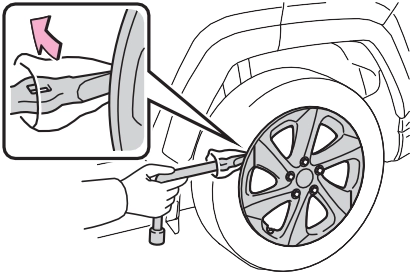
by hand until the notch of the jack is in contact with the jack point.
After removing the jack from the
jack holder, turn the jack portion in the opposite direction to lower the jack, and then adjust the jack set position.
The jack point guides are located under the rocker panel. They indi- cate the jack point positions.
Except for models made in Japan*
*: The country of production is writ- ten on the Certification Regula- tion label. (P.665)
|
|
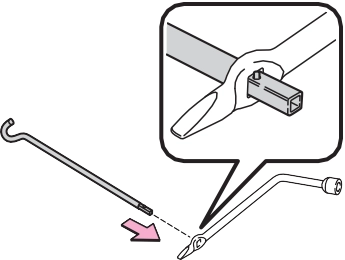
*: The country of production is writ- ten on the Certification Regula- tion label. (P.665)
|
|
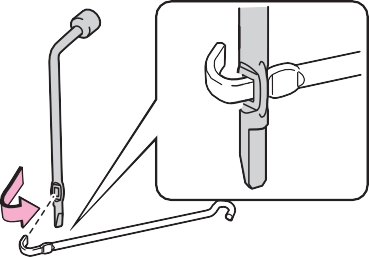
|
|
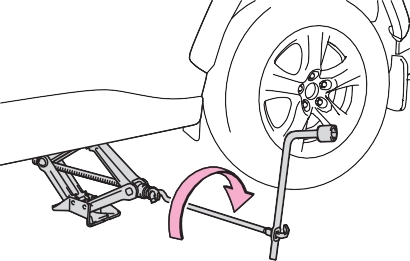
When resting the tire on the ground, place the tire so that the wheel design faces up to avoid
loosely tighten each wheel nut by hand by approximately the same amount.
When replacing a steel wheel with
a steel wheel, tighten the nuts until
the tapered portion comes into loose contact with the disc wheel
seat .
When replacing an aluminum wheel with a steel wheel, tighten the wheel nuts until the tapered portion
comes into loose contact with the disc wheel seat .
When replacing an aluminum wheel with an aluminum wheel, turn the
wheel nuts until the washers come into contact with the disc
wheel .
|
|
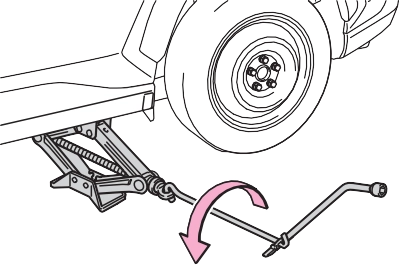
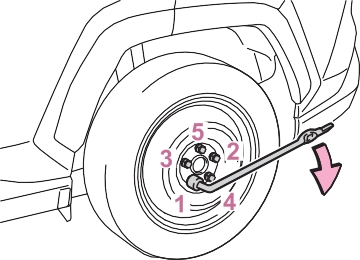
Tightening torque:
76 ftlbf (103 Nm, 10.5 kgfm)
|
|
Align the cutout of the wheel orna- ment with the valve stem as shown.
|
|
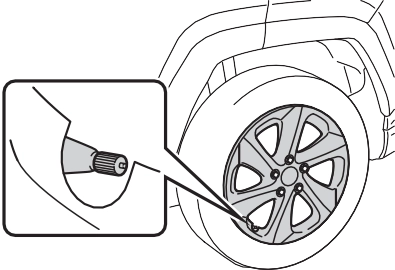
*: The wheel ornament cannot be
649
installed on the compact spare tire.
As the compact spare tire is not equipped with a tire pressure warn- ing valve and transmitter, low infla- tion pressure of the spare tire will not be indicated by the tire pressure warning system. Also, if you replace the compact spare tire after the tire pressure warning light comes on, the light remains on.
The vehicle height may become lower when driving with the compact spare tire compared to when driving with standard tires.
Install the compact spare tire on one of the rear wheels of the vehicle.
Perform the following steps and fit tire chains to the front tires:
Before storing the jack, adjust the height of the jack to match the shape of the jack holder.
The storage direction of the jack dif- fers depending on the type, so make sure to store the jack in the correct direction.
Except for models made in Japan*:
For models made in Japan*:
*: The country of production is writ- ten on the Certification Regulation label. (P.665)
|
|
|
When using the compact spare tire
Remember that the compact spare tire provided is specifi- cally designed for use with your vehicle. Do not use your com- pact spare tire on another vehi- cle.
Do not use more than one com- pact spare tire simultaneously.
Replace the compact spare tire with a standard tire as soon as possible.
Avoid sudden acceleration, abrupt steering, sudden brak- ing and shifting operations that cause sudden engine braking.
|
 WARNING

651
|
|
|
When replacing the tires (vehicles with tire pressure warning system)
When removing or fitting the wheels, tires or the tire pressure warning valve and transmitter, contact your Toyota dealer as the tire pressure warning valve and transmitter may be damaged if not handled correctly. |
 NOTICE
tem. (P.70) 8
One of the following may be the cause of the problem:
The engine starting system may be malfunctioning due to an electrical problem such as elec- tronic key battery depletion or a blown fuse. However, an interim measure is available to start the engine. (P.652)
One of the following may be the cause of the problem:
Contact your Toyota dealer if the problem cannot be repaired, or if repair procedures are unknown.
When the engine does not start, the following steps can be used as an interim measure to start the engine if the engine switch is functioning normally:
Parking brake indicator will come on.
Even if the engine can be started using the above steps, the system may be malfunction- ing. Have the vehicle inspected by your Toyota dealer.
If you lose your keys
653
(P.129) 8
|
|
|
In case of a smart key system malfunction, or other key related problems
Take your vehicle with all the elec- tronic keys provided with your vehicle to your Toyota dealer. |
 NOTICE
following operations.
Turning the key rearward unlocks the driver’s door. Turning the key once again within 5 seconds unlocks the other doors.
*1: If equipped
*2: These settings must be custom- ized at your Toyota dealer.
|
|
|
When using the mechanical key and operating the power windows or the moon roof (if equipped) or panoramic moon roof (if equipped)
Operate the power window or the moon roof or panoramic moon roof after checking to make sure that there is no possibility of any passenger having any of their body parts caught in the window or the moon roof or panoramic moon roof. Also, do not allow chil- dren to operate the mechanical key. It is possible for children and other passengers to get caught in the power window or the moon roof or panoramic moon roof. |
 WARNING
When the electronic key is detected, a buzzer sounds and the engine switch will turn to ON.
When the smart key system is deactivated in customization set- ting, the engine switch will turn to ACC.
is displayed on the multi- information display.
In the event that the engine still cannot be started, contact your Toyota dealer.
Shift the shift lever to P, set the park-
655
ing brake and press the engine switch as you normally do when stopping the engine.
As the above procedure is a tempo- rary measure, it is recommended that the electronic key battery be replaced immediately when the bat- tery is depleted. (P.604)
Using the mechanical key to lock the doors will not set the alarm sys- tem.
If a door is unlocked using the mechanical key when the alarm sys- tem is set, the alarm may be trig- gered. (P.73)
Release the brake pedal and press the engine switch in step 3 above. The engine does not start and modes will be changed each time the switch is pressed. (P.197)
When connecting the jumper (or booster) cables, depending on the situation, the alarm may activate and the doors locked. (P.74)
8
on your vehicle and
connect the clamp on the other end of the positive cable to on the second vehicle. Then, connect a negative cable clamp to
on the second vehicle and connect the clamp at the other end of
the negative cable to .
Positive (+) battery terminal (second vehicle) Negative (-) battery terminal (second vehicle)
Solid, stationary, unpainted metallic point away from the battery and any moving parts as shown in the illustration
speed of the second vehicle and start the engine of your vehicle.
Vehicles with smart key sys- tem: Maintain the engine speed of the second vehicle and start the engine of your vehicle by turning the engine switch to ON.
8-2. Steps to take in an emergency
657
The engine may not start on the first
attempt after the battery has
The engine cannot be started by push-starting.
(Vehicles with Stop & Start system: Except when the engine is stopped due to the Stop & Start system)
When the battery terminals are removed, the information stored in the ECU is cleared. Before remov- ing the battery terminals, contact your Toyota dealer.
The electricity stored in the battery will discharge gradually even when the vehicle is not in use, due to nat- ural discharge and the draining effects of certain electrical appli- ances. If the vehicle is left for a long time, the battery may discharge, and the engine may be unable to start. (The battery recharges auto- matically during driving.)
recharged but will start normally after the second attempt. This is not a malfunction.
battery. 8
The Stop & Start system may not automatically stop the engine for up to an hour.
Use a genuine battery specifically designed for use with the Stop & Start system or a battery with equiv- alent specifications to a genuine battery. If an unsupported battery is used, Stop & Start system functions may be restricted to protect the bat-
tery. Also, battery performance may decrease and the engine may not be able to restart. Contact your Toy- ota dealer for details.
Use a battery that the case size is same as the previous one (LN3), 20 hours rate capacity (20HR) is equiv- alent (65Ah) or greater, and perfor- mance rating (CCA) is equivalent (603A) or greater.
Type B:
Use a battery that the case size is same as the previous one (LN2), 20 hours rate capacity (20HR) is equiv- alent (60Ah) or greater, and perfor- mance rating (CCA) is equivalent (560A) or greater.
Type C:
Use a battery that the case size is same as the previous one (LN2), 20 hours rate capacity (20HR) is equiv- alent (60Ah) or greater, and perfor- mance rating (CCA) is equivalent (563A) or greater.
|
|
|
When removing the battery terminals
Always remove the negative (-) terminal first. If the positive (+) ter- minal contacts any metal in the surrounding area when the posi- tive (+) terminal is removed, a spark may occur, leading to a fire in addition to electrical shocks and death or serious injury. |
 WARNING
659

If you do not see steam: Carefully lift the hood.
Radiator Cooling fan
If a large amount of coolant leaks, immediately contact your Toyota dealer.
Reservoir “FULL” line “LOW” line
Water can be used in an emer-
gency if coolant is unavailable.
|
|
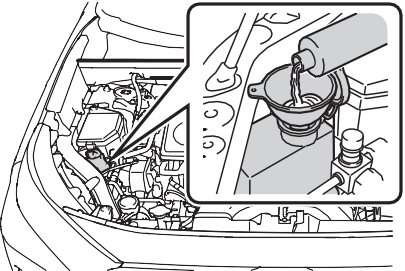
The fan operates when the air con- ditioning system is turned on imme- diately after a cold start. Confirm that the fan is operating by check- ing the fan sound and air flow. If it is difficult to check these, turn the air conditioning system on and off repeatedly. (The fan may not oper- ate in freezing temperatures.)
If the fan is operating:
Have the vehicle inspected at the nearest Toyota dealer.
If the message does not disappear: Stop the engine and contact your Toyota dealer.
If the message is not displayed: Have the vehicle inspected at the nearest Toyota dealer.
661
 5 Shift the shift lever to D or R and release the parking brake. Then, while exercising caution, depress the acceler- ator pedal.
Press to turn off TRAC. (P.361)
|
|
|
When attempting to free a stuck vehicle
If you choose to push the vehicle back and forth to free it, make sure the surrounding area is clear to avoid striking other vehicles, objects or people. The vehicle may also lunge forward or lunge back suddenly as it becomes free. Use extreme caution. When shifting the shift lever
Be careful not to shift the shift lever with the accelerator pedal depressed. This may lead to unexpected rapid acceleration of the vehicle that may cause an accident resulting in death or serious injury. |
 WARNING
|
|
|
To avoid damaging the trans- mission and other compo- nents
Avoid spinning the wheels and depressing the accelerator pedal more than necessary.
If the vehicle remains stuck even after these procedures are performed, the vehicle may require towing to be freed.
|
 NOTICE
Vehicle specifications 9
9-3. Initialization
Items to initialize 699
9