Instrument cluster display
Your vehicle may be equipped with an instrument cluster display, which offers useful information to the driver. With the ignition in the OFF mode, opening/closing of a door will activate the display for viewing, and display the total miles, or kilometers, in the odometer. Your instrument cluster display is designed to display important information about your vehicle’s systems and features. Using a driver interactive display located on the instrument panel, your instrument cluster display can show you how systems are working and give you warnings when they aren’t. The steering wheel mounted controls allow you to scroll through and enter the main menus and submenus. You can access the specific information you want and make selections and adjustments.
INSTRUMENT CLUSTER DISPLAY LOCATION AND CONTROLS
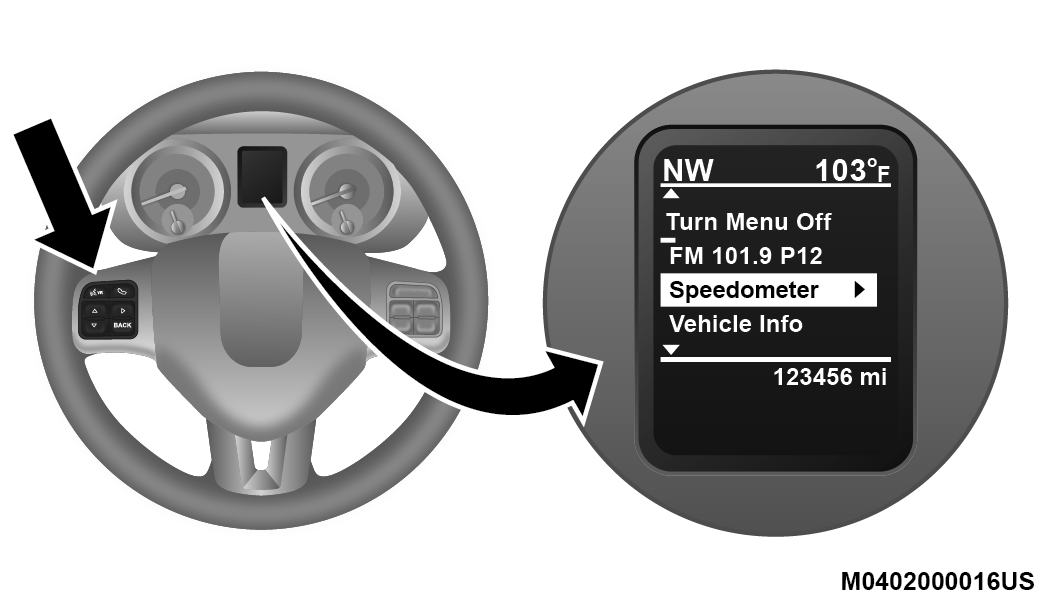
The instrument cluster display features a driver-interactive display that is located in the instrument cluster.
Instrument Cluster Display
This system allows the driver to select a variety of useful information by pushing the switches mounted on the steering wheel. The menu items consist of the following:
-
Radio Info
-
Fuel Economy
-
Vehicle Speed
-
Trip Info
-
Tire Pressure
-
Vehicle Information
-
Messages
-
Turn Menu OFF
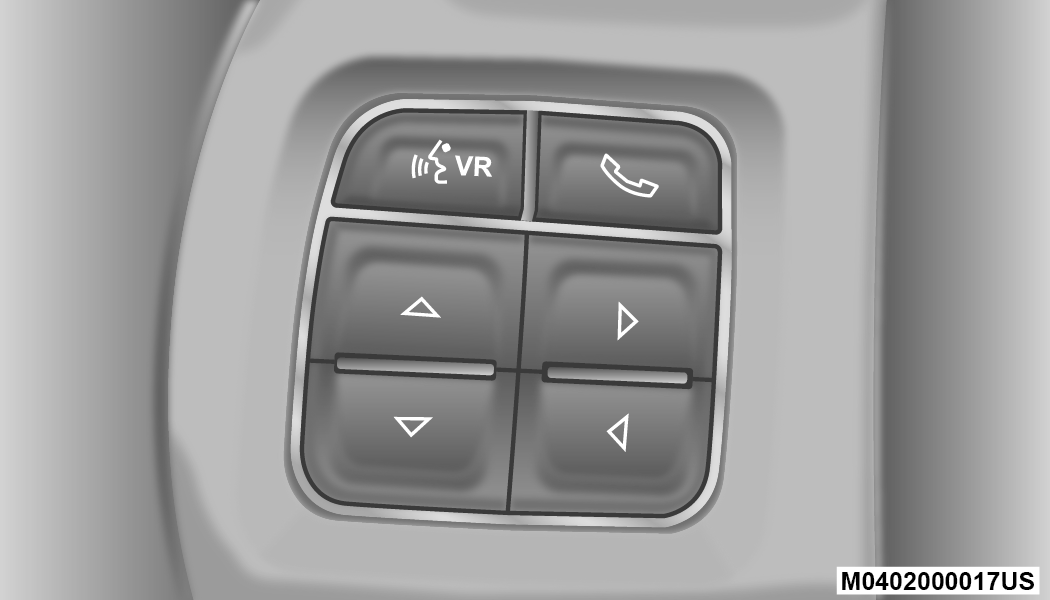
The system allows the driver to select information by pushing the following buttons mounted on the steering wheel:
Instrument Cluster Display Controls
-
Up Arrow Button

Push and release the up arrow button to scroll upward through the main menus and submenus.
-
Down Arrow Button

Push and release the down arrow button to scroll downward through the main menus and submenus.
-
Right Arrow Button

Push and release the right arrow button for access to main menus or submenus. Push and hold the right arrow button for two seconds to reset features.
-
Back Button

Push and release the BACK button to scroll back to a previous menu.
OIL CHANGE DUE
Your vehicle is equipped with an engine oil change indicator system. The “Oil Change Due” message will appear in the instrument cluster display for five seconds after a single chime has sounded to indicate the next scheduled oil change interval. The engine oil change indicator system is duty cycle based, which means the engine oil change interval may fluctuate dependent upon your personal driving style.
Unless reset, this message will continue to display each time you cycle the ignition to the ON/RUN position. To turn off the message temporarily, push and release the up arrow button. To reset the oil change indicator system (after performing the scheduled maintenance), perform the following procedure:
-
Without pushing the brake pedal, push and release the ENGINE START/STOP button and cycle the ignition to the ON/RUN position (do not start the engine).
-
Fully push the accelerator pedal, slowly, three times within 10 seconds.
-
Without pushing the brake pedal, push and release the ENGINE START/STOP button once to return the ignition to the OFF/LOCK position.
Note:
If the indicator message illuminates when you start the vehicle, the oil change indicator system did not reset. If necessary, repeat this procedure.
INSTRUMENT CLUSTER DISPLAY SELECTABLE MENU ITEMS
Push and release the up or down arrow button until the desired Selectable Menu item is displayed in the instrument cluster display.
Follow the Menu or submenu prompts as desired.
FUEL ECONOMY
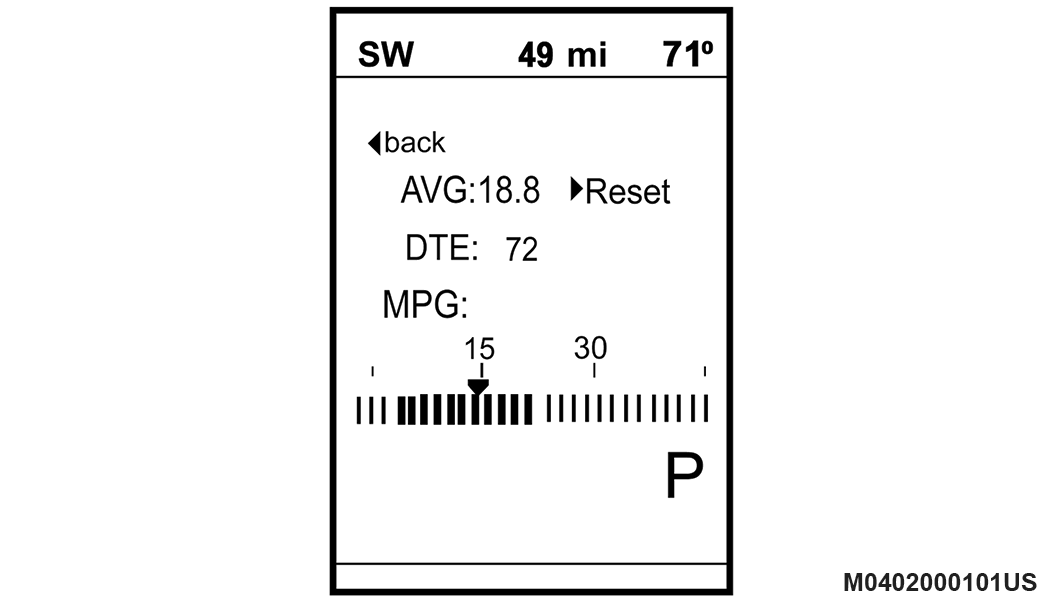
Push and release the up or down arrow button until “Fuel Economy” displays highlighted in the instrument cluster display and push the right arrow button. The following Fuel Economy functions will display in the instrument cluster display:
-
Average Fuel Economy
-
Distance To Empty (DTE)
-
Instantaneous Fuel Economy
Average Fuel Economy
Shows the average fuel economy since the last reset. When the fuel economy is reset, the display will read “RESET” or show dashes for two seconds. Then, the history information will be erased, and the averaging will continue from the last fuel average reading before the reset.
Fuel Economy
Distance To Empty (DTE)
Shows the estimated distance that can be traveled with the fuel remaining in the tank. This estimated distance is determined by a weighted average of the instantaneous and average fuel economy, according to the current fuel tank level. DTE cannot be reset through the right arrow button.
Note:
Significant changes in driving style or vehicle loading will greatly affect the actual drivable distance of the vehicle, regardless of the DTE displayed value.
When the DTE value is less than 30 miles (48 km) estimated driving distance, the DTE display will change to a “LOW FUEL” message. This display will continue until the vehicle runs out of fuel. Adding a significant amount of fuel to the vehicle will turn off the “LOW FUEL” message and a new DTE value will display.
Instantaneous Fuel Economy
This display shows the instantaneous fuel economy MPG or L/ 100 km in bar graph form while driving. This will monitor the gas mileage in real-time as you drive and can be used to modify driving habits in order to increase fuel economy.
VEHICLE SPEED
Push and release the up or down arrow button until “Vehicle Speed” displays highlighted in the instrument cluster display. Push the right arrow button to display the current speed in mph or km/h. Pushing the right arrow button a second time will toggle the unit of measure between mph or km/h.
Note:
Changing the unit of measure in the Vehicle Speed menu will not change the unit of measure in the instrument cluster display.
TRIP INFO
Push and release the up or down arrow button until “Trip Info” displays highlighted in the instrument cluster display and push the right arrow button. Pushing the right arrow button with "Trip Info" highlighted will cause the instrument cluster display to show Trip A, Trip B, and Elapsed Time all in one display. If you want to reset one of the three functions you use the up or down arrow button to highlight (select) the feature that you want to reset. Pushing the right arrow button will cause the selected feature to reset individually. The three features can only be reset individually. The following Trip functions display in the instrument cluster display:
-
Trip A
-
Trip B
-
Elapsed Time
The Trip Functions mode displays the following information:
Trip A
-
Shows the total distance traveled for Trip A since the last reset.
-
Shows the elapsed time traveled for Trip A since the last reset.
Trip B
-
Shows the total distance traveled for Trip B since the last reset.
-
Shows the elapsed time traveled for Trip B since the last reset.
Elapsed Time
Shows the total elapsed time of travel since the last reset. Elapsed time will increment when the ignition is in the ON/RUN position.
To Reset The Display
Reset will only occur while a resettable function is being displayed. Push and release the right arrow button once to clear the resettable function.
TIRE PRESSURE
Push and release the up or down arrow button until “Tire PSI:” displays highlighted in the instrument cluster display. Push and release the right arrow button to view a graphic of the vehicle with a tire pressure value at each corner of the graphic.
VEHICLE INFO (CUSTOMER INFORMATION FEATURES)
Push and release the up or down arrow button until “Vehicle Info” displays in the instrument cluster display and push the right arrow button. Push the up or down arrow button to scroll through the available information displays.
-
Coolant Temperature
Displays the actual coolant temperature.
-
Oil Temperature
Displays the actual oil temperature.
-
Oil Pressure - If Equipped
Displays the actual oil pressure.
-
Transmission Temperature
Displays the actual transmission temperature.
-
Engine Hours
Displays the number of hours of engine operation.
MESSAGES
Push and release the up or down arrow button until “Messages: XX” displays highlighted in the instrument cluster display. If there is more than one message, pushing the right arrow button will display a stored warning message. Push and release the up or down arrow button if there is more than one message to cycle through the remaining stored messages. If there are no messages, pushing the right arrow button will not change the display.
TURN MENU OFF
Select from the Main Menu using the up or down arrow button. Pushing the right arrow button clears the menu display. Pushing any one of the four Display control buttons will bring the menu back.
BATTERY SAVER ON/BATTERY SAVER MODE MESSAGE — ELECTRICAL LOAD REDUCTION ACTIONS — IF EQUIPPED
This vehicle is equipped with an Intelligent Battery Sensor (IBS) to perform additional monitoring of the electrical system and status of the vehicle battery.
In cases when the IBS detects charging system failure, or the vehicle battery conditions are deteriorating, electrical load reduction actions will take place to extend the driving time and distance of the vehicle. This is done by reducing power to or turning off non-essential electrical loads.
Load reduction is only active when the engine is running. It will display a message if there is a risk of battery depletion to the point where the vehicle may stall due to lack of electrical supply, or will not restart after the current drive cycle.
When load reduction is activated, the message “Battery Saver On” or “Battery Saver Mode” will appear in the instrument cluster.
These messages indicate the vehicle battery has a low state of charge and continues to lose electrical charge at a rate that the charging system cannot sustain.
Note:
-
The charging system is independent from load reduction. The charging system performs a diagnostic on the charging system continuously.
-
If the Battery Charge Warning Light is on it may indicate a problem with the charging system. Refer to “Battery Charge Warning Light” in “Getting To Know Your Instrument Panel” for further information.
The electrical loads that may be switched off (if equipped), and vehicle functions which can be affected by load reduction:
-
Heated Seat/Vented Seats/Heated Wheel
-
Rear Defroster And Heated Mirrors
-
HVAC System
-
115 Volts AC Power Inverter System
-
Audio and Telematics System
Loss of the battery charge may indicate one or more of the following conditions:
-
The charging system cannot deliver enough electrical power to the vehicle system because the electrical loads are larger than the capability of charging system. The charging system is still functioning properly.
-
Excess vehicle electrical loads are turned on (e.g. HVAC on max settings, exterior and interior lights, overloaded power outlets +12 Volts, 115 Volts AC, USB ports) during certain driving conditions (city driving, towing, frequent stopping, etc.).
-
Installed options (additional lights, upfitter electrical accessories, audio systems, alarms and similar devices.
-
Unusual driving cycles (short trips separated by long parking periods).
-
The vehicle was parked for an extended period of time (weeks, months).
-
The battery was recently replaced and was not charged completely.
-
The battery was discharged by an electrical load left on when the vehicle was parked.
-
The battery was used for an extended period with the engine not running to supply radio, lights, chargers, +12 Volts portable appliances like vacuum cleaners, game consoles and similar devices.
What to do when an electrical load reduction action message is present (“Battery Saver On” or “Battery Saver Mode”)
During a trip:
-
Reduce power to unnecessary loads if possible:
-
Turn off redundant lights (interior or exterior)
-
Check what may be plugged in to power outlets +12 Volts, 115 Volts AC, USB ports
-
Check HVAC settings (blower, temperature)
-
Check the audio settings (volume)
-
After a trip:
-
Check if any aftermarket equipment was installed (additional lights, upfitter electrical accessories, audio systems, alarms) and review specifications if any (load and ignition OFF draw currents).
-
Evaluate the latest driving cycles (distance, driving time and parking time).
-
The vehicle should have service performed if the message is still present during consecutive trips, and if the evaluation and driving pattern of the vehicle did not help to identify the cause.
Download Manual