Engine compartment
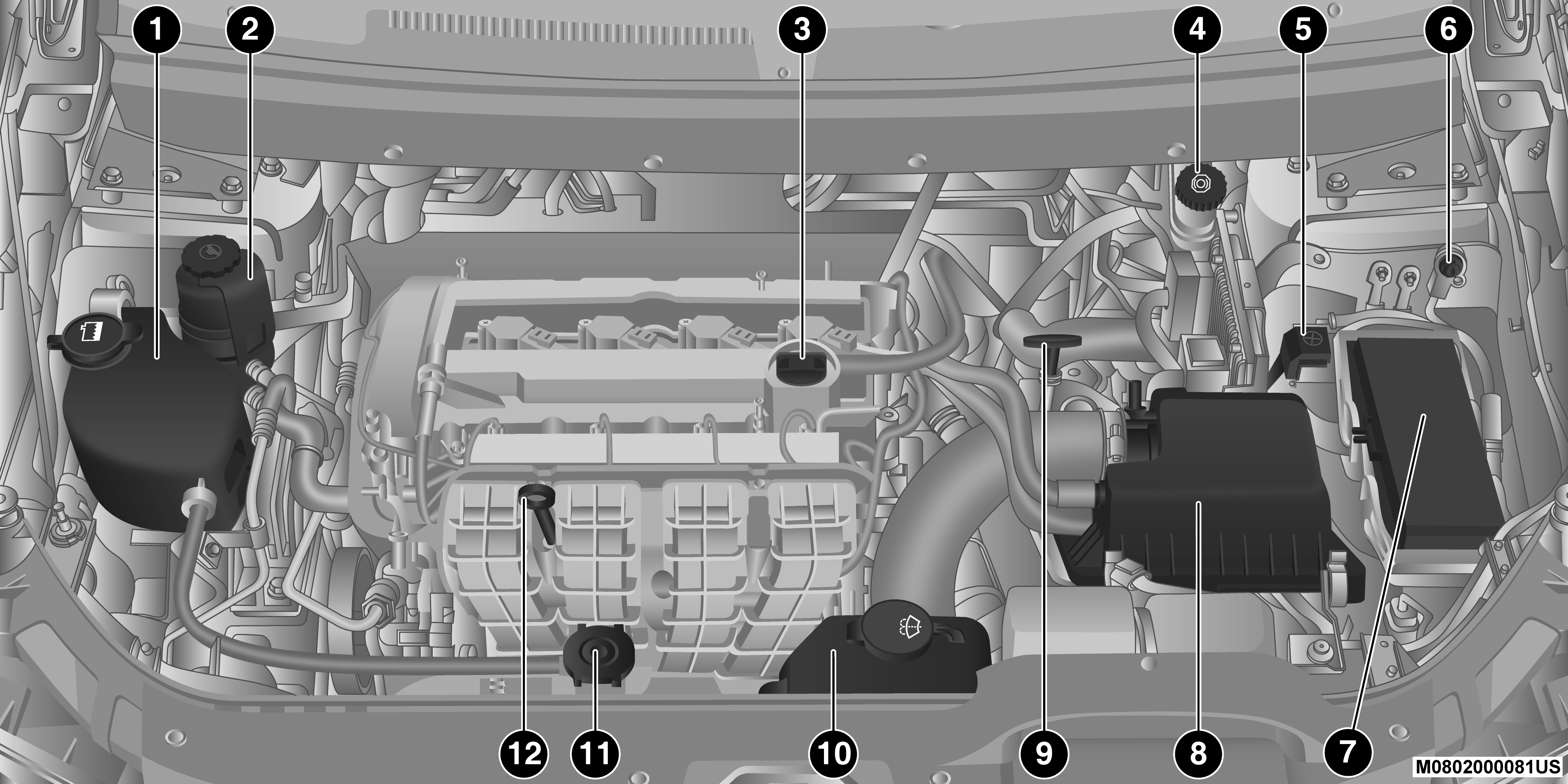
|
1 — Engine Coolant Reservoir |
7 — Power Distribution Center (Fuses) |
|
2 — Power Steering Fluid Reservoir |
8 — Air Cleaner Filter |
|
3 — Engine Oil Fill |
9 — Automatic Transmission Dipstick (4–Speed Only – If Equipped) |
|
4 — Brake Fluid Reservoir Cap |
10 — Washer Fluid Reservoir |
|
5 — Remote Jump Start (Positive Battery Post) |
11 — Coolant Pressure Cap |
|
6 — Remote Jump Start (Negative Battery Post) |
12 — Engine Oil Dipstick |
CHECKING OIL LEVEL
To ensure proper engine lubrication, the engine oil must be maintained at the correct level. Check the oil level at regular intervals, such as every fuel stop. The best time to check the engine oil level is about five minutes after a fully warmed engine is shut off. Checking engine oil level when the engine is cold will give you an incorrect reading.
Checking the oil while the vehicle is on level ground and only when the engine is hot, will improve the accuracy of the oil level readings. Maintain the oil level between the range markings on the dipstick. Either the range markings consist of a crosshatch zone marked SAFE or a crosshatch zone marked with MIN at the low end of the range and MAX at the high end of the range. Adding 1 Quart (1 Liter) of oil when the reading is at the low end of the range marking will raise the oil level to the high end of the range marking.
CAUTION:
Do not overfill the engine with oil. Overfilling the engine with oil will cause oil aeration, which can lead to loss of oil pressure and an increase in oil temperature. This loss of oil pressure and increased oil temperature could damage your engine.
ADDING WASHER FLUID
The windshield washer and the rear window washer share the same fluid reservoir. The fluid reservoir is located in the engine compartment. Be sure to check the fluid level in the reservoir at regular intervals. Fill the reservoir with windshield washer solvent (not radiator antifreeze) and operate the system for a few seconds to flush out the residual water.
When refilling the washer fluid reservoir, apply some washer fluid to a cloth or towel and wipe the wiper blades clean. This will help blade performance.
To prevent freeze-up of your windshield washer system in cold weather, select a solution or mixture that meets or exceeds the temperature range of your climate. This rating information can be found on most washer fluid containers.
The fluid reservoir will hold nearly 1 Gallon (4 Liters) of washer fluid when the message “LoWASH” appears in the instrument cluster.
WARNING:
Commercially available windshield washer solvents are flammable. They could ignite and burn you. Care must be exercised when filling or working around the washer solution.
MAINTENANCE-FREE BATTERY
Your vehicle is equipped with a maintenance-free battery. You will never have to add water, nor is periodic maintenance required.
Note:
The battery is stored in a compartment that is located behind the left front fender and is accessible through the wheel well. The wheel and tire assembly do not need to be removed to access the compartment. Remote battery terminals are located in the engine compartment for jump starting. Refer to “Jump Starting Procedure” in “In Case Of Emergency” for further information.
To access the battery, turn the steering wheel fully to the right and remove the access panel from the inner fender shield.
WARNING:
-
Battery fluid is a corrosive acid solution and can burn or even blind you. Do not allow battery fluid to contact your eyes, skin, or clothing. Do not lean over a battery when attaching clamps. If acid splashes in eyes or on skin, flush the area immediately with large amounts of water.
-
Battery gas is flammable and explosive. Keep flame or sparks away from the battery. Do not use a booster battery or any other booster source with an output greater than 12 Volts. Do not allow cable clamps to touch each other.
-
Battery posts, terminals, and related accessories contain lead and lead compounds. Wash hands after handling.
CAUTION:
-
It is essential when replacing the cables on the battery that the positive cable is attached to the positive post and the negative cable is attached to the negative post. Battery posts are marked positive (+) and negative (-) and are identified on the battery case. Cable clamps should be tight on the terminal posts and free of corrosion.
-
If a “fast charger” is used while the battery is in the vehicle, disconnect both vehicle battery cables before connecting the charger to the battery. Do not use a “fast charger” to provide starting voltage.
PRESSURE WASHING
CAUTION:
Cleaning the engine compartment with a high pressure washer is not recommended. Precautions have been taken to safeguard all parts and connections however, the pressures generated by these machines is such that complete protection against water ingress cannot be guaranteed.
Download Manual