Roof rack
 Introduction to the subject
In this chapter you will find information on the following subjects:
The roof of your vehicle has been designed to optimize aerodynamics and does not have traditional rain gutters that are used to attach many kinds of roof racks.
Since the rain gutters are molded into the roof to provide efficient aerodynamics, only Volkswagen-approved base carrier mounts and roof racks can be used.
When should the roof rack be removed?
- When it is no longer needed.
- Before driving through an automatic car wash.
- When the vehicle would otherwise be too high for minimum clearance to enter, for example, a garage.
More information:
- Lights
- Transporting
- Tires and wheels
- Saving fuel and helping the environment
- Parts, accessories, repairs, and modifications
 WARNING
Transporting heavy or bulky loads on the roof rack will change the way the vehicle handles by shifting the vehicle's center of gravity and increasing the wind drag.
- Always secure the load properly with suitable and undamaged straps so that the load will not shift.
- Cargo that is large, heavy, bulky, long or flat will have a negative effect on the vehicle's aerodynamics, center of gravity and overall handling.
- Always avoid sudden maneuvers and hard braking.
- Always adapt your speed and driving to the heavier load and the weight distribution in the vehicle. Take road, weather, traffic, and visibility conditions into account as well.
 NOTE
NOTE
- Always remove the roof rack before driving through an automatic car wash.
- Your vehicle is higher when the roof rack is installed, especially when it is loaded. Compare the vehicle height with existing clearance heights, such as underpasses and garage doors.
- Always make sure that the roof rack system and anything being carried on it does not interfere with the roof antenna, the power sunroof, or the rear hatch.
- Make sure that the rear hatch does not touch items on the roof rack when opened.

If a roof rack is installed, fuel consumption increases due to increased air resistance.
Attaching the roof rack base carrier and roof rack
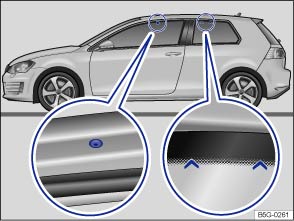
Fig. 96 Mounting points for the base carrier and roof rack on 2-door vehicles.
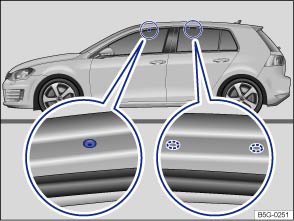
Fig. 97 Mounting points for the base carrier and roof rack on 4-door vehicles.
Read and follow the introductory information and safety information first
The base carrier is the basis of a complete roof rack system. For safety reasons, additional attachments are necessary for transporting luggage, bicycles, surfboards, skis, and small boats. Suitable accessories can be purchased from your authorized Volkswagen dealer or authorized Volkswagen Service Facility.
Mounting the roof rack base carrier and roof rack on 2-door vehicles
Always attach the base carrier and roof rack correctly.
Always carefully follow the installation instructions from the base carrier or roof rack manufacturer.
The front mounting holes are on the underside of the roof frame. They are sealed with plastic screws that must be removed before installation (magnified view on left). The holes are only visible when the door is open. The rear markings for the base carrier are above the rear side windows (magnified view on right).
Only mount the roof rack base carrier on the markings shown in the illustration.
Once you have installed the base carrier correctly, you can secure the roof rack on the base carrier according to the manufacturer's instructions.
Mounting the roof rack base carrier and roof rack on 4-door vehicles
Always attach the base carrier and roof rack correctly.
Always carefully follow the installation instructions from the base carrier or roof rack manufacturer.
The front mounting holes are on the underside of the roof frame. They are sealed with plastic screws that must be removed before installation (magnified view on left). The rear markings for the base carrier are on the underside of the roof frame (magnified view on right).
The holes and markings are only visible when the door is open.
Only mount the roof rack base carrier on the markings shown in the illustration.
Once you have installed the base carrier correctly, you can secure the roof rack on the base carrier according to the manufacturer's instructions.
WARNING
Installing or using a base carrier or roof rack improperly can cause the entire system to fly off the vehicle, causing accidents and injuries.
- Always follow the installation instructions provided by the manufacturer.
- Use the base carrier and roof rack only if they are undamaged and properly installed.
- Secure the roof rack base carrier only at the attachment points shown in the illustration or .
- Always install the base carrier and roof rack properly.
- Make sure that all bolts and fasteners are properly installed and properly tightened before every trip and retighten them as needed after driving a short distance. During a long trip, check all bolts and fasteners at each stop.
- Always properly install special fixtures for items such as bicycles, skis, surfboards, etc.
- Do not modify or repair the base carrier or roof rack.

Follow the installation instructions provided for installing the roof rack system. Always carry them in the vehicle.
Securing a load on the roof rack
Read and follow the introductory information and safety information first
It is not possible to secure a load unless the roof rack system has been properly installed .
Maximum permissible roof load
The maximum permissible roof load is 165 lbs. (75 kg). The roof load is the combined weight of the roof rack and the items being carried on the roof .
Be sure you know the weight of the roof rack and the items you want to transport on the roof. Weigh them if necessary. Never carry a total of more than the maximum permissible roof load.
When using a roof rack with a lower load limit, do not load the rack to the maximum weight mentioned above. In this case, you may only load the roof rack to the weight limit specified in the system's installation instructions.
Distributing the load
Distribute the load evenly and secure it properly .
Checking the mountings
After the base carrier and roof rack have been installed, check all bolts and fasteners after driving a short time and at regular intervals thereafter.
WARNING
If the maximum permissible roof load is exceeded, accidents and substantial vehicle damage may occur.
- Never exceed the specified roof load, the maximum Gross Axle Weight Rating, or the Gross Vehicle Weight Rating.
- Do not exceed the loading capacity of the roof rack, even if the permissible roof load is not fully utilized.
- Always make sure that loads are evenly distributed and that heavier items are, as far as possible, toward the front.
WARNING
Loose or improperly secured items can fall off the roof rack and cause accidents and injuries.
- Always use suitable, undamaged tie-down ropes and ratchet straps.
- Secure the load properly.
Download Manual