Saving fuel and helping the environment
 Introduction to the subject
In this chapter you will find information on the following subjects:
Fuel consumption, environmental impact, and wear and tear on engine, brakes and tires depend mainly on the following 3 factors:
- Your personal driving style.
- External conditions (weather, road conditions).
- Technical requirements.
You can reduce fuel consumption by up to 25% by using a few simple techniques and adjusting your driving style.
 WARNING
Always adjust your speed and the distance you keep between you and the vehicles ahead of you to the road, traffic, weather, and visibility conditions.
Efficient driving style
Read and follow the introductory information and safety information first
Shifting faster
As a rule, the following applies: The higher gear is always the most efficient gear. The rule of thumb for most vehicles is to drive in 3rd gear at 20 mph (30 km/h), 4th gear at 25 mph (40 km/h), 5th gear at 30 mph (50 km/h), and 6th gear at 36 mph (60 km/h).
If traffic and driving conditions permit, skipping gears when upshifting also saves fuel.
Do not run the gears up to their limit. Use 1st gear only to start moving and then smoothly shift into 2nd gear. Avoid kick-downs in vehicles with automatic transmissions.
Vehicles equipped with the gear recommendation feature aid in fuel efficient driving by indicating the optimum time to shift gears .
Coasting
If you take your foot off the accelerator, fuel delivery to the engine is interrupted, which lowers fuel consumption.
Therefore, when nearing a red stop light, for instance, allow the vehicle to coast without using the accelerator. Press the clutch pedal and release it only if the vehicle moving too slowly or the coasting distance is too long. The engine will then continue to run at idle.
In situations where the vehicle will be stopped for a longer period of time, such as at a railroad crossing, physically switch off the engine.
Defensive driving and flowing with traffic
Frequent braking and acceleration increase fuel consumption significantly. Just by driving defensively and keeping a sufficiently large distance away from the vehicle in front of you can make up for the speed fluctuations caused by taking your foot off the accelerator. Active braking and accelerating is then not necessarily required.
Calm and smooth driving
Consistency is more important than speed. The more smoothly you drive, the less fuel the vehicle consumes.
When driving on the highway or freeway, a constant, moderate speed is more efficient and economical than constantly accelerating and braking. Usually you can reach your destination just as quickly by driving at a moderate, but steady speed.
The cruise control can assist in maintaining a uniform driving style.
Moderate use of extra electrical loads
Comfort inside the vehicle is nice and important, but it is important to use them in an environmentally conscious manner.
Some devices can increase fuel consumption when activated (examples):
- Climate control system (air conditioner): If the air conditioner has to produce starkly contrasting temperatures, it requires a large amount of energy, which is generated by the engine. The temperature in the vehicle should therefore not be extremely different from that of the outside temperature. It may be helpful to ventilate the vehicle before driving and then to drive a short distance with the windows open. After that, switch on the air conditioner with the windows closed. Keep the windows closed when driving at high speeds. Open windows increase fuel consumption.
- Switch off seat heating once it has served its purpose.
- Switch off the rear window defroster as soon as the windows are free of fog and ice.
Additional factors that increase fuel consumption (examples):
- Malfunctioning engine control.
- Driving in the mountains.
- Towing a trailer.
 NOTE
NOTE
Never let the vehicle coast or roll down a hill in Neutral (N), especially when the engine is not running. The transmission will not be lubricated and will be damaged.
Fuel-efficient driving
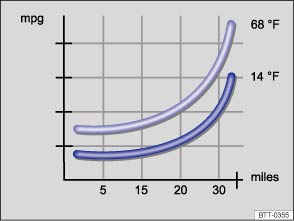
Fig. 134 Fuel consumption in miles per gallon (mpg) at 2 different outside air temperatures.
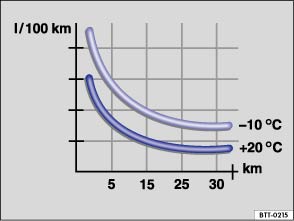
Fig. 135 Fuel consumption in l/100 km at 2 different outside air temperatures.
Read and follow the introductory information and safety information first
Driving defensively and economically can easily reduce fuel consumption by 10 to 15%.
The vehicle consumes the most fuel when accelerating. Defensive driving requires less braking and therefore less acceleration. If possible, coast the vehicle to a stop, for example, when you can see that the next traffic light is red or about to turn red.
Avoid traveling short distances
A cold engine consumes significantly more fuel immediately after starting. It takes a few miles (km) before the engine is warmed up and fuel consumption is stabilized.
To reduce fuel consumption and the emission of pollutants effectively, the engine and catalytic converter must reach their optimal operating temperature. Critical in this context is also the outside air temperature.
and display the varying fuel consumption rates for the same distance driven, once at +68 °F (+20 °C) and once at +14 °F (-10 °C).
Therefore, avoid driving short distances unnecessarily and consolidate routes.
Under the same conditions, the vehicle consumes more fuel in winter than in summer.
Letting the engine run to warm up is not only illegal in some places, but also technically not necessary and wastes fuel.
Adjust the tire pressure
The proper tire pressure helps reduce rolling resistance as well as fuel consumption.
When purchasing new tires, always make sure that the tires are optimized for lower rolling resistance.
Use low viscosity engine oil
Fully synthetic, low viscosity engine oils that expressly comply with Volkswagen oil quality standards reduce fuel consumption. Low viscosity engine oils reduce the frictional resistance on the engine and are distributed more evenly and quickly, particularly when cold-starting the engine. The effect is particularly apparent in vehicles that frequently travel short distances.
Always ensure the right engine oil level is maintained and keep to the scheduled service intervals (engine oil changes).
Make sure the engine oil that you purchase expressly complies with Volkswagen oil quality standards and is the oil approved by Volkswagen for your vehicle.
Avoid unnecessary weight
The lighter the vehicle, the more economical and eco-friendly it will be. For example, an extra 220 lbs (100 kg) of weight increases fuel consumption by up to 1 pint per 60 miles (0.3 l/100 km).
Remove all unnecessary items and unnecessary dead weight from the vehicle.
Remove unnecessary aftermarket components
The more aerodynamic the vehicle, the less fuel it will consume. Aftermarket components such as bicycle racks reduce its aerodynamic performance.
Therefore, remove unnecessary structures and unused rack systems, particularly if planning to drive at higher speeds.
Download Manual