Practical tips
Frequently asked questions (FAQ)
If you suspect a malfunction or vehicle damage, read and follow the following advice before contacting an authorized Volkswagen dealer or an authorized Volkswagen Service Facility. You may also find helpful information under Special considerations or Checklist in the index.
| Description | Possible causes, among others | Possible remedy |
|---|---|---|
| Engine does not start. | Vehicle battery dead. | – Perform jump-start . – Charge vehicle battery . |
| The wrong vehicle key is used. | Use a valid vehicle key . | |
| Fuel level too low. | Refuel . | |
| Vehicle cannot be locked or unlocked using vehicle key. | – Battery in the remote control vehicle key is dead. – Too far away from the vehicle (out of range). – Buttons have been pressed too many times. |
– Replace the battery in the remote control vehicle key . – Move closer to vehicle. – Synchronize vehicle key . – Lock or unlock vehicle manually . |
| Unusual noises. | Cold engine, braking assist systems, electronic steering column lock. | Check the Noises entry in the index. |
| Odd driving behavior. | Assistance systems activated. | Check the Assistance systems entry in the index. |
| DSG® automated transmission too hot. | Stop vehicle as soon as you can safely do so. | |
| Front seats cannot be adjusted with power controls. | Vehicle battery dead. | Charge vehicle battery . |
| Fuse blown. | Check fuse and replace if necessary . | |
| Features do not work as described in this manual. | Settings were adjusted in the Volkswagen Information System. | Check and reset to factory settings if necessary . |
| Headlights do not light up the road as they should. | – Headlights incorrectly adjusted. – Light bulbs burned out. – Low beams not switched on. |
– Have the headlight range adjusted by an authorized Volkswagen dealer or an authorized Volkswagen Service Facility. – Change light bulbs . – Switch on low beams . |
| Electrical consumers do not work. | Vehicle battery charge too low. | Charge vehicle battery . |
| Remaining fuel level too low. | Refuel . | |
| Fuse blown. | Check fuse and replace if necessary . | |
| Fuel consumption higher than indicated. | – Short hauls. – Jumpy accelerator pedal. |
– Avoid short distance driving. – Drive defensively. – Accelerate smoothly. |
| Electrical loads switched on. | Switch off unnecessary loads. | |
| Engine control malfunction. | Have the malfunction corrected . | |
| Tire pressure too low. | Adjust tire pressure . | |
| Driving in the mountains. | No direct corrective action possible. | |
| Towing a trailer or driving with a roof rack. | – Check use. – Remove if not in use. |
|
| Driving with heavy payload. | No direct corrective action possible. | |
| Driving at high engine speed. | Select a higher gear. |
Lift points for the vehicle
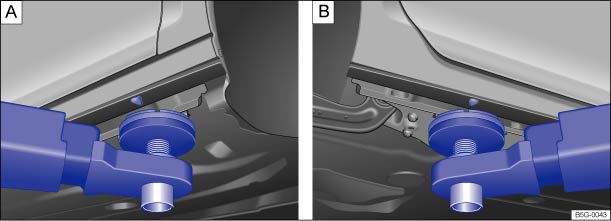
Fig. 161 A: Lifting point at the front. B: Lifting point at rear for lifting the vehicle using a workshop hoist or floor jack.
The vehicle may only be raised at the lift points shown in the illustration . If the vehicle is lifted at different points, vehicle damage and serious injuries may occur .
Workshop hoists that use fluid cushions (receiving platforms) must not be used for lifting the vehicle.
There are many precautions that have to be followed when lifting a vehicle on a workshop hoist or floor jack. Do not try to lift a vehicle on a workshop hoist or floor jack unless you have the training, knowledge, and experience to be able to do so safely.
Information about lifting the vehicle with the vehicle jack .
 WARNING
Improperly lifting your vehicle with a workshop hoist or a floor jack can cause the vehicle to fall off and cause serious personal injury.
- Always read and heed the operating instructions from the floor jack manufacturer and legal regulations if necessary before using the floor jack to lift the vehicle.
- Never let anyone stay in the vehicle when it is being lifted or when it is off the ground.
- Always lift your vehicle only at the designated lift points shown in the illustration . Not using the designated lift points can cause the vehicle to fall off the floor jack when heavy parts such as the engine or transmission are removed.
- Always make sure that the vehicle's lift points lie as flat as possible and centered on the carrier plates of the floor jack.
- Never start the engine when you have raised the vehicle on the floor jack. The engine vibrations and vehicle movements could knock the vehicle off the floor jack.
- If you must work under a vehicle raised on a floor jack, always make sure that the vehicle is safely supported on safety stands intended for that purpose that are strong enough to support the weight of the vehicle.
- Never use the floor jack as a ladder or step ladder.
- Always make sure that the weight of the vehicle is not heavier than the lifting capacity of the floor jack and safety stands being used.
 NOTE
NOTE
- To help prevent serious vehicle damage, never lift the vehicle by the engine oil pan, transmission housing, or by the front or rear axles or suspension.
- To help prevent damage to the underbody or chassis, always insert a rubber pad between the hoist and the lifting points. In addition make sure the lifting arms have enough clearance.
- The lifting arms should not touch side sills or other parts of the vehicle.
Download Manual