TOWING A DISABLED VEHICLE
This section describes procedures for towing a disabled vehicle using a commercial towing service.
If the transmission and drivetrain are operable, disabled vehicles may also be towed as described on page 230.
Vehicles equipped with the Active-Level Four Corner Air Suspension System must be placed in Transport mode, before tying them down (from the body) on a trailer or flatbed truck
page 165. If the vehicle cannot be placed in
Transport mode (for example, engine will not run), tie-downs must be fastened to the axles (not to the body). Failure to follow these instruc- tions may cause fault codes to be set and/or cause loss of proper tie-down tension.
|
Towing Condition |
Wheels OFF The Ground |
2WD Models |
4WD Models |
|
Flat Tow |
NONE |
If transmission is operable: Transmission in NEUTRAL
30 mph (48 km/h) max speed
30 miles (48 km) max distance
|
Detailed instruction on page 230 Automatic Transmission in PARK
Transfer Case in NEUTRAL (N)
Tow in forward direction
|
|
Wheel Lift Or Dolly Tow |
Front |
NOT ALLOWED |
|
|
Rear |
OK |
NOT ALLOWED |
|
|
Flatbed |
ALL |
BEST METHOD |
BEST METHOD |
Proper towing or lifting equipment is required to prevent damage to your vehicle. Use only tow bars and other equipment designed for this purpose, following equipment FCA’s instructions. Use of safety chains is mandatory. Attach a tow bar or other towing device to main structural members of the vehicle, not to fascia/bumpers or associated brackets. State and local laws regarding vehicles under tow must be observed.
If you must use the accessories (wipers, defrosters, etc.) while being towed, the ignition must be in the ON/RUN mode, not the ACC mode.
If the key fob is unavailable or the vehicle's battery is discharged, find Instructions on shifting the transmission out of PARK
page 390.
TWO-WHEEL DRIVE MODELS
FCA recommends towing your vehicle with all four wheels OFF the ground using a flatbed.
If flatbed equipment is not available, and the transmission is operable, the vehicle may be towed (with rear wheels on the ground) under the following conditions:
The transmission must be in NEUTRAL (N). Instructions on shifting the transmission to NEUTRAL (N) when the engine is off
page 390.
The towing speed must not exceed 30 mph (48 km/h).
The towing distance must not exceed 30 miles (48 km).
If the transmission is not operable, or the vehicle must be towed faster than 30 mph (48 km/h) and farther than 30 miles (48 km), tow with the rear wheels OFF the ground.
Acceptable methods to tow the vehicle on a flatbed are as follows:
The front wheels raised and the rear wheels on a towing dolly
Using a suitable steering wheel stabilizer to hold the front wheels in the straight position with the rear wheels raised when and the front wheels ON the ground.
FOUR-WHEEL DRIVE MODELS
FCA recommends towing with all wheels OFF the ground. Acceptable methods are to tow the
vehicle on a flatbed or with one end of vehicle 7
raised and the opposite end on a towing dolly.
(Continued)
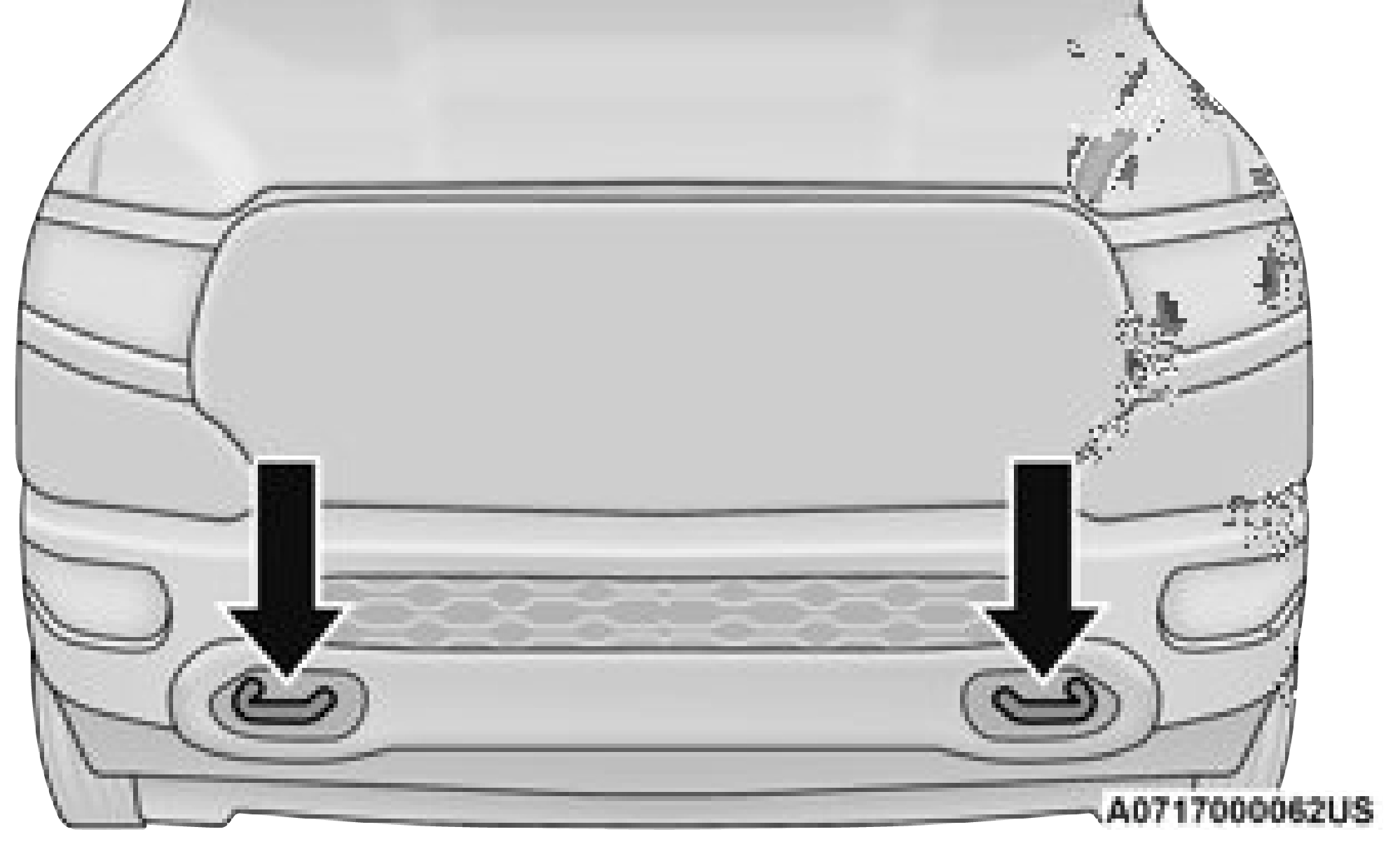
EMERGENCY TOW HOOKS — IF EQUIPPED
Your vehicle may be equipped with emergency tow hooks.
NOTE:
For off-road recovery, it is recommended to use both of the front tow hooks to minimize the risk of damage to the vehicle.
Download Manual